BRASIL 247 / MORE
China 2025: The world watches the power of planning
China's Five-Year Plan concludes with advances in technology, ecological transition and reduction of regional inequality
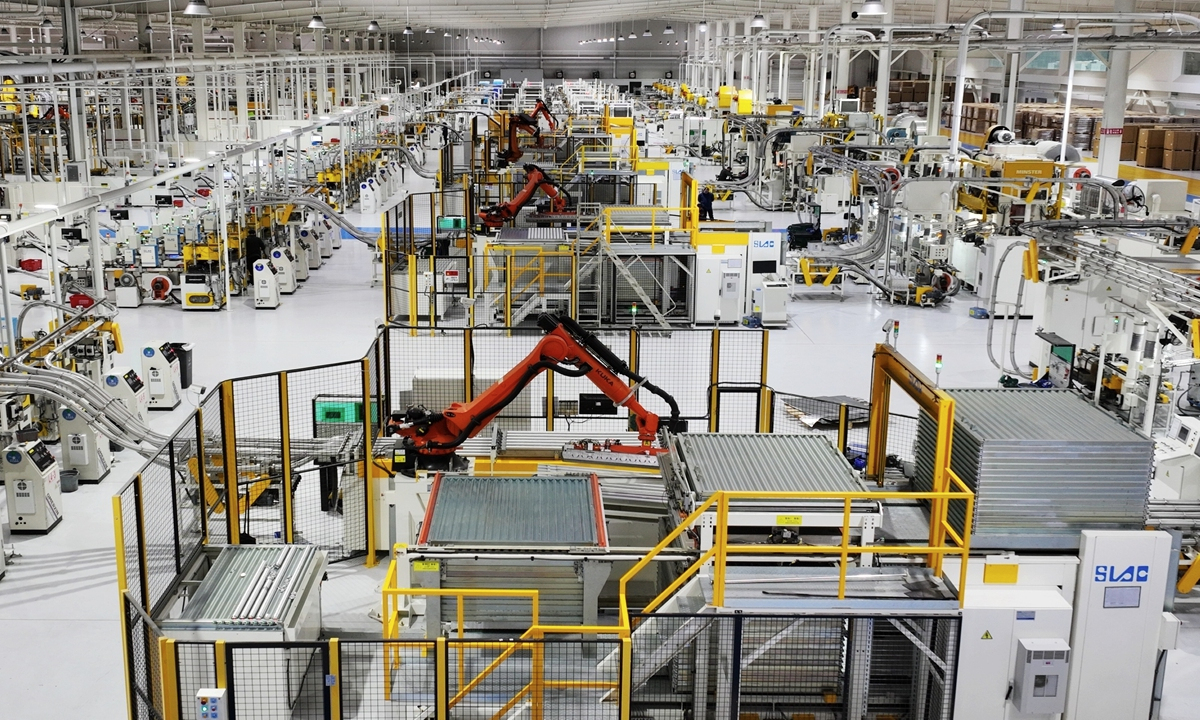
Industrial robots are operating on an intelligent production line in a smart manufacturing enterprise in Yangzhou, East China's Jiangsu Province. Photo: VCG
As China's 14th Five-Year Plan draws to a close, the world is witnessing the unfolding of a development strategy that combines state planning, technological innovation and reducing regional inequality. In contrast to the political improvisation and recurring cycles of crisis in the West, China gives clear signs that stability and predictability are, indeed, competitive advantages in the 21st century.
The year 2025 marks the end of the 14th Five-Year Plan, which began in 2021. In five years, the world's most populous country is giving unequivocal signs that its bet on strategic planning continues to bear fruit. It has promoted expressive advances in science, technology, green infrastructure and territorial redistribution of growth.
While much of the West was debating between cycles and crises, with political and tariff pandemics and authoritarian populism, China was moving forward with a long-term national project, delivering growth with innovation, social cohesion and environmental leadership. In the view of some analysts, the Chinese model is shaping the 21st century.
Unlike neoliberal economies, where economic policies oscillate to the taste of electoral humors, China operates with medium- and long-term plans that guide investment, innovation, and structural transformation. The 14th Five-Year Plan was no different: it set quality growth targets, prioritized the energy transition, boosted the digitization of the economy, and strengthened food and energy security. Artificial intelligence has been treated as a strategic asset, and the recently approved "AI Plus" initiative reinforces this role in the field of cutting-edge technology.
In the green industry sector, the results speak for themselves. China now accounts for more than 60% of global solar panel production and more than half of global electric vehicle sales. The commitment to electric mobility, combined with the construction of smart cities and the advancement of the clean energy matrix, positions the country as the largest living laboratory of the global ecological transition. And it does so while ensuring economic growth of over 5% per year - a remarkable achievement in times of global stagnation.
Another central point was the reduction of the disparity between developed coastal regions and the historically neglected inland. The strategy stimulated the development of the interior of the country, away from the saturated metropolises of the coast, in search of territorial rebalancing. New railways, smart cities, technology poles and free zones have boosted the growth of previously marginalized regions. This reduced inequalities, led to the expansion of the middle class, increased food security, and strengthened the domestic market — a strategy known as "double circulation": boosting domestic consumption without abdicating export leadership.
Medium cities in the interior have become industrial and technological poles, with advanced railway infrastructure and logistics - elements that are scarce in Latin American countries such as Brazil, whose infrastructure policy is erratic and marked by the absence of federal coordination.
The 14th Five-Year Plan also reinforced "technological self-sufficiency" as a strategic pillar in the face of restrictions imposed by the United States. US trade war against China, far from containing its progress, has accelerated import substitution in key sectors such as semiconductors, robotics, defense and big data. Rather than succumb to isolation, China has expanded its ties with the BRICS and countries of the Global South, redefining international trade around the Belt and Road Initiative (BRI).
Brazil has a lot to learn. We lack a coordinated planning effort. We are living with partial reforms, erratic cuts, unfulfilled promises. While China mobilizes public and private resources under clear guidelines, Brazil still depends on foreign market fluctuations and the goodwill of the financial sector.
Even with challenges such as population aging and geopolitical tension with the United States, China will reach 2025 with a more diversified, technologically robust and socially balanced economy. It is not just the industrial "engine of the world." It is an example of how planning can be the difference between sustained and sustainable development and chronic dependence.
If the next decade will be Asian, as analysts such as Kishore Mahbubani - globally recognized as one of Asia's leading intellectuals - have already anticipated, it is because China continues to bet on long-term national plans, while the West, amid wars and financial bubbles, seems to have abdicated its ability to dream and plan.
(Reported by Brasil 247 on August 5, 2025)
