SPORT / MISCELLANY
Host China rises to top spot on medal table for Chengdu World Games
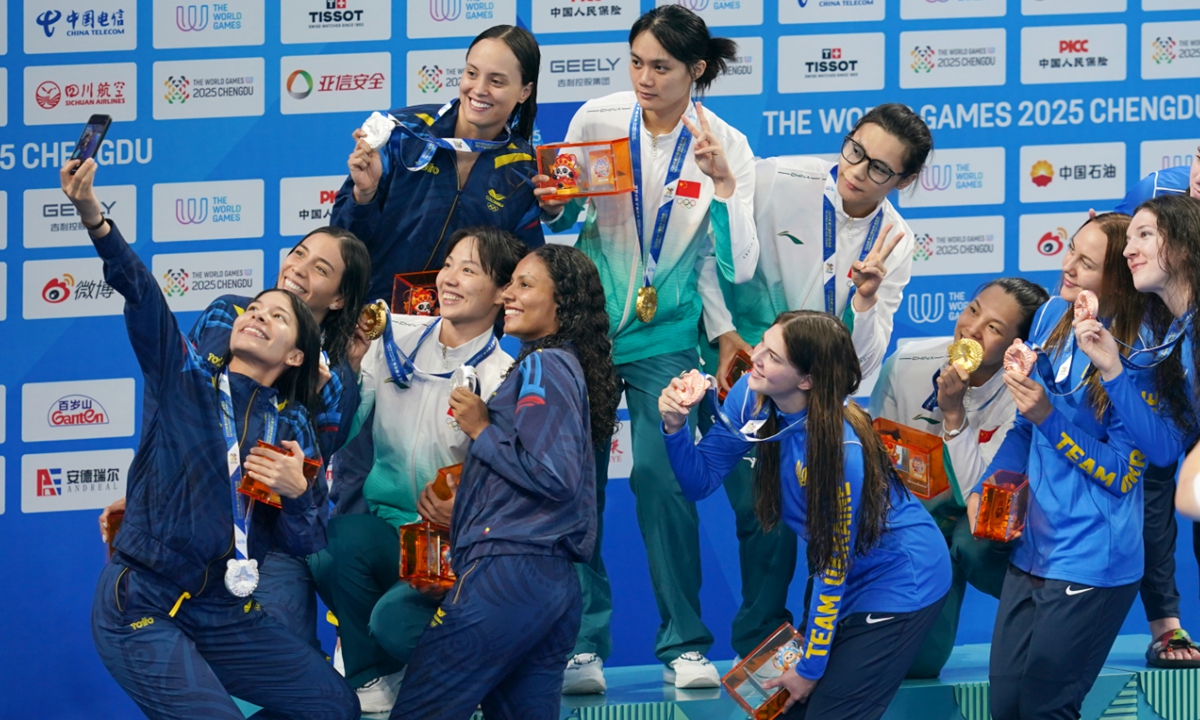
Chengdu World Games Photo: VCG
The 12th World Games entered its fourth day of competition on Monday, with 24 gold medals up for grabs. By the end of the day, host China stands at first on the medal table with 14 golds, 4 silvers and 2 bronzes, showcasing broad competitive strength not only in its traditionally strong events but also in several other disciplines.On Monday afternoon, in the men's dynamic with fins (FFS1-FFS2) freediving final, 18-year-old Long Dengxi claimed gold with 181.5 meters - his second title at the Games. Just a day earlier, Long had won the men's dynamic without fins (FFS1-FFS2) final with 134.5 meters, setting a new world record for the event.
Beyond its traditionally strong events, Team China also shone in non-traditional strengths like Muay Thai, in which Liu Xiaohui and Han Xin claimed the women's 48kg and 60kg titles, and Zhang Chengcheng earned bronze in the men's 86kg.
The 20-year-old Liu defeated Thailand's Onok in the final, leading each round 10-9 and sealing victory with a 30-27 score.
"My opponent was strong and clearly determined to win. I was an unknown, so I studied a lot of her fight videos, while she didn't know much about me," Liu told media after the match. "I have a foundation in traditional martial arts, and my fighting style is quite different from many Muay Thai athletes."
The tug-of-war competition on Monday drew significant public attention. Although Team China did not qualify for the event, He Zhenwen, president of the Chinese Tug-of-War Association, told media that the Games not only showcased the unique appeal of tug-of-war but also created unprecedented opportunities for the sport's development in China.
He noted that tug-of-war, which has a history of more than 2,500 years in China, enjoys broad grassroots followings nationwide. In recent years, the sport has developed rapidly in the country, with hard-surface tug-of-war reaching a highly competitive level, and grass-surface tug-of-war also growing quickly.
On Sunday, China claimed silver in the 10-seat 200-meter dragon boat race, with Thailand taking gold. This edition of the World Games marked the first-time dragon boat racing has been included as an official event in a major international multi-sport competition.
As the birthplace of dragon boat racing and the host nation, China's absence from the gold medal tally in this event surprised many spectators watching the sport for the first time. The global enthusiasm and recognition for dragon boat racing far exceed what many in China expected, itself a sign of the sport's successful international outreach. Statistics show there are now around 50 million dragon boat enthusiasts worldwide, with the sport practiced in nearly 100 countries and regions, according to the Xinhua News Agency.
For the International World Games Association (IWGA), the Games give non-Olympic sports a global stage and helps them connect with new audiences. IWGA president Jose Perurena told the Global Times that this was precisely the vision of the organization's founders back in the late 1970s: to create an international event that places the spotlight on athletes competing in non-Olympic sports.
"I believe, 44 years after the first edition, we've succeeded in turning that vision into a reality," he said.
"We create an environment where they are front and center, where meaningful connections with fans are possible, and where the atmosphere is warm, personal, and genuine."
RELATED ARTICLES