ARTS / CULTURE & LEISURE
Ancient mirror discovered in N.China’s Shanxi reveals Jin Dynasty’s ‘bronze ban’ policy
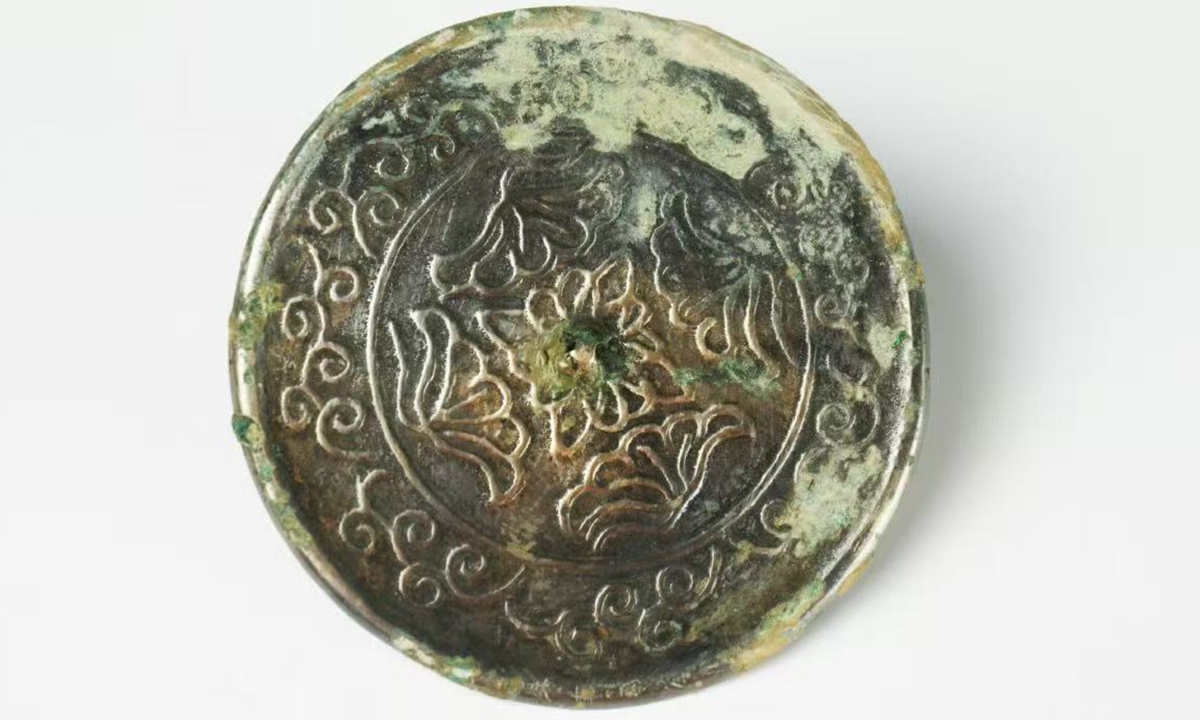
The Jin Dynasty (1115-1234) bronze mirror that was recently unearthed in Fenyang, North China's Shanxi Provicne Photo: Sina Weibo
A Jin Dynasty (1115-1234) bronze mirror was recently unearthed during a shantytown redevelopment project in Fenyang, North China's Shanxi Province. Its inscriptions shed light on how the dynasty managed bronze circulation.Discovered in a tomb dating back to the Jin Dynasty, the mirror bears an inscription in Chinese characters that reads "lushisi guan." This was an official government seal from that era, and the inscription was issued from the civil affairs' administrative office of the period, archaeological expert Lu Zhaojun, told the Global Times.
"During the Jin Dynasty, the 'lushisi' functioned similarly to what we now call a regional administrative bureau," said Lu, noting that the presence of official government seals on such an object shows that "bronze products were hugely valued in that period."
Unlike during the Shang Dynasty (c.1600BC-1046BC) when bronze artifacts were often adorned with decorative patterns or auspicious inscriptions, this Jin mirror's discovery "sheds light on the era's 'bronze ban' policy," said Wang Pujun, the lead researcher to the archaeological project.
Bronze was an essential material used for the minting of currency, and was considered by many ancient dynasties a strategic state resource. Facing frequent wars and metal shortage, Wang said that the Jin government repeatedly issued regulations to ensure sufficient bronze circulation.
"These regulations mandated that all bronze products, including mirrors and coins, must be state-cast, and private production was strictly prohibited," Wang remarked.
In addition to the inscription, the excavated mirror displays exquisite craftsmanship. The circular mirror features a delicately carved floral relief on its back, and it measures 12.5 centimeters in diameter, yet only 0.4 centimeter in thickness.
Surrounding the mirror's central knob are four evenly spaced bronze lotus leaf decorations. Such a design reflects "the sophistication of ancient Chinese bronze-casting techniques," and the Jin era's bronze handicrafts were particularly renowned for their "creative aesthetics," noted archaeological historian You Hongcai.
Interestingly, Jin Dynasty mirrors also featured designs such as "shuangyu" (twin fish), dragon motifs, and scenes depicting children playing among flowers.
These mirrors reflect the societal progress of the Jin Dynasty. For instance, the exquisitely carved twin fish mirrors gained popularity during the Dading era of Emperor Shizong. Both in composition and casting technique, they represent a clear example of the rapid advancement of Jin artistry— evolving from utilitarian objects to artistic pieces featuring deliberate aesthetic value.
"Our study of bronze artifacts has never been merely about the objects themselves. In ancient times, these ritual vessels carried with them the cultural beliefs of their societies. Thus, contemporary research on bronze artifacts allows us not only to better understand the technological achievements of past eras, but also to appreciate their aesthetic, social structures, and even the intricate interplay of economic and political forces," Yang Huan, a bronze artifact researcher based in Xi'an, Shaanxi Province, told the Global Times.
RELATED ARTICLES