US raises pressure on Ukraine before Trump-Zelensky meeting
European allies strive to stay involved as US pushes to end three-year conflict
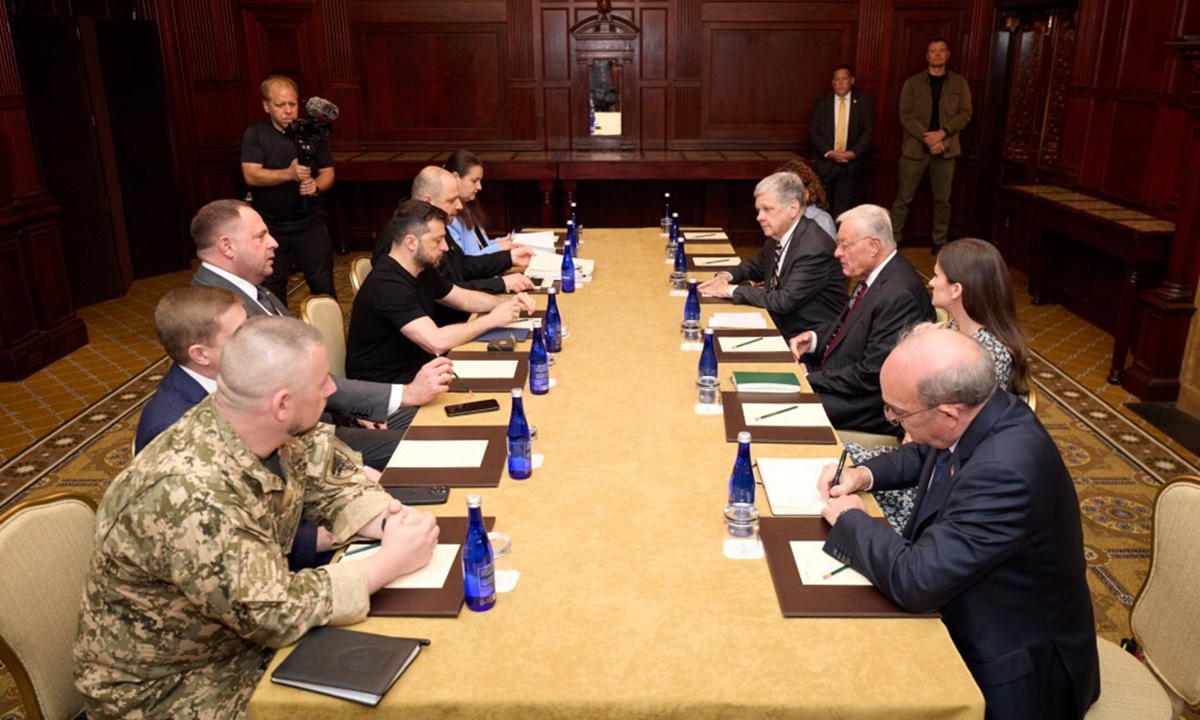
Ukrainian President Volodymyr Zelenskyy meets with US President Donald Trump's Special Representative for Ukraine, General Keith Kellogg, in Washington D.C. on August 18, 2025. Photo: VCG
Ukrainian President Volodymyr Zelensky has arrived in Washington, DC, and will be joined by some half a dozen key European leaders when he meets US President Donald Trump on Monday local time. Meanwhile, the US President is ratcheting up pressure on Ukraine to agree to terms to end the conflict with Russia, including that Ukraine should give up Crimea and NATO membership, according to media reports on Monday.
Trump will host a summit Monday with Zelensky and a bodyguard of European leaders "in the most important moment yet" in a quickening push to end the three-year-long Russia-Ukraine conflict, CNN reported.
On Sunday night, Trump posted on his Truth Social platform, saying the Ukrainian leader can "end the war with Russia almost immediately, if he wants to, or he can continue to fight."
"Remember how it started. No getting back Obama given Crimea (12 years ago, without a shot being fired!), and NO GOING INTO NATO BY UKRAINE. Some things never change!!!" Trump added.
The last time Zelensky was in the Oval Office in February, the two engaged in a remarkable shouting match, resulting in the Ukrainian leader berated by his US hosts, denied a planned luncheon, and abruptly asked to leave the West Wing.
Trump's remarks follow his summit with Russian leader Vladimir Putin in Alaska, which saw the US President split from key European allies and Kiev, as Trump backed Putin's plan for a sweeping peace agreement based on Ukraine ceding territory it controls to Russia, instead of the urgent ceasefire Trump had said he wanted before the meeting, according to media reports.
For Ukraine, the Monday meeting will be crucial in trying to sway Trump, minimize conflict, and buy more time; Zelensky may also collaborate with European leaders to propose solutions to counter those from Trump and Putin, Cui Hongjian, director and professor of the Center for European Union and Regional Development Studies at Beijing Foreign Studies University, told the Global Times on Monday.
Sun Xiuwen, an associate professor at the Institute for Central Asian Studies at Lanzhou University, noted that the Alaska summit has already "set the tone" for Ukraine in its negotiations with the US - that Kiev may need to compromise under the US-Russia consensus and cede territory for some security guarantees, Sun told the Global Times.
After arriving in the US late on Sunday, Zelensky repeated his call for allies' effective security guarantees. "The Constitution of Ukraine makes it impossible to give up territory or trade land," Zelensky said, repeating his red line on territory, per media reports.
'NATO-style' security guarantees?
US special envoy Steve Witkoff said Sunday that Trump and Putin had agreed to "robust security guarantees" during their summit in Alaska, according to media reports.
"The United States is potentially prepared to be able to give Article 5 security guarantees, but not from NATO - directly from the United States and other European countries," Witkoff said, reported The Washington Post.
Witkoff continued that the security guarantee deal would be further discussed among the US, Zelensky and European allies during the Monday afternoon meeting in Washington.
Under Article 5 of the NATO treaty, if a member country is attacked, each member of the alliance "will consider this act of violence as an armed attack against all members and will take the actions it deems necessary." Ukraine is not a member of NATO but has been seeking support from allies since the conflict broke out in 2022, per Washington Post report.
Per the CNN, Zelensky suggested new security guarantees "would need to be stronger than those that didn't work in the past."
Cui suggested the vague "NATO-style" security guarantees avoid promising Ukraine's NATO membership, this shows Trump's reluctance to make concrete commitments.
Sun said the key difference lies in that NATO's Article 5 has legal binding force, whereas the US-proposed "NATO-style" security guarantees is merely a political commitment.
Europe trying to stay involved
Trump is promoting his summit with Zelensky and other European leaders, calling it a "big day at the White House," Washington Post reported.
"We have never had so many European Leaders here at one time," Trump wrote Monday on his Truth Social network. "A great honor for America!!! Lets see what the results will be???"
NATO Secretary General Mark Rutte, alongside European leaders including UK Prime Minister Sir Keir Starmer, will join Zelensky in Washington for talks on Ukraine's future on Monday.
Also attending are French President Emmanuel Macron, Italian Prime Minister Giorgia Meloni, German Chancellor Friedrich Merz, Finnish President Alexander Stubb and European Commission President Ursula von der Leyen. It is unclear how many of them will go to the White House, according to the BBC.
"For so many heads of state to travel with such little notice across the Atlantic to what is essentially a wartime crisis meeting appears without precedent in the modern era, underscoring the sky-high stakes," said a BBC report.
Ursula von der Leyen announced on Sunday that the EU's 19th package of sanctions against Russia is set to be unveiled in early September, Politico reported.
French President Emmanuel Macron said European leaders would ask Washington "to what extent" they were ready to contribute to the security guarantees offered to Ukraine in any peace agreement. Of Moscow's position, he said: "There is only one state proposing a peace that would be a capitulation: Russia," France24 reported.
Russian foreign ministry spokeswoman Maria Zakharova called that an "abject lie" in a statement on Telegram later Sunday. Moscow had been proposing a "peaceful resolution" of the conflict for seven years under the terms of the Minsk Accords, she said.
The European leaders are hurrying to the White House out of two main considerations: first, by closely aligning with Ukraine, they are trying to enhance their influence, as otherwise their ability to impact negotiations would further diminish; second, while supporting Ukraine, they seek to avoid direct conflict with the US, Cui said.
RELATED ARTICLES