ARTS / CULTURE & LEISURE
Conservation of cave temples amid climate challenges focus of Luoyang forum
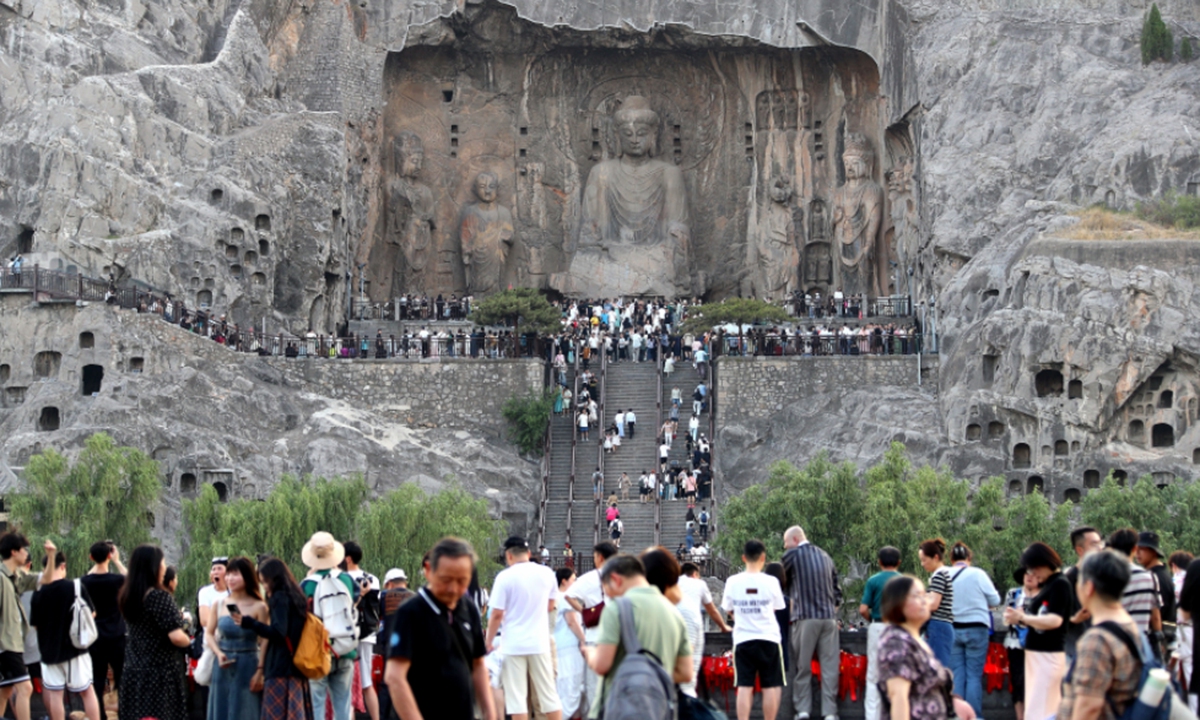
Tourists visit the Longmen Grottoes scenic area in Luoyang, Central China's Henan Province, on May 20, 2025. The Longmen Grottoes, a UNESCO World Heritage site, has more than 2,300 grottoes with 110,000 Buddhist figures and images, more than 80 dagobas and 2,800 inscribed tablets, most of which were created between the Northern Wei (386-534) and Song (960-1279) dynasties. Photo: VCG
Factors such as increases in extreme weather events and unpredictable climatic conditions, the result of climate change, are challenging efforts to preserve cave temples worldwide, according to scholars, cultural heritage experts and representatives from over 10 countries who are participating in the 2025 International Forum on Cave Temple Conservation in Luoyang, Central China's Henan Province.
The forum, which opened Tuesday, is centered on the theme of "Cave Temple Conservation, Inheritance and Value Communication." Luoyang is home to the Longmen Grottoes, a UNESCO World Heritage site with more than 2,300 caves and niches carved into the steep limestone cliffs over a kilometer-long stretch.
Cave temples, a key category of world cultural heritage, are found globally and are closely linked to the spread of Buddhism.
China alone has 2,155 cave temples and 3,831 cliffside sculptures, according to official statistics.
Among them, the Mogao Grottoes in Dunhuang, Northwest China's Gansu Province, the Dazu Rock Carvings in Southwest China's Chongqing Municipality, the Yungang Grottoes in North China's Shanxi Province and the Longmen Grottoes in Henan, all of which are listed as UNESCO World Heritage sites, are examples of cave temple complexes. Other notable sites include India's Ajanta Caves and Cambodia's Angkor Wat.
Participants from Afghanistan, Australia, Cambodia, Canada, Japan, Mexico, Pakistan, Singapore, the UK and the US joined domestic officials, scholars and researchers from Chinese cultural institutions, universities and research academies at the forum.
The three-day event aims to pool global expertise on cave temple conservation, with participants sharing techniques, experiences and ideas on archaeology, cultural communication, site management and sustainable development regarding cave temples.
In her morning address, Duong Bich Hanh, a UNESCO representative in China, said cave temples stretching from Afghanistan to India and across East and Central Asia stand as witness to human faith and cross-cultural exchange. They embody complex histories, exquisite craftsmanship and deep connections between people and the environment, she said, reminding people that cultural heritage is both local and universal - part of humanity's shared story.
Hanh emphasized that this forum brings together diverse experiences and strengths. Protecting cave temples is not only about safeguarding stone and pigments, but also about preserving the values and meanings these sites embody, noted Hanh.
China's Dunhuang Academy, which administers the Mogao Grottoes, shared its long experience in cave conservation. Su Bomin, director of the academy, shared with attendees that the Mogao Grottoes have undergone nearly 80 years of protection efforts by the academy, including about 60 major projects, and that the condition of six grottoes has steadily improved.
He especially noted the digital preservation project, saying the academy has been building databases to ensure permanent storage of wall paintings and other valuable cultural assets.
Su added that Dunhuang's initiative to digitally record cultural relics scattered overseas has achieved "practical progress," including the collection of high-resolution digital resources of Dunhuang artifacts housed in foreign institutions.
"The cultural value carried by the grottoes is a tangible witness to the development of Chinese civilization," Su told the Global Times in an interview after the speech. "Protecting grotto culture is in essence protecting the roots of our nation in another sense."
"At the same time, through forums like this one, we can share our advancements in cultural heritage protection with colleagues worldwide, allowing our technologies to be applied in their own preservation projects," said Su.
Su stressed that grotto heritage is part of humanity's common legacy.
"The theories and technologies we develop should be shared globally so that we can all work together to safeguard cultural heritage," he said.
International participants also highlighted the importance of education and collaboration. Tanimoto Chikaosa, a professor at Osaka University in Japan, suggested that academic exchange could strengthen conservation efforts.
If Chinese students could study in Japan and Japanese students could study in China, with mutual recognition of credits and degrees, it would create a better environment for joint training in conservation, he said.
Beyond conservation and inheritance regarding the forum's theme of promoting the value of cave temples, Dong Shubing, vice dean of the Academy of Arts and professor at Tsinghua University, told the Global Times that appreciation cannot be limited to observation and study.
"Young people need to see these sites for themselves," he said. "Only by being there and immersing themselves can they truly experience Chinese culture and the artistic beauty of the grottoes."
RELATED ARTICLES