ARTS / CULTURE & LEISURE
‘Gaining fall weight’ trend rises, diet and fitness in the spotlight
Healthy living boost
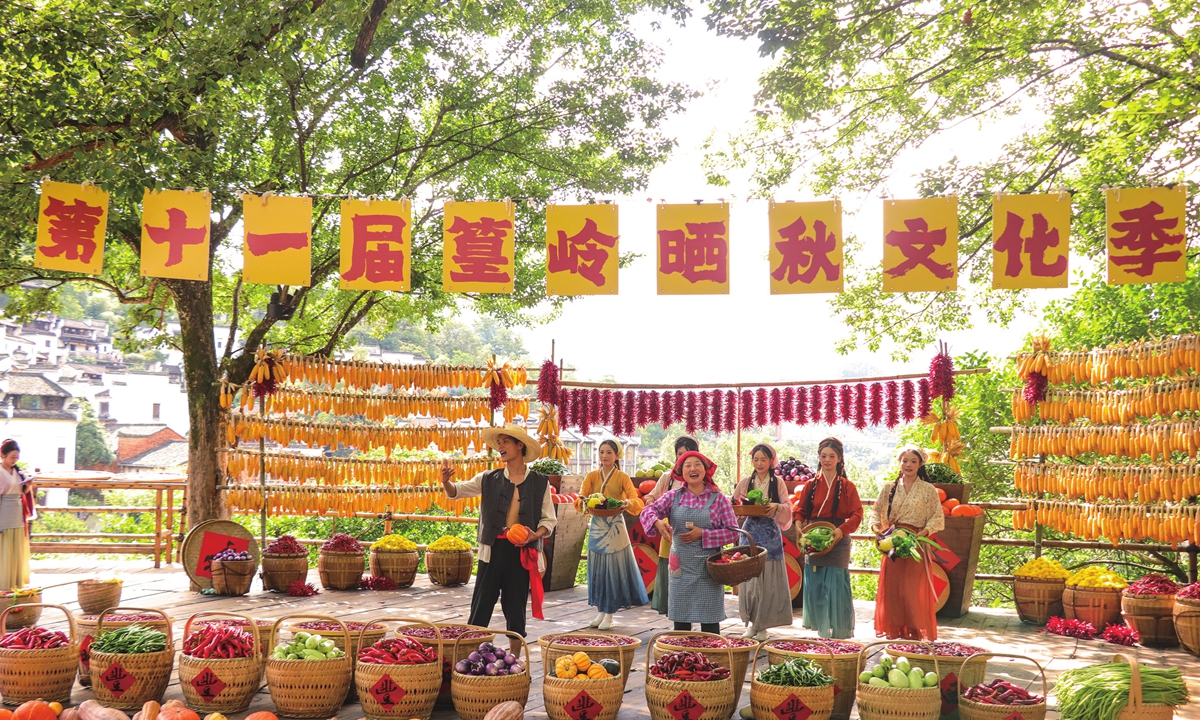
Villagers showcase newly harvested red peppers, corn, pumpkins, beans and other crops in Huangling village, East China's Jiangxi Province, on August 7, 2025. Photos: VCG
Autumn's first cup of milk tea, the first handful of chestnuts, the first stick of candied hawthorn... have you also found yourself scrolling past such seasonal topics on social media?Following the arrival of the solar term known as Liqiu (Beginning of Autumn) on August 7, the annual custom of tie qiu biao, literally "gain fall weight," has once again become a talking point.
What is different this year about this tradition of "gaining fall weight" in preparation for the cold weather, however, is the proliferation of online "tournaments" around the ritual.
On a social media platform in China, the tag "Autumn's New Trio Tournament" drew 1.81 million clicks.
Ren Yiyi, a young woman from Guangdong, told the Global Times that in the past, the reminder about "gaining fall weight" usually came from family members at the dinner table.
She noted that the elders would bring out dumplings for a meal and note that this was the first post-Liqiu dish, meant to help you store up energy for the colder months. But now, social platforms make it impossible to ignore.
"On the video app, the very first thing I saw on August 8 was a pop-up for the 'New Autumn Three-Dish Tournament.' When I clicked in, I saw chestnuts, hot pot, even candied hawthorn. It wasn't just about north-south differences anymore - every region seemed to have its version of the tradition."
She admitted that she had always thought people ate winter melon around this time.
"We call it ken qiu gua - 'biting into the autumn melon.' Every year around now, we start cooking it. But after seeing all the sharing on social media this year, I realized that different regions each have their own customs. Ours has been reclassified into the 'light-eating camp.'"
Seasonal customs
Indeed, on social media platforms, the tradition of gaining nourishment at the start of autumn has diversified into several "schools of eating."
The classic hearty camp is still strong, with hot pot, braised pork, lamb, and rich stews taking center stage.
Many users showcase pictures with wagyu beef, giant prawns, or full seafood buffets.
At the same time, a light-nourishment camp has gained traction, promoting milder, refreshing options like winter melon stews, grilled meats with mint, and seafood platters that balance richness with freshness.
For professionals, the boom of different "gain fall weight" camps online should be considered from a balanced perspective.
Wang Xiangsheng, a physician at Jining Hospital of Traditional Chinese Medicine in Shandong Province, told the Global Times that the saying "gain fall weight" came from an earlier era.
"In hot summers, people ate less and consumed more energy. When autumn brought cooler weather, they would eat richer food to replenish their strength. But today, our diets are already far more balanced and nutrient-rich than in the past."
"'Gain fall weight' must be personalized," he said.
"For those who are overweight or obese, eating heavy, greasy foods is not only unhelpful but harmful."
According to Wang, underweight individuals may benefit from increased nutrition under medical guidance, while the elderly and those with hypertension or gastrointestinal conditions should avoid overindulgence.
"If there is indeed a need for nourishment, it should be done slowly and gently, with grains as the staple and only moderate amounts of meat," Wang said.
"The awareness of seasonal changes should go beyond merely what we eat."
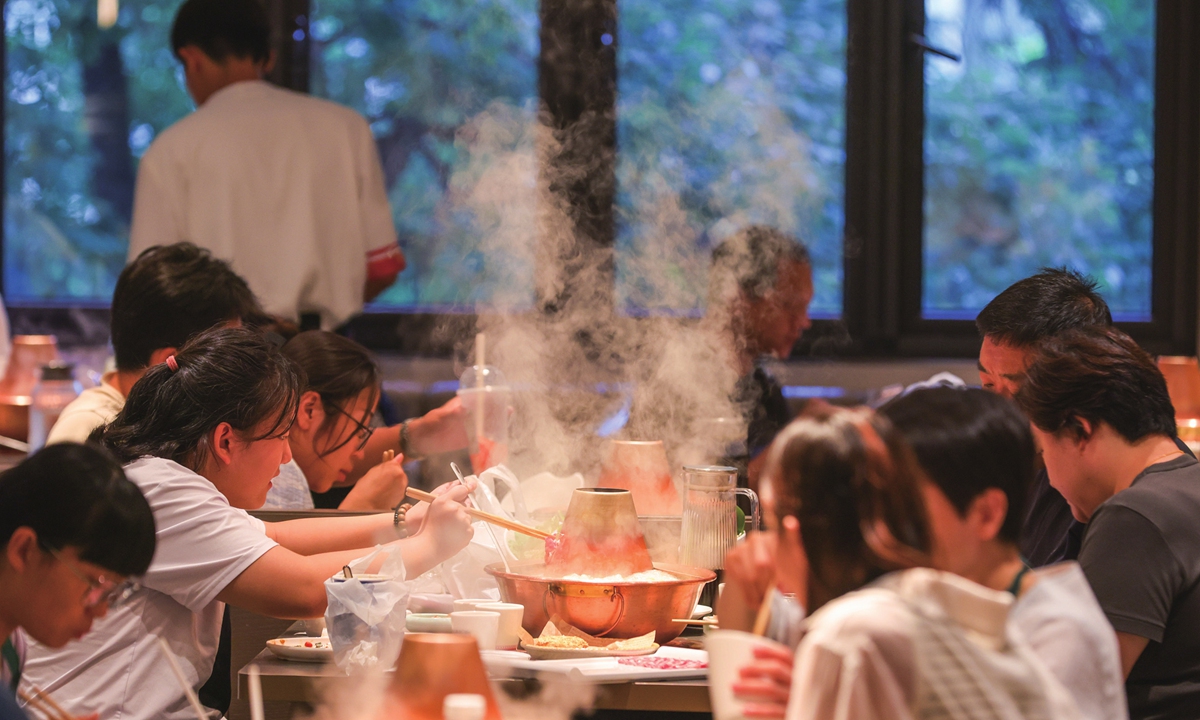
Diners enjoy hot pot at a restaurant specializing in copper pots in Beijing on August 7, 2025.
Fitness popularity soarsOn platforms like Meituan and Douyin, gym membership packages have become popular options. Monthly passes priced at around 100 yuan ($13.92) sold 97,000 units annually on Meituan, while weekly and single-entry passes are also in high demand. Some gyms offer single-entry cards starting at 9.9 yuan, with weekly sales exceeding 100, according to the Xinhua News Agency.
"Back in the day, when autumn arrived, I would think of eating large amounts of meat to 'bulk up,' but now people around me pay much more attention to balance and overall health," Hu Rui, a fitness enthusiast from Beijing, told the Global Times.
"Today, I adjust my diet by eating more vegetables and protein, while also incorporating strength training and aerobic exercise. This way, I can replenish energy without gaining excessive fat."
Hu added that endurance exercises such as jogging and climbing stairs not only burn calories but also strengthen cardiovascular function, helping the body better adapt to seasonal changes.
Early autumn is an ideal time to begin cold-adaptation exercises, which can improve the body's ability to cope with lower temperatures.
Activities such as hiking or outdoor workouts in the morning and evening expose the body to cooler air, keeping the temperature-regulating mechanisms engaged and enhancing adaptability to environmental changes, according to Guangming Online.
"Moderation and consistency are the most important principles for autumn exercise," Luo Chaofan, a rehabilitation therapist at the National Health Commission, told the Global Times.
"You shouldn't overeat just to 'bulk up,' nor overtrain to the point of exhaustion. Combining a balanced diet with regular exercise is the truly healthy way to approach the 'gain fall weight' tradition."
According to Luo, aerobic exercises such as jogging, cycling, and hiking help manage body weight while improving cold tolerance and immunity.
These can be complemented with gentle stretching or resistance training to keep joints and muscles well-prepared for seasonal changes.
"Light activities such as swimming, tai chi, or baduanjin are recommended, ideally in the morning or evening," Wang said.
"Warm-up stretches in advance, and cool-down movements afterward are essential to reduce the risk of injury."
From a health perspective, experts urge balance - pairing food with fitness to welcome the season in a sustainable way.
RELATED ARTICLES