Louis Vuitton opens beauty store in Nanjing, Jiangsu, signaling luxury brand’s confidence in Chinese market
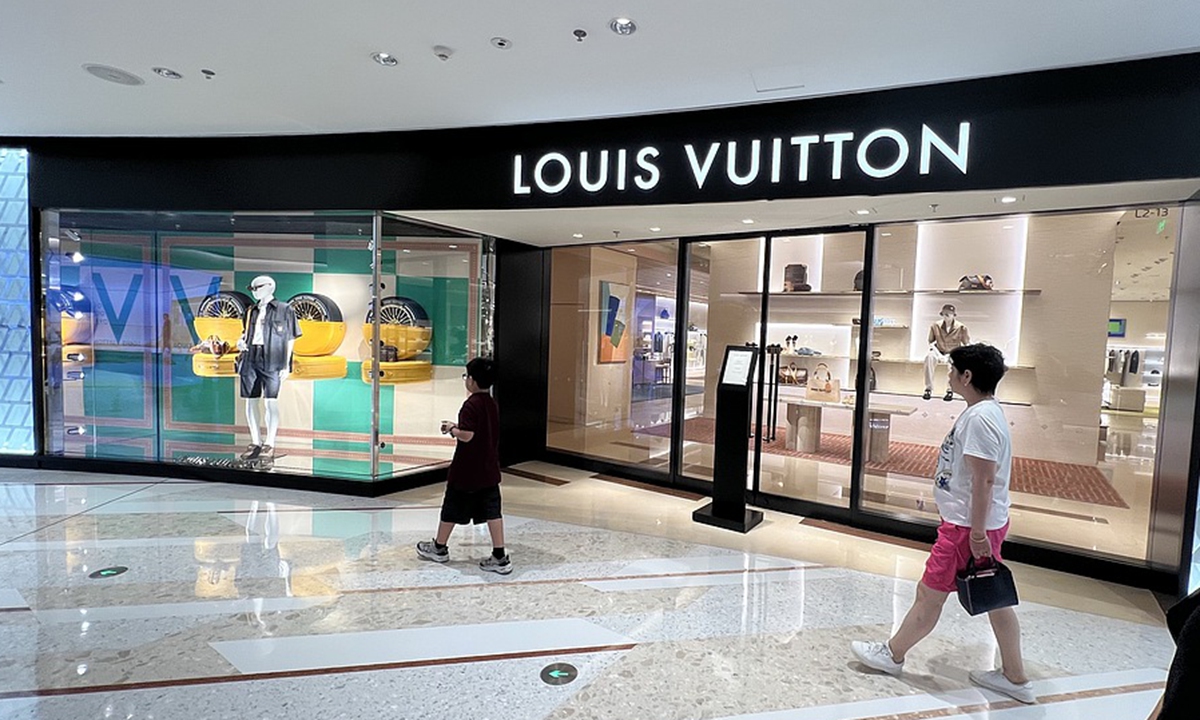
Exterior view of a Louis Vuitton boutique at a luxury shopping mall at Deji Plaza in Nanjing, East China's Jiangsu Province on August 2, 2025. Photo:VCG
Louis Vuitton (LV), the French luxury brand under LVMH, unveiled its first global fragrance and beauty boutique at Deji Plaza in Nanjing, East China's Jiangsu Province on Wednesday, simultaneously debuting the brand's beauty line on its official website and mini program.
A Chinese expert said that the launch, which drew wide attention, is a sign of foreign investors' confidence in China's vast consumer market and their commitment to staying in the market.
This marks a rare move for LV to debut a new beauty line in the Chinese mainland, with global online pre-sales scheduled to start on August 25, according to Chinese business and financial media outlet Yicai. Among the highlights, the LV Rouge lipstick series is priced at 1,200 yuan ($165) per piece, according to the report.
Following June's "Louis Express" in Shanghai, LV has opened its first standalone perfume and cosmetics boutique in China, breaking from the tradition of keeping beauty lines within leather goods stores.
"China remains a critical market for global luxury players, and the beauty sector carries immense growth potential," Zhang Yi, CEO of iiMedia Research Institute, told the Global Times. "By opening in Deji Plaza, LV is leveraging a high-end consumption hub whose clientele closely matches its own target customers."
The choice of Deji Plaza is also telling. Touted as China's new "King of Retail," the Nanjing shopping center generated 24.5 billion yuan in sales in 2024, surpassing its 2023 figure and topping the global mall revenue ranking for the first time, according to media reports. Analysts said the mall's affluent customer base closely matches the target audience of major global luxury brands.
While expanding into beauty, LV has been quietly scaling back some of its experimental ventures. The company has recently closed chocolate boutiques in markets such as Seoul and Tokyo, as well as its outlet in Shanghai.
Zhang stressed that the presence of high-standard international brands also raises the bar for local players. "Intensified competition creates a 'catfish effect,' spurring domestic firms to upgrade, innovate and strengthen their competitiveness," he said.
Global luxury houses such as Chanel, Prada and Hermès have long expanded into beauty lines in China. With high-end luxury sales under pressure amid the global economic slowdown, many brands are broadening their business portfolios in search of growth.
"More Chinese consumers now seek a blend of ingredient awareness and a sense of ritual in their purchases, moving beyond labels or logos toward products that deliver scientific appeal, visible efficacy and refined use," Zhang said.
He noted that this shift has turned beauty into a channel for segmented demand and repeat purchases, offering luxury groups room for differentiation. "Recent moves show high-end beauty is being positioned as a strategic complement to core luxury lines," Zhang added.
China's cosmetics market reached 1.07 trillion yuan in 2024, up 2.8 percent year-on-year; Bain & Company projects the global luxury cosmetics and perfume market will generate $63.3 billion in revenue in 2025, rising to $83 billion by 2029, according to media reports.
Some international luxury brands saw sales growth in China in the first half of 2025, while others posted losses, according to media reports. With the color cosmetics market already highly competitive, whether global players can win over Chinese consumers remains to be seen, according to media reports.
Global Times
RELATED ARTICLES