ARTS / CULTURE & LEISURE
China travel fever keeps centuries-old Peking duck dish thriving
Taste of cultural heritage
By and Li Yuche Published: Aug 21, 2025 11:03 PM

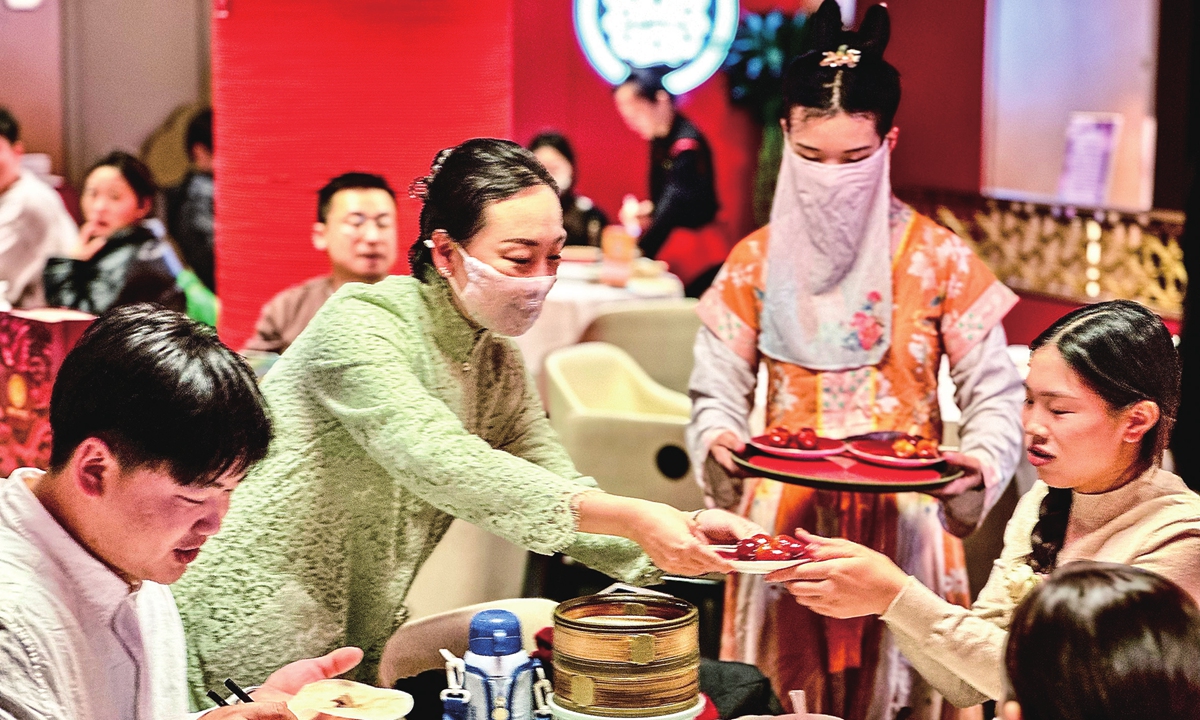
People dine at the Quanjude restaurant in Wangfujing, Beijing, in February 2025. Photos: Courtesy of Quanjude
China's optimized visa-free entry policy, among other measures to further open up to foreigners, has fueled a surging trend of "China Travel." In the first half of this year alone, the number of inbound visitor trips reached 38.05 million, with the new arrivals keen on experiencing Chinese culture, and the capital city Beijing ranked as a top destination.Like many foreign visitors, Sergey Gordeev from the US first landed in Beijing for his China trip. What he looked forward to was tasting the signature local cuisine, the Peking duck. Compared to natural sceneries or heritage sites, Gordeev said dining is the "most direct link to people worldwide," and tasting China's iconic cuisine allows him to "see the character of its culture and the soul of its people."
Although he can only utter simple Chinese phrases like "xiexie" (thank you) to express himself, Gordeev was surprisingly well-informed about Peking duck's royal-cuisine origin and its journey to global fame. But what sustains Peking duck's appeal among international visitors?
"The DIY duck-wrap ritual engages diners, while the roasting technique resonates with Western barbecue traditions, granting instant recognition. This culinary kinship makes Peking duck a universal language of cross-cultural exchange," Zhou Yanlong, general manager of the China Quanjude Group, which makes signature Peking duck dishes, told the Global Times, highlighting Peking duck's unique "interactive experience" and "cultural familiarity" for even foreign diners.
A precious heritage
Not many dishes from the ancient capital are as welcome as the Peking duck for fine dining nowadays, with more than a century of history.
Zhou said the Peking duck dish owes its longevity not just to its history - more than 160 years in Quanjude, but to its culinary craftsmanship.
Before a duck reaches the stove, its preparation involves 13 steps, such as air-pumping and sugar glazing. In a modern era of machine-produced food processing, chefs in Zhang's restaurants insist on crafting each roast duck entirely by hand.
This is not just a poetic resistance against industrialized food culture, but also a way to "guard what time has bequeathed to us," said Wu Yubo, the sixth-generation inheritor of Quanjude's craft of making Peking Duck - a national intangible cultural heritage (ICH).
Though all Peking roast ducks may gleam with that signature amber gloss, master Wu's version distinguishes itself for the ICH techniques used, such as the hung-oven roasting of the duck over fruitwood flames. Each bite reveals not just a crispy and juicy meaty texture, but offers a perfume-like symphony, with evolving layers of aroma from fruity to caramel-sweet, and finally to a subtle carbon nuance.
What makes the Peking duck an ICH dish lies both in its taste and the chef's skills, which demand years, if not decades of mastery. Take the broth-filling step as an example, veterans such as Wu can gauge water levels in a duck's cavity purely by intuition.
Inserting the duck into the oven is also a physics-defying art. Using a wooden pole, the chef must swing the duck (suspended more than a meter away) in a perfect arc toward the oven's mouth, then swiftly thrust it inside. Only this precise motion achieves the "three non-touches" principle, that is, no contact with the oven's rim, walls, or soot.
These processes are what Wu calls the "enduring principles" that restaurants like Quanjude must safeguard.
While upholding its "enduring principles," the Peking duck restaurants are also innovating, recasting the iconic dish as a "neo-Chinese aesthetic" creation for modern palates. Now, it serves photogenic peony-shaped duck slices, as well as fusion offerings such as "Peking duck tapas."
"Our history and our pursuit of neo-Chinese cuisine are not in conflict. If we don't stick to tradition, how would we even understand what 'Chinese' means, let alone create something new?" said Wu.
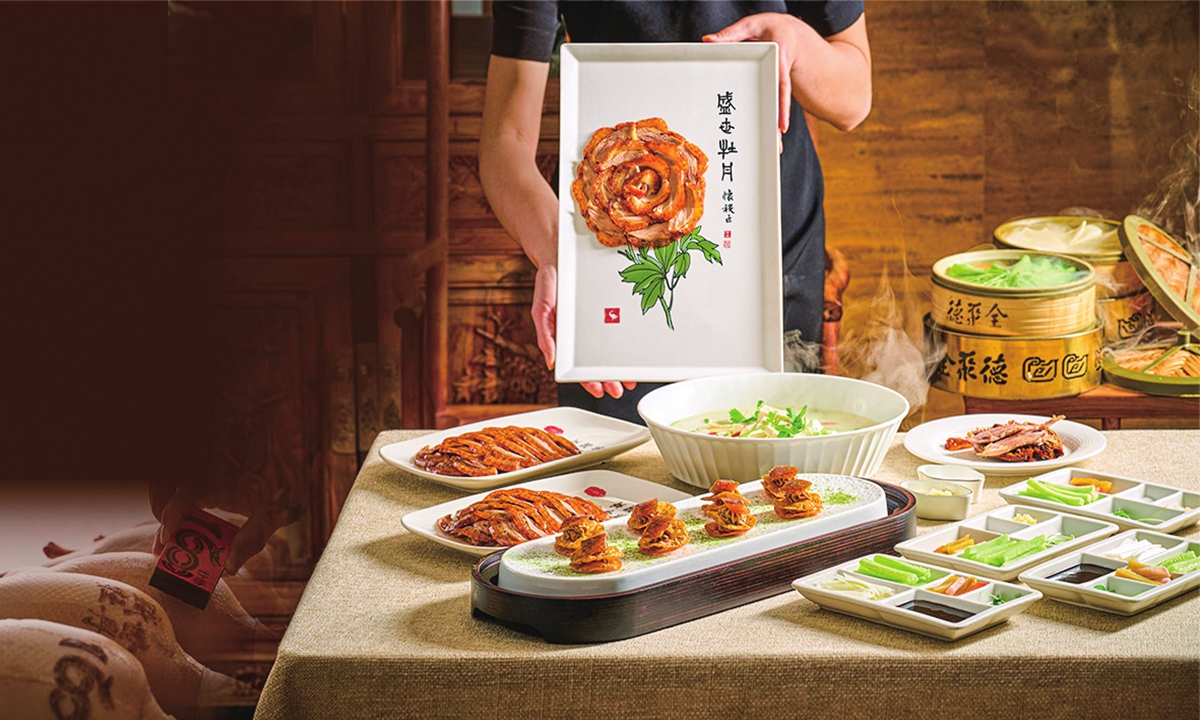
Peking duck dishes are displayed
A cultural linkPeking duck is more than just a dish - it's a "culinary diplomat," said Zhou.
He noted that historically, national leaders hosted foreign guests at Quanjude on dozens of occasions, which became a part of China's international engagement, alongside the better-known "ping-pong diplomacy."
"The dish of Peking duck served as a window to showcase China's prosperity and cultural depth to the world," Zhou explained, emphasizing that this role remains just as relevant today.
Step into Quanjude's themed restaurants, such as Palace Museum-themed outlet, American tourist Paloma B tried on a Hanfu, traditional Chinese outfit, before her meal and exclaimed that the experience made her feel "part of the tradition, not just a spectator."
The authenticity extends to the dining ritual. "It is like carving a Thanksgiving turkey, but with Beijing flair," Paloma joked, as she wrapped crispy-skinned duck, scallions, and sauce in a delicate pancake.
For another visitor Christopher Boidy, Peking duck speaks a universal language. America has sandwiches, burgers.
Mexico has tacos - wrapping meat, veggies, and sauce in carbs is a global love affair, he said, adding that Peking duck does it in its own unique way, and that's why it wins over so many foreigners.
"In a world racing toward modernization, holding fast to such traditions is truly amazing and authentic," he remarked.
Zhou believes that the vitality of a nation's dining culture reflects its stability and the happiness of its people. "When international guests see the locals' contented smiles, savor authentic roast duck, and feel genuine human warmth, they glimpse a real, vivid and vibrant nation," Zhou said.
RELATED ARTICLES