BRASIL 247 / MORE
Brazil becomes second-largest destination for direct investment from China in 2025 H1: China Global Investment Tracker
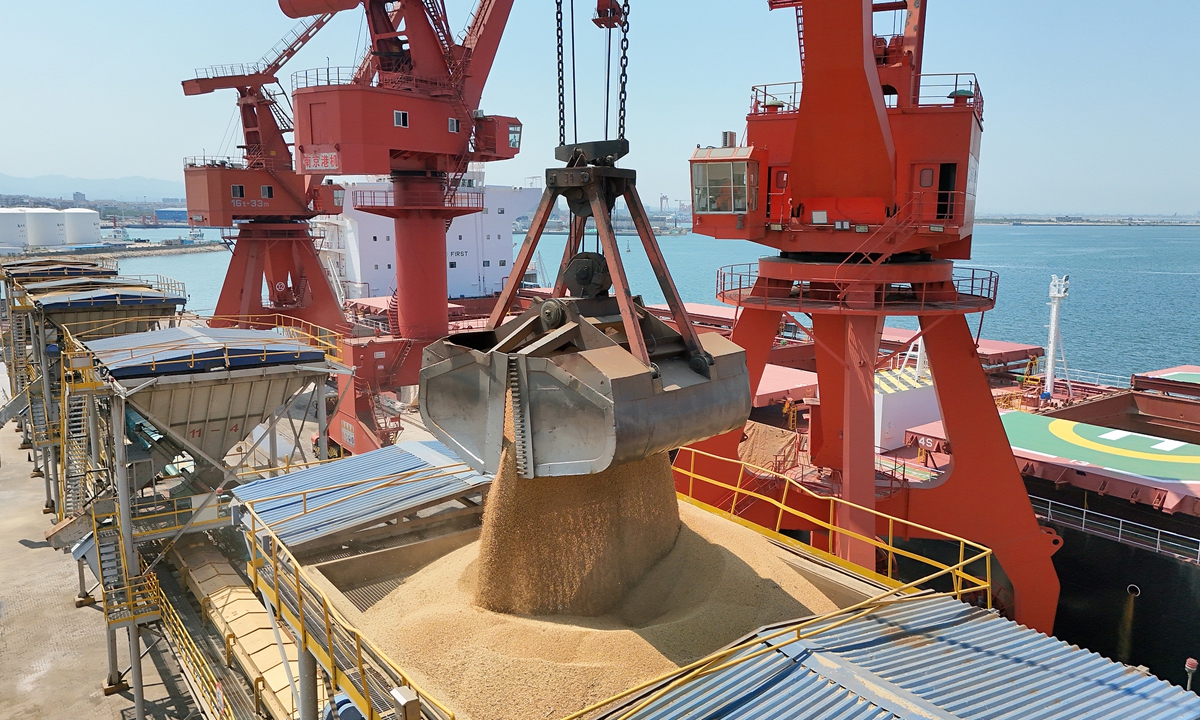
Imported soybeans from Brazil are being unloaded from the ship at the Longkou Port in Yantai, East China’s Shandong Province, on June 17, 2025. Photo: CFP
On August 22, 2025, data released by the China Global Investment Tracker, a platform maintained by the American Enterprise Institute (AEI), confirmed that Brazil has consolidated its position as the second-largest destination for direct investment from China in the first half of 2025, behind only Indonesia.
This development reflects China's steady expansion in emerging markets while the US intensifies trade restrictions.
According to the figures, from January to June 2025 Chinese companies invested $22 billion globally, with $2.6 billion in Indonesia and $2.2 billion in Brazil, representing a 5% increase compared with the same period in 2024. Since 2005, Brazil has consistently ranked among the main recipients of Chinese investment, supported by its abundance of natural resources, infrastructure needs, and large consumer market.
Expansion in agriculture and mining
Recent projects highlight China's growing role in Brazil's strategic sectors. COFCO, China's agribusiness giant, is completing a solid bulk terminal at the Port of Santos, following R$1.2 billion investment in rail equipment and another R$1 billion in port infrastructure.
In mining, Chinese companies advanced in strategic acquisitions:
• MMG, affiliated with state-owned China Minmetals, allocated up to $500 million to acquire Anglo American's nickel mines.
• China Nonferrous purchased Mineração Taboca for $340 million.
• Huaxin Cement acquired Embu, a supplier of stones for civil construction, for $186 million.
• Baiyin Nonferrous took control of Mineração Vale Verde, a copper producer in Alagoas, in a $420 million transaction.
These projects demonstrate China's long-term interest in critical minerals, essential for energy transition and high-tech industries.
Diversification beyond raw materials
China's presence in Brazil now extends far beyond commodities. In the automotive sector, Great Wall Motors (GWM) opened a factory in Iracemápolis, São Paulo, with plans to invest R$10 billion by 2032. GAC began selling electric cars, while BYD, already operating in Bahia, launched major advertising campaigns, even appearing in prime-time Brazilian television shows.
Geely also entered the Brazilian market, opening its first dealership and acquiring 26% of Renault's subsidiary in a $720 million deal. In services, Chinese expansion is led by delivery apps: 99, controlled by Didi, and Keeta, operated by Meituan, which recently announced R$5.6 billion in new investment.
According to Tulio Cariello, director of the Brazil-China Business Council (CEBC):
"Raw materials remain important, but the focus on the consumer market is very clear when we look at electric vehicles and, now, delivery applications."
Impact of US restrictions and Brazil's strategic role
For Derek Scissors, author of the China Global Investment Tracker, the increased Chinese presence in Brazil is also a direct consequence of restrictions imposed by developed nations:
"Chinese investors remain intensely interested in Brazil's commodities — iron ore, soybeans, oil. Brazil is blessed with what China needs. In return, China will help build energy and other infrastructure."
China has also consolidated its leadership in trade with the Global South. In 2024, exports to these markets surpassed $1.5 trillion, more than 50% higher than exports to the US and Western Europe, according to Standard & Poor's.
This trend confirms that China continues to expand cooperation with developing countries, supporting shared growth and stability, while the US seeks to impose unilateral restrictions that isolate itself from the emerging new order.
(Reported by Brasil 247 on August 22, 2025)
