Postal services in several countries suspend deliveries to US amid end of duty-free rule
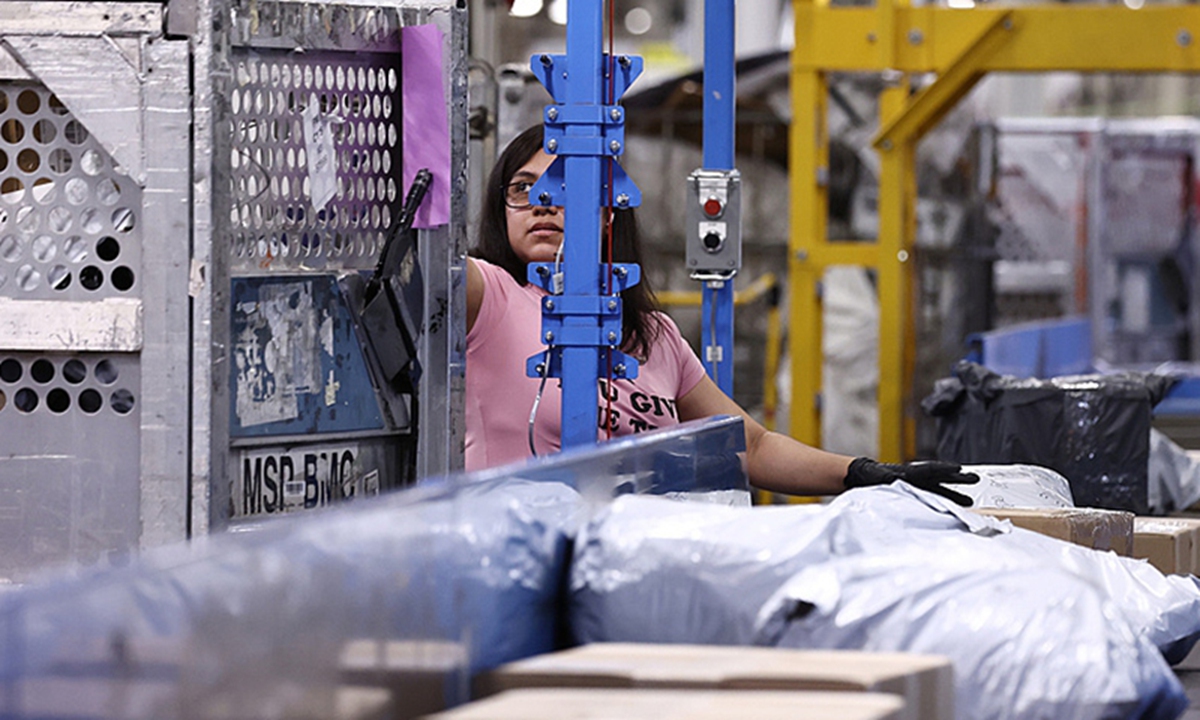
A US Postal Service employee sorts parcels for distribution Photo: VCG
Postal services across the world are suspending parcel deliveries to the US, citing confusion about how to process millions of low-value packages that will lose their duty-free treatment from August 29, Bloomberg reported. Chinese experts said Saturday that tariffs, a major cost in international trade, can disrupt supply chains when altered arbitrarily, ultimately impacting consumers and small business owners.
The US current administration announced in July that it would suspend the global "de minimis" exemption, which allows for minimal paperwork for international shipments under $800, according to the Reuters.
France's national postal service, La Poste, announced Friday local time that it will suspend goods parcel service to the US starting August 25, except for express shipping, due to US tariffs on European imports, Xinhua News Agency reported. It added that postal agencies in several other European countries, including Germany, Belgium, Spain, and Austria, have announced the suspension of parcel deliveries to the US.
The postal services in Norway and Finland also suspended related services on Saturday, Bloomberg reported.
Several Asian postal services have also adjusted in response to the new US tariff rules, suspending shipments to the US. Thailand's local media platform, Thai Examiner, reported on Saturday that Thailand Post has suspended parcel delivery to the US, effective Friday. Singapore's SingPost will suspend standard services for commercial shipments to America from Monday, said Bloomberg.
Korea Post said it will halt accepting air parcels and some express mail services to the US starting Tuesday, while keeping premium services, operated via private couriers, available subject to customs duties.
China Central Television (CCTV) finance channel, citing data from the South Korean Statistical Office, reported on Saturday that South Korea's e-commerce sales in overseas markets totaled approximately 1.7 trillion won (about $64 million) in 2024, with the US market accounting for 20 percent, ranking second.
According to data from the Korea International Trade Association, most cross-border e-commerce businesses in South Korea are small and medium-sized enterprises or individual operators, and the US' policy change will have a greater impact on them, CCTV noted.
He Weiwen, a senior fellow at the Center for China and Globalization, told the Global Times on Saturday that many cross-border e-commerce enterprises rely heavily on a single market and supply chain structure. Changes in US tariff policies make it difficult for them to quickly adjust their supply chains, leading to supply disruptions or significant cost increases.
He said that higher tariffs directly increase costs associated with procurement and transportation for cross-border e-commerce businesses. For small and medium-sized enterprises and individual operators that rely on sales in the US market, these rising costs could compress their profit margins and render some low-margin products unprofitable.
"Tariffs are a significant cost in international trade, affecting upstream and downstream pricing, raw material supply, inventory, and market expectations," said Zhou Mi, a senior research fellow at the Chinese Academy of International Trade and Economic Cooperation.
Zhou added that in the context of large-scale and structural adjustments in international trade, transportation companies may also cut routes to the US due to declining trade volume, while the supply shortages and higher prices will pose serious challenges to retailers.
For example, some American small businesses are already on the brink. Howard Miller, a family-owned manufacturer of handcrafted clocks and home furniture based in Zeeland Mich., said last month that it planned to shut down operations next year after 99 years in business, according to the New York Times.
"Our business has been directly impacted by tariffs that have increased the cost of essential components unavailable domestically and driven specialty suppliers out of business, making it unsustainable for us to continue our operations," said Howard J. Miller, the company' s chief executive and grandson of its founder, per the report.
Zhou noted that if countries reduce their exports to the US, domestic suppliers may gain more opportunities temporarily, but the overall supply will significantly decrease. This imbalance could result in a supply shortage, leading to rising prices, and consumers would have to pay more for the same products, or even for lower-quality goods.
"Tariffs will ultimately be passed on to US consumers," He Weiwen added.
The US government data, including that from the US Commerce Department, showed that prices rose in June on items heavily exposed to tariffs, such as home furnishings, toys and appliances, the New York Times reported in early August.
RELATED ARTICLES