ARTS / CULTURE & LEISURE
Dunhuang Academy, Kyrgyzstan to build joint lab for cultural heritage protection
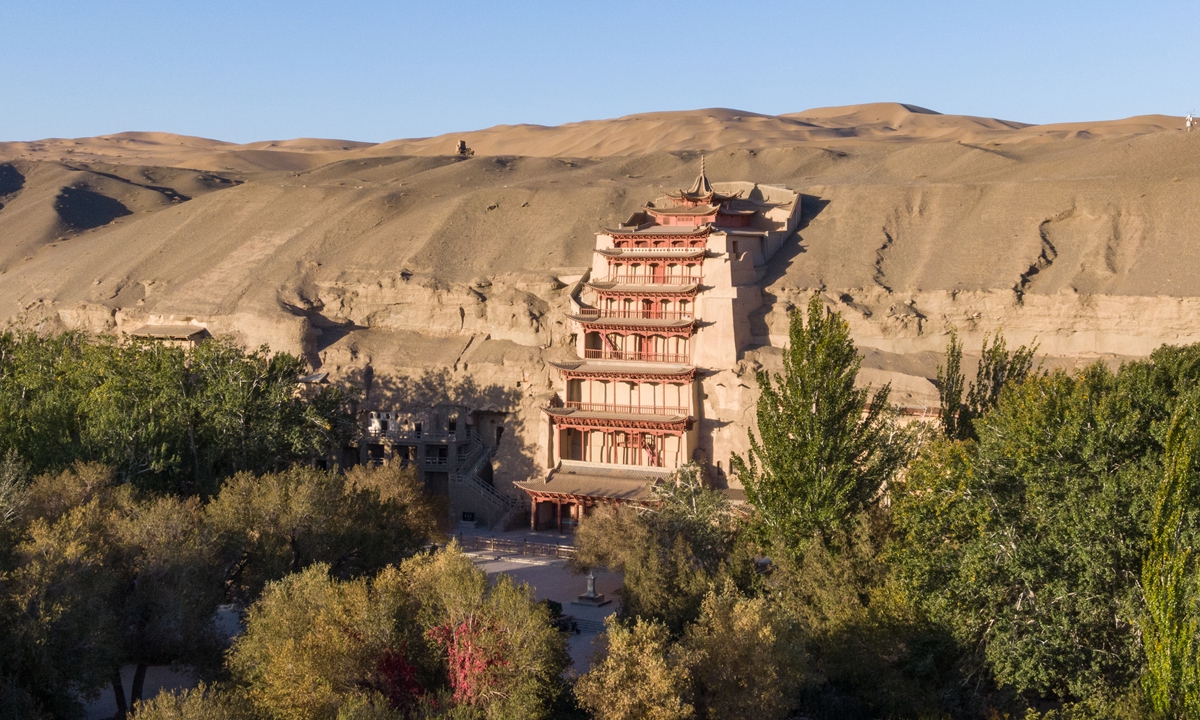
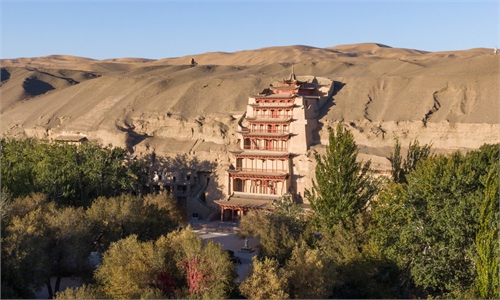
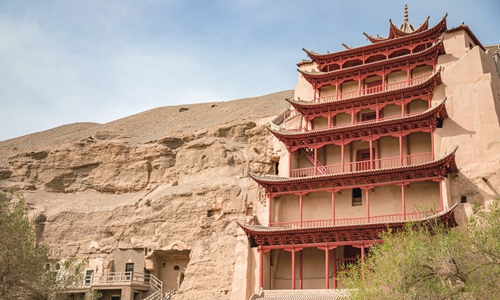
The Mogao Caves in Dunhuang, Gansu Province Photo: Courtesy of the Dunhuang Academy
The conservation techniques of China's Dunhuang Academy, already applied in more than 300 national-level projects across 21 provinces and autonomous regions in China, will soon extend overseas as the academy teams up with Kyrgyzstan to establish a joint laboratory dedicated to cultural heritage protection, Yu Zongren, head of the academy's conservation institute, confirmed with the Global Times on Sunday.The move follows a recent joint field survey of 16 medieval sites in the Chu River Valley, including the ruins of Suyab, in Kyrgyzstan. The mission completed on-site investigations, structural analysis, and preliminary conservation planning for the Suyab site, marking a tangible step forward in bilateral cooperation under the Belt and Road framework.
Over the past decades, the Dunhuang Academy, as one of China's and the world's largest research institutes dedicated to grotto conservation, has developed a comprehensive set of techniques for the preservation of murals, grotto temples, and earthen sites.
"From the nearly 20 years of conservation at the Xixia Imperial Tombs in arid regions to extending the lifespan of relics in humid environments, we have gained valuable experience that can now benefit Silk Road countries," Yu said, adding that Dunhuang's conservation techniques, developed in China's dry western climate, "match very well" with the needs of Central and West Asia.
The Suyab ruins, located at the crossroads of two major Silk Road routes, once flourished as a hub of trade and cultural exchange. Established in 679 in the presence of Tang Dynasty (618-907) military, the city was rebuilt following the layout of Tang Dynasty capital Chang'an, with government offices, granaries, and temples, reflecting the deep influence of Tang civilization. The site is also famously the possible birthplace of renowned Tang Dynasty poet Li Bai.
Today, however, most of the site has weathered into mounds after centuries of wind and rain, with only fragments of walls remaining. The once bustling Silk Road town is now covered in grass, with cattle and sheep roaming freely, a sharp contrast to its former glory.
Experts note that Dunhuang's own experience is directly relevant to the challenges faced at Suyab.
"Whether it is the Mogao Caves or murals, the geographic environment of Dunhuang offers useful lessons for the Suyab site," Chen Jiachang, a researcher from the China Academy of Cultural Heritage, told the Global Times on Sunday.
"Both lie in semi-humid western regions and so face similar emergency conservation needs and environmental pressures," Chen added.
For instance, the Mogao Caves were carved in soft sandstone, making them vulnerable to weathering and erosion. Conservation has therefore required comprehensive reinforcement of unstable rock masses and prevention of structural damage.
"In similar climates, water management is also key," Chen explained. "Environmental and climate changes are creating new problems: Regions once considered dry now face intensified weathering and material instability. In China, we have successfully used composite materials, including metal complexes, to mitigate such issues. I believe the new joint lab will help tackle these shared challenges."
To address such risks, the Dunhuang Academy has developed a full set of mural conservation techniques and standards, established an Internet of Things-based monitoring and early-warning system, built China's first mobile archaeological laboratory, and created the country's only full-climate physical simulation platform. It has also pioneered the world's first Silk Road heritage risk-monitoring system.
Yu noted that the Chu Valley survey systematically collected data on the location, historical features, construction techniques, and preservation status of 16 key sites, creating a comprehensive database. This, he said, not only strengthens mutual trust and cooperation between China and Kyrgyzstan in archaeology and heritage protection, but also lays the groundwork for a regional heritage conservation mechanism.
Beyond Kyrgyzstan, the Dunhuang Academy has in recent years conducted exchanges and personnel visits with India, Pakistan, Uzbekistan, Turkmenistan, and Tajikistan.
"We hope that by sharing cultural heritage protection concepts and technologies, we can further enhance cooperation and speed up the spread of Dunhuang's conservation techniques among Belt and Road countries," Yu said.
RELATED ARTICLES