ARTS / CULTURE & LEISURE
Maturation of China’s single-player premium games
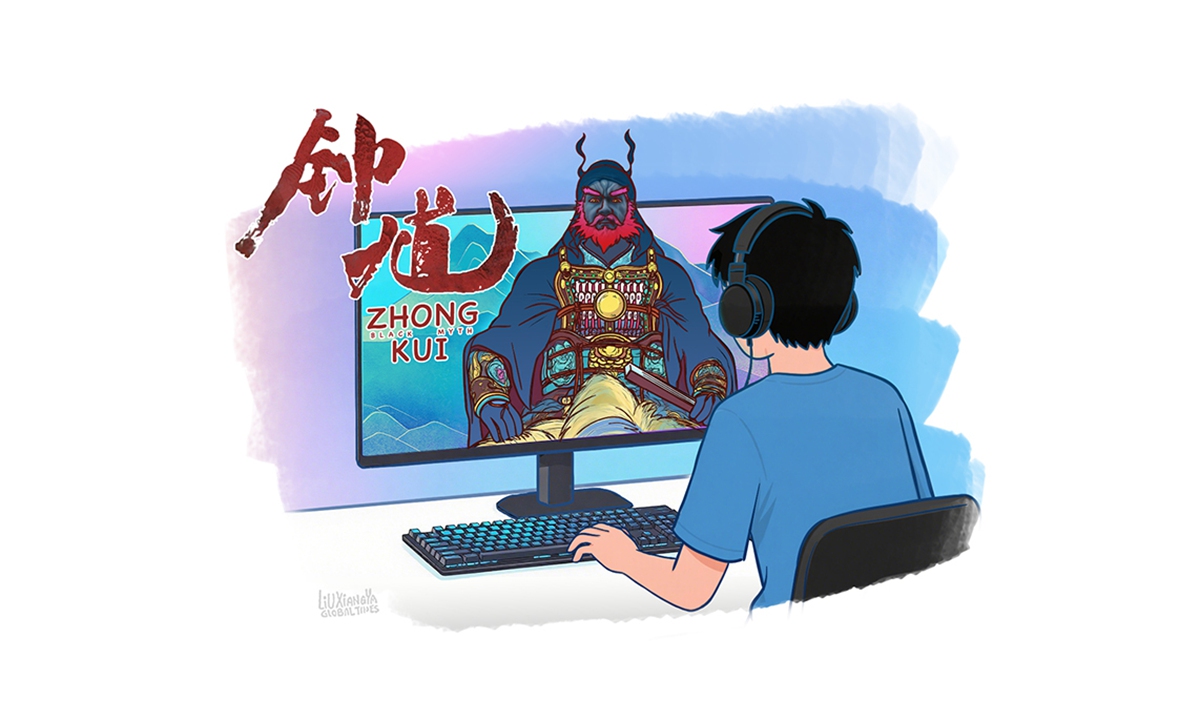
Illustration: Liu Xiangya/GT
Black Myth: Zhong Kui, the second installment in the Black Myth series following the Chinese AAA video game Black Myth: Wukong, recently premiered its first CG teaser trailer at Gamescom 2025 in Cologne, Germany. The trailer quickly went viral, amassing over 10 million views on China's video platform Bilibili, highlighting the growing necessity of folklore oriented games in China's gaming industry.Liu Mengfei, a gaming industry observer at Beijing Normal University and former vice chair of the Digital Games Research Association, told the Global Times that "consumer games" resemble fast-moving consumer trends, relying on monetization mechanics such as pay-to-win and gacha (a popular game monetization and genre that involves players spending in-game or real currency to obtain random virtual items, characters, or other assets) draws for quick returns; premium games are games that you pay for once for a complete gaming experience. Though costlier and more time-intensive to develop, they carry the potential to export culture overseas and to upgrade the industry. The Black Myth series stands as a representative of these types of premium games.
In the first half of 2025, China's gaming market recorded 168 billion yuan ($23 billion) in revenue, up 14.08 percent year-on-year, reaching a new high. The number of gamers climbed to nearly 679 million. During the same period, revenue from domestically developed games overseas hit $9.501 billion, an 11.07 percent increase, according to the Xinhua News Agency.
"Games are no longer just understood as entertainment," said Ao Ran, executive vice president and secretary-general of the China Audio-Video and Digital Publishing Association. "They are also key arenas for technological innovation, vital carriers of traditional Chinese culture, important vehicles for Chinese culture to go global, and an integral part of the digital economy."
"With profound cultural foundations and continuous technological advancement, China's gaming industry is earning growing recognition on the world stage," Ao added.
In the first half of 2025, overseas revenue from China's self-developed mobile games exceeded $9.5 billion, a year-on-year increase of over 11 percent. Most of these mobile games are consumption-oriented, relying on fast-paced gameplay, social mechanics, and monetization models like gacha and microtransactions to drive revenue.
These games hold clear advantages: fast-paced gameplay, strong social mechanics, and aggressive monetization, all of which cater precisely to players' immediate entertainment needs and sustain a massive market cycle. However, their commercial focus contrasts sharply with works-oriented titles, which prioritize narrative depth and cultural expression over quick returns.
"Such works are essentially extensions of fan economies, rather than creations drawing true inspiration from the fabric of Chinese cultural tradition," Liu said. "Over time, this fosters an industrial ecology that emphasizes execution over imagination, where development priorities outweigh creative vision, ultimately leading to a lack of narrative depth and cultural substance."
While consumer games may generate short-term prosperity, they struggle to support the long-term competitiveness of Chinese gaming on the global stage.
In sharp contrast stands the works-oriented path exemplified by the Black Myth series. Jiang Yao, CEO of the leading Chinese game review site Gcores, told the Global Times that from Wukong to Zhong Kui, the developers are not only reimagining mythological figures but also exploring how to transform a broader range of cultural resources - from folk tales and ghost lore to historical texts into meaningful gameplay experiences.
This path is clearly more challenging, but the success of Wukong has already proven its feasibility: it not only earned acclaim from players worldwide but also spawned collaborations in cultural tourism, exhibitions, and merchandise, demonstrating that works-oriented games can sustain a viable commercial model.
More importantly, it has shifted societal perceptions of "work of game" projects. Investors are now more willing to back large-scale original titles, and local governments have set up funds to support development. As industry insiders note, these systemic changes carry significance far beyond the breakout success of a single game.
Jiang pointed out that Zhong Kui focuses on a folklore figure who is far less widely recognized, highlighting the team's cultural audacity. By moving beyond the "safe zone" of the Four Great Classical Novels, the developers are expanding the scope of cultural expression.
"This approach not only allows players to engage with and understand Chinese stories through entertainment, but also provides the industry with a path toward greater cultural diversity and depth," he said.
As a transitional work marking the team's maturation, Zhong Kui's significance lies in consolidating the foundation for China's single-player premium games.
For the gaming industry in China, the key is not whether any single title becomes a blockbuster, but whether more teams like Game Science can maintain independence and creative vigor, proving that China can produce major games rooted in its own cultural identity while remaining internationally competitive.
The author is a reporter with the Global Times. life@globaltimes.com.cn
RELATED ARTICLES