ARTS / CULTURE & LEISURE
Regional amateur leagues revive grassroots football

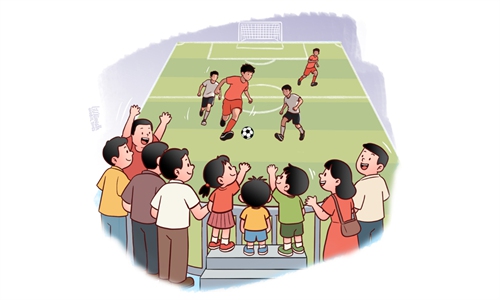
Illustration: Liu Xiangya/GT
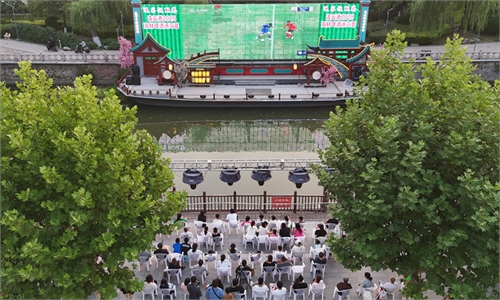
In recent months, China has witnessed a burgeoning proliferation of regional football leagues across multiple provinces and cities. The past weekend has witnessed the start of several new tournaments such as the Guangdong Football Super League and the Inner Mongolia Football Super League.Meanwhile, the 2025 Urumqi City Football Super League will kick off on September 7, while the Sichuan Provincial City Football League is scheduled to begin on September 20. Additionally, the Guizhou Village Super League, or Cunchao, is planning to have a national tournament in 2026.
Prior to that, the grassroots football wave had already broken out in East China's Jiangsu Province, with the Jiangsu Football City League - popularly known as "Suchao" - sparking nationwide attention. It garnered enormous fan interest both online and in stadiums, thanks to its inclusive, meme-infused appeal and simple city-based rivalries.
Emulating this model, East China's Jiangxi Province launched the "Ganchao" in mid-July, pulling in 66,960 spectators across opening-round matches and even chartering a high-speed "football special" train to ferry fans to away matches, highlighting both logistical innovation and civic spirit.
Meanwhile, in Wuhan, Central China's Hubei Province, the Wuhan Football Super League kicked off to an extraordinary turnout last week, with the opening match drawing 46,780 attendees, reinforcing the powerful public appetite for accessible, community-rooted football.
Taken together, these developments illustrate a nationwide surge of interest in grassroots football. The question then is: Why are these leagues resonating so strongly at this moment?
First, these regional leagues exemplify intertwined dimensions of impact: community activation, youth development, and cultural-commercial synergy. They revive football as a shared social experience: playful, accessible and rooted in place. Rather than relocating fans to distant metropolitan stadiums, matches are held in city centers or even county-level venues, embedding football into everyday life. With players drawn from daily life and fans cheering for familiar faces rather than distant stars, these leagues cultivate belonging and local pride.
Second, the amateur nature of these competitions opens up invaluable avenues for youth and non-professional players. The inclusion of Yancheng team goalkeeper Li Zhiliang and Xuzhou team midfielder Miao Rundong into the Chinese national under-18 football team is a great symbol of what amateur leagues can offer. Unlike the Chinese Super League (CSL) and other professional tiers, the new provincial and city tournaments are designed with low barriers to entry. Those amateur leagues often bar professional, adult-level players, ensuring that playing opportunities go to students and workers among other local talents. For ambitious teenagers, the tournaments represent valuable platforms for competitive experience.
Third, these leagues are breaking the mold by integrating football with culture, tourism, and commerce. Importantly, this cross-sector integration activates new consumption channels - from local snacks at stadiums to tourism packages - revitalizing district-level economies. From opening ceremonies to match-day programming, organizers increasingly seek to blend football with culture, tourism and commerce.
The Guizhou Village Super League offers a blueprint. Matches there were often accompanied by parades of traditional dress, folk songs, and regional cuisine, turning each game into a cultural fair as much as a sporting contest. Spectators were not only watching football - they were experiencing Guizhou's intangible cultural heritage in real time.
These examples, taken together, suggest that the momentum of amateur regional leagues signals a broader recalibration of how sports can serve society. Football is no longer a distant spectacle only for the fans of professional clubs. Instead, it's becoming a vehicle for connection across generational, geographic and economic divides.
As a broader lens for the future, these amateur leagues suggest football in China may find more sustainable success in deepening local roots rather than chasing star power. If nurtured properly, with stable funding and institutional continuity, they could form the backbone of a revitalized football ecosystem that is broad, participatory and resilient.
For years, discussions about Chinese football have focused on professional results and the long-standing ambition to qualify again for the FIFA World Cup after the national team's underachievement. Yet success can be measured in more than just international rankings. The flourishing of regional leagues shows that football is finding new life in the grassroots, in ways that connect to people's identities and livelihoods.
In many ways, these leagues are transforming football from a spectator sport into a participatory civic practice. In return, communities find shared experiences, young players find stages, and cities find renewed pride. These regional football leagues are catalysts for a more inclusive and dynamically engaged football culture in China. They bring down entry barriers, foster local pride, create narrative excitement, and, critically, give wings to young talent and ordinary people alike. In doing so, they redefine what it means for sports to belong to the many rather than the few.
The author is a reporter with the Global Times. life@globaltimes.com.cn
RELATED ARTICLES