ARTS / CULTURE & LEISURE
Museum merch, trendy toys growing into big business
Why bag charms?
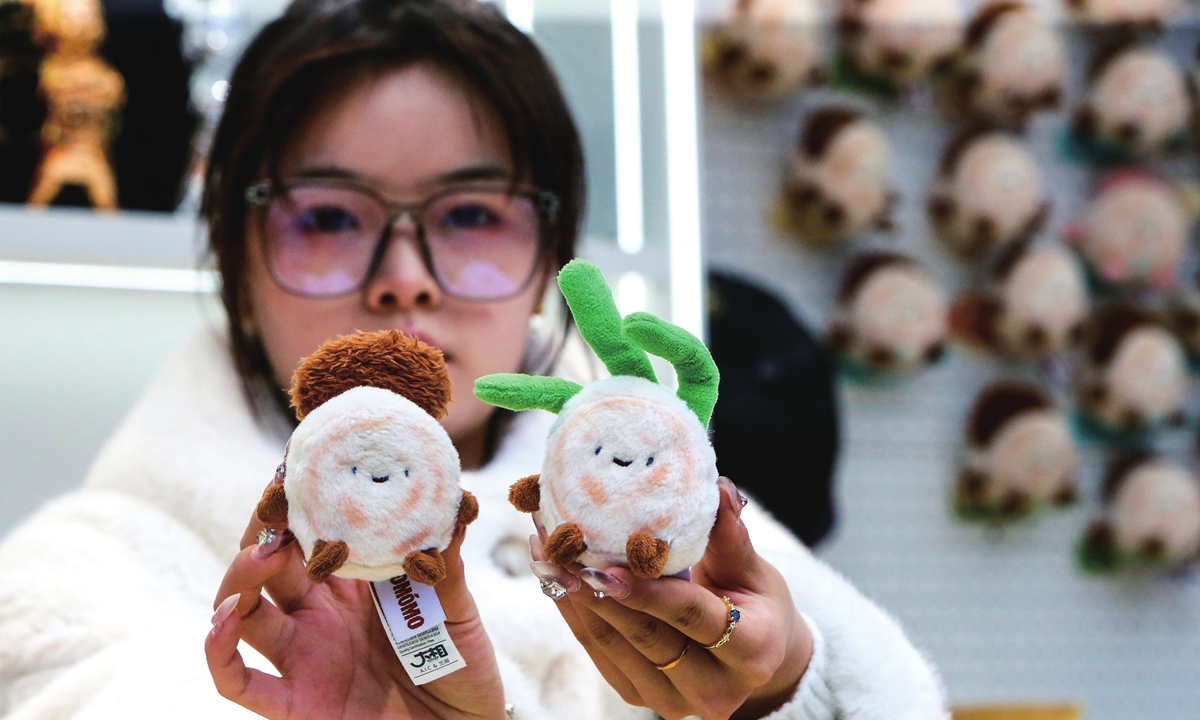
A staff member showcases Xi'an's cultural-creative plush charm brand RongMomo in Xi'an, Northwest China's Shaanxi Province. Photos: VCG
Priced at just a few dozen yuan, the playful charms drew huge attention during pre-sales thanks to their adorable and creative design. Suzhou resident Su Qingyun told the Global Times that when the charms were launched in late 2024, she had tried to buy them online, only to see them sell out instantly. "Later I looked everywhere for resellers, but they were all gone. I finally bought mine from a tourist visiting Suzhou," she said.
Coincidentally, Friday saw the official store release of the long-awaited mini version of Labubu, the brand that CEO Wang Ning called a bag charm. Whether it is international celebrities hanging Labubu dolls on their bags, or viral videos of the character circulating on TikTok, the new charm's design appears to be fueling yet another wave of "portable plush craze."
"Right now we are seeing the rise of an 'emotional economy,'" Zhang Yi, CEO of iiMedia Research Institute, told the Global Times. "Bag charms are visible accessories with social attributes. People discuss which designs they like and how best to match them. That shared discussion itself adds emotional value."
Constant innovation
After buying the Suzhou Museum "crab" charm, Su soon discovered that bag charms had become a common cultural product in museums across China. "When I traveled to Sichuan, I found the Sanxingdui Museum had its own charm," she recalled. "It was shaped like a bird, inspired by the museum's bronze sacred bird, but made cartoonish. The clever part was that inside it was an eyeglasses cleaning cloth you could pull out and use."
Indeed, museums nationwide have jumped on the opportunity. The Ningxia Museum's sheep charm, the Natural History Museumof China's whale charm, and Nanjing Museum's Yuan Dynasty blue-and-white prunus vase (meiping) charm are among the many products that combine recognizable relics with approachable design.
Liu Ziqi, founder of Xi'an's cultural-creative plush charm brand RongMomo, once told media that such products thrive on "a love of one's own culture, including culinary traditions."
This aligns with broader consumer trends. According to 2024 McKinsey China Consumer Report, urban Gen Z consumers spend more on dining out and cultural entertainment, reflecting their pursuit of social companionship and spiritually fulfilling activities.
"Compared with handheld plush toys, bag charms stand out for their role in community identity and social recognition," Li Yongjian, a researcher of the internet economy at the Chinese Academy of Social Sciences, told the Global Times. "You can casually hang one on your bag. If someone recognizes it, you immediately share a cultural bond, which even helps spark social connections."
In Beijing, the Natural History Museum of China opened a cultural-creative shop inside a subway station in August, offering many charms, including the popular "whale." A shop assistant told the Global Times that passengers of all ages stopped to look, and most went home with a bag charm. "It's small, harmless, and once you hang it up, people either know you've been to our museum, or they just think you're someone with a childlike love of animals," the staffer said.
Su herself once had a surprising encounter thanks to the bag charm. "On a bus I noticed a woman with the same crab charm. I asked about it, and found out she was visiting Suzhou for the first time. We became friends, and she even gave up her seat for my companion," she recalled.
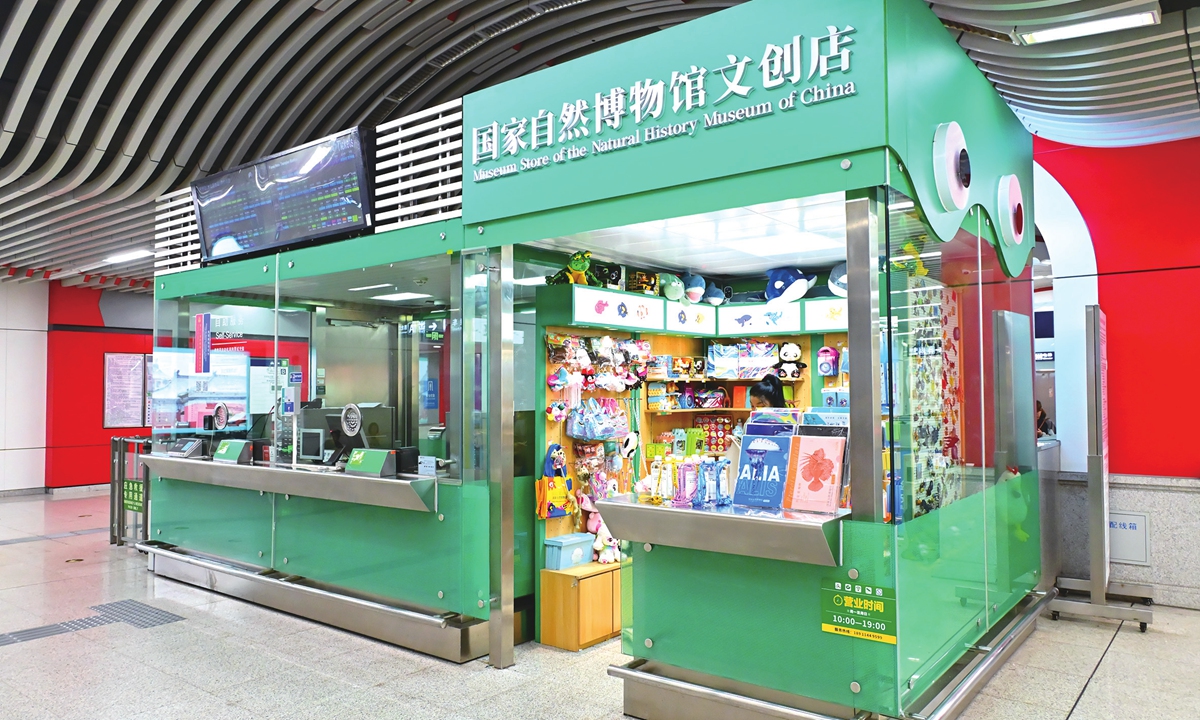
The Natural History Museum of China's first cultural-creative shop opens inside a Beijing subway station on August 17, 2025.
Small products, big industryAs bag charms continue to soar in popularity, manufacturers and IP holders are racing to release more creative designs to cater to different consumer groups.
The hit Chinese animated film Nobody, which critics said evokes the dreamy aesthetic of the Shanghai Animation Film Studio's classic works, also boosted sales of its spin-off charms, including a pig-demon plush and a gourd-shaped sachet.
The company Qi Jun Toys in Dongguan, South China's Guangdong Province, produced those charms. Manager Ma Haojia said more than 10,000 items had been sold. "Aside from emotional appeal, film tie-ins also help drive demand. For movie IPs or artist IPs, the real key is the emotional resonance behind the artwork," Ma noted.
With Dongguan already known as China's "capital of designer toys," producing 85 percent of the country's trendy toys and a quarter of the world's anime merchandise, the city's supply chains make bag charm manufacturing highly efficient. "Eighty percent of our raw materials can be sourced within 3 kilometers, unless a client specifies otherwise," Ma said.
Chinese-inspired charms, such as traditional Chinese medicine sachets, are also trending overseas alongside globally popular designs like Labubu.
Gao Jingfang, a psychiatrist at the Zhejiang Provincial Hospital of Chinese Medicine, told the Global Times that her own bag charm was a handmade herbal sachet given by a colleague. "These charms resonate with people who care about wellness. Word spread quickly, and now many people are asking me to customize herbal sachet charms for them."
"Uniqueness and creativity are the keys to turning small charms into a big cultural industry. By staying attuned to market shifts and rooted in cultural demand, these small accessories can indeed grow into a major business," Li concluded.
RELATED ARTICLES