Thailand’s Constitutional Court removes PM Paetongtarn over ethics breach; experts say move may deepen political uncertainty
By Zhang Wanshi and Published: Aug 29, 2025 08:56 PM

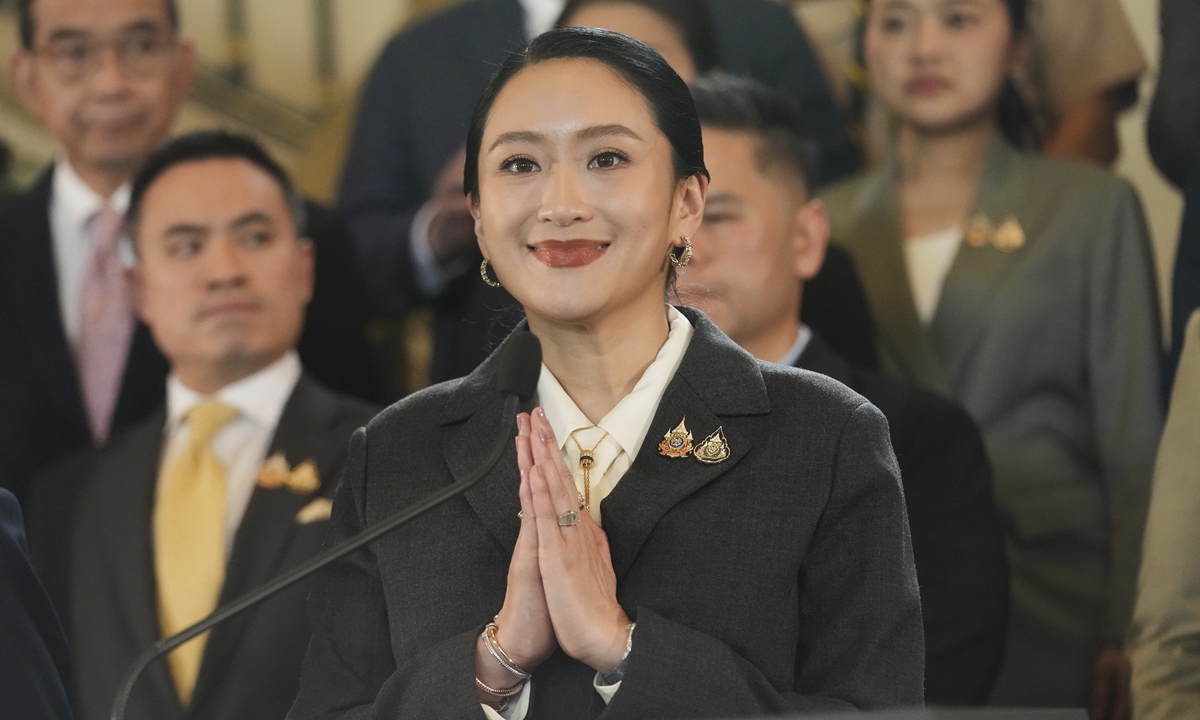
Thailand's Constitutional Court on Friday removed Prime Minister Paetongtarn Shinawatra from office after finding her phone conversation over the border issue with Cambodia violated the constitution, according to the Xinhua News Agency.
Paetongtarn's removal reflects Thailand's recurring cycle of political turmoil. The country now faces heightened uncertainty, with tensions among rival forces set to persist and instability likely to remain over the long term, said Chinese analysts.
The verdict makes her the second Thai premier to be ousted by the Constitutional Court since the 2023 General Election. Paetongtarn, a 39-year-old political novice and the kingdom's youngest ever leader, came office in August 2024 after her predecessor and Shinawatra family ally Srettha Thavisin was removed from the prime minister post by the Constitutional Court, for ethics violation, according to The Straits Times.
After just one year in office, Paetongtarn also becomes the third prime minister in the Shinawatra family to be removed from office without completing a full term, said the report.
On Friday, Paetongtarn, along with her ministers and aides, gathered in front of reporters at the Government House and said that "with due respect to the justice system, I acknowledge the court's verdict… But as a Thai person, I insist on my sincerity ... to work for the country," according to BBC.
Paetongtarn also noted that the verdict is "yet another abrupt political change" in Thailand, where she becomes the fifth leader since 2008 to be dismissed by this court, per BBC. It also noted that Thailand's deputy PM will replace Paetongtarn before a new vote is held for prime minister.
Paetongtarn had been provisionally suspended since July 1 as the nine-judge court considered its decision in the case that stemmed from the recent border clashes between Thailand and Cambodia and a controversial leaked phone conversation between Paetongtarn and Cambodia's former Prime Minister Samdech Techo Hun Sen on June 15, said the Straits Times.
In the call, Paetongtarn is heard pleading with the Cambodian Senate president and former prime minister to help resolve tensions between the two countries, while promising to do whatever he asked in return. Adopting a deferential tone, she addressed Hun Sen as "uncle", while also appearing to criticize the Thai army and referring to one of her military commanders as an "opponent," the Straits Times reported.
A Reuters report on Friday noted that the court's decision "paves the way for the election by parliament of a new prime minister, a process that could be drawn out, with Paetongtarn's ruling Pheu Thai party losing bargaining power and facing a challenge to shore up a fragile alliance with a razor-thin majority."
The focus will next shift to who will replace Paetongtarn, with Thaksin expected to be at the heart of a flurry of horse-trading between parties and other power-brokers to try to keep Pheu Thai in charge of the coalition, said the report.
Paetongtarn's removal by the Constitutional Court is not surprising, Luo Yongkun, professor from Institute of International Relations of Shanghai Academy of Social Sciences, told the Global Times on Friday, noting that this is not the first case in the country that the court ruled to remove the prime minister from office.
The political scene in Thailand now faces two possible directions, either the ruling party, opposition, and military forces negotiate a compromise to select a new prime minister and complete the transition, or talks collapse and parliament is dissolved for new elections, the expert said.
Luo added that it is unpredictable that how Thailand's political situation will unfold, but what is certain is that whether through a new cabinet or new elections, the outcome will not immediately ease tensions and new conflicts will continue to emerge, keeping Thai politics unstable for a long time.
Ge Hongliang, deputy director of the College of ASEAN Studies at Guangxi University for Nationalities, also told the Global Times on Friday that an early election cannot be ruled out, though its chances may appear slim. Echoing Luo's view, Ge also noted that the current move may deepen political uncertainty in the country.
RELATED ARTICLES