SOURCE / PRESS RELEASE
27th International Analytical Ultracentrifugation Workshop and Symposium held at Tsinghua University
The 27th International Analytical Ultracentrifugation Workshop and Symposium (AUC 2025) was held at Tsinghua University from August 24 to 30, 2025.
The conference, jointly organized by the Beijing Frontier Research Center for Biological Structure and Technology Center for Protein Science at Tsinghua University, marks the first time the symposium was held in China and represents a milestone for the technique's service to and support of scientific innovation in related domestic research fields.
Nearly 130 experts and scholars from around the world exchanged insights on the application of Analytical Ultracentrifugation (AUC) in life sciences, biomedicine, and materials science. Dr Li Wenqi, facility manager of Core Facility for Biomolecule Preparation and Characterization at Tsinghua University, chaired the organizing committee, and the opening ceremony was presided over by Wang Xinquan, Secretary of the CPC Committee of Tsinghua University's School of Life Sciences.
Tsinghua University Vice President Wang Hongwei said in his opening remarks that Tsinghua hosted China's first AUC Workshop and Symposium in 2017. Over the past eight years, continuous efforts have driven significant progress in this field in China and across Asia. Hosting the international AUC Workshop and Symposium in China for the first time highlights global recognition of Chinese research and showcases the country's strength. Tsinghua will continue to advance life‑science and biomedicine innovation.
The conference featured over 20 specialized workshops, 30 thematic presentations, and 8 oral reports. Workshops provided systematic training from fundamental principles to cutting-edge applications; participants learned hands‑on use of software such as Sedfit, Sedphat, and GUSSI, and discussed UltraScan's use in GMP environments.
Notably, Li Wenqi's team introduced China's first self-developed AUC analysis software, AUCAgent, which offers automated data analysis to significantly improve research efficiency.
The symposium on August 28-29 served as the conference's core event, showcasing and discussing methodological breakthroughs in AUC and its latest innovations in biopharmaceuticals, vaccine development, gene therapy, and materials science.
During the symposium, Tsinghua University Press officially published Analytical Ultracentrifugation Principles and Applications, the first AUC monograph originally written by Chinese scholars, which systematically summarizes the field's theory and practice and will significantly advance related teaching and research in China.
Experts such as Borries Demeler, Lake Paul, Li Shaowei, and Susumu Uchiyama presented reports on biomedicine, introducing new methods in UltraScan software for analyzing LNP, VATC analysis, and highlighting the critical role of AUC in vaccine development and quantifying rAAV empty shell rate. Trushar Patel and Zhou Rui presented on complex systems research, detailing the latest findings on the formation of DDX1 protein and NEAT1 RNA complexes, as well as AUC's contributions to Alzheimer's disease research.
In methodological innovation, several scholars showcased the latest advancements, including Ye Xiaodong and Johannes Walter's work on protein-polyelectrolyte mechanisms and PS@PDA particle characteristic analysis, and Wang Peng's team's design of a fluorescence detector for AUC based on confocal structures, which enhanced detection sensitivity through algorithm optimization.
As a major international event in AUC, the conference showcased cutting‑edge global results, built a platform for deep exchanges and industry‑academia collaboration, highlighted AUC's strategic value in life sciences, and injected new momentum for Chinese research to go global and benefit human health. Tsinghua also used the opportunity to demonstrate its influence and responsibility on the international academic stage.
The conference, jointly organized by the Beijing Frontier Research Center for Biological Structure and Technology Center for Protein Science at Tsinghua University, marks the first time the symposium was held in China and represents a milestone for the technique's service to and support of scientific innovation in related domestic research fields.
Nearly 130 experts and scholars from around the world exchanged insights on the application of Analytical Ultracentrifugation (AUC) in life sciences, biomedicine, and materials science. Dr Li Wenqi, facility manager of Core Facility for Biomolecule Preparation and Characterization at Tsinghua University, chaired the organizing committee, and the opening ceremony was presided over by Wang Xinquan, Secretary of the CPC Committee of Tsinghua University's School of Life Sciences.
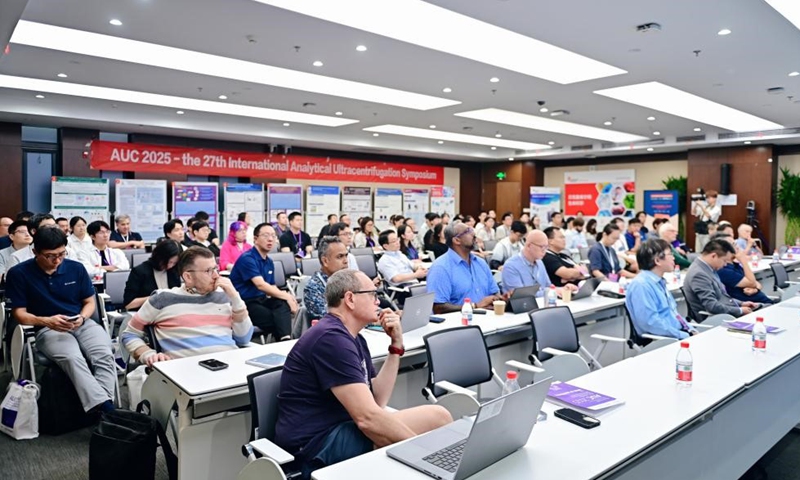
Experts and scholars attend the 27th International Analytical Ultracentrifugation Workshop and Symposium (AUC 2025) held at Tsinghua University from August 24 to 30, 2025. Photo: Courtesy of AUC 2025
Tsinghua University Vice President Wang Hongwei said in his opening remarks that Tsinghua hosted China's first AUC Workshop and Symposium in 2017. Over the past eight years, continuous efforts have driven significant progress in this field in China and across Asia. Hosting the international AUC Workshop and Symposium in China for the first time highlights global recognition of Chinese research and showcases the country's strength. Tsinghua will continue to advance life‑science and biomedicine innovation.
The conference featured over 20 specialized workshops, 30 thematic presentations, and 8 oral reports. Workshops provided systematic training from fundamental principles to cutting-edge applications; participants learned hands‑on use of software such as Sedfit, Sedphat, and GUSSI, and discussed UltraScan's use in GMP environments.
Notably, Li Wenqi's team introduced China's first self-developed AUC analysis software, AUCAgent, which offers automated data analysis to significantly improve research efficiency.
The symposium on August 28-29 served as the conference's core event, showcasing and discussing methodological breakthroughs in AUC and its latest innovations in biopharmaceuticals, vaccine development, gene therapy, and materials science.
During the symposium, Tsinghua University Press officially published Analytical Ultracentrifugation Principles and Applications, the first AUC monograph originally written by Chinese scholars, which systematically summarizes the field's theory and practice and will significantly advance related teaching and research in China.
Experts such as Borries Demeler, Lake Paul, Li Shaowei, and Susumu Uchiyama presented reports on biomedicine, introducing new methods in UltraScan software for analyzing LNP, VATC analysis, and highlighting the critical role of AUC in vaccine development and quantifying rAAV empty shell rate. Trushar Patel and Zhou Rui presented on complex systems research, detailing the latest findings on the formation of DDX1 protein and NEAT1 RNA complexes, as well as AUC's contributions to Alzheimer's disease research.
In methodological innovation, several scholars showcased the latest advancements, including Ye Xiaodong and Johannes Walter's work on protein-polyelectrolyte mechanisms and PS@PDA particle characteristic analysis, and Wang Peng's team's design of a fluorescence detector for AUC based on confocal structures, which enhanced detection sensitivity through algorithm optimization.
As a major international event in AUC, the conference showcased cutting‑edge global results, built a platform for deep exchanges and industry‑academia collaboration, highlighted AUC's strategic value in life sciences, and injected new momentum for Chinese research to go global and benefit human health. Tsinghua also used the opportunity to demonstrate its influence and responsibility on the international academic stage.
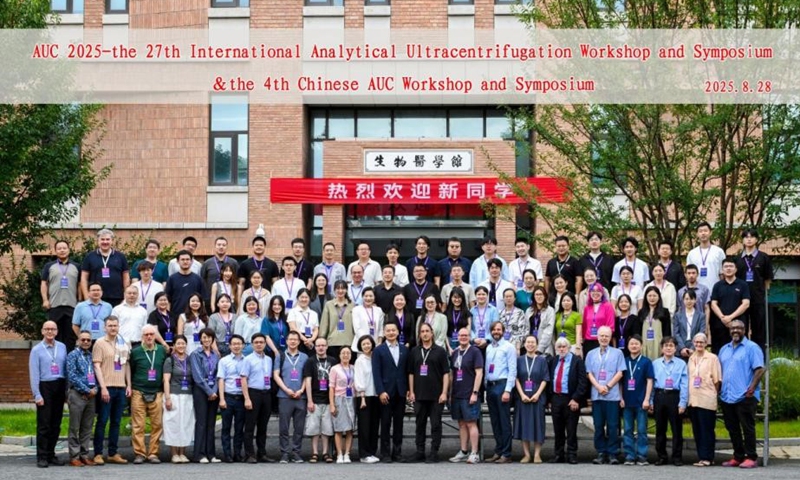
Attendees of the 27th International Analytical Ultracentrifugation Workshop and Symposium (AUC 2025) pose for a group photo in Beijing on August 28, 2025. Photo: Courtesy of AUC 2025
