ARTS / CULTURE & LEISURE
Chief designer of 2026 Olympic torch highlights sustainable legacy from Beijing 2022
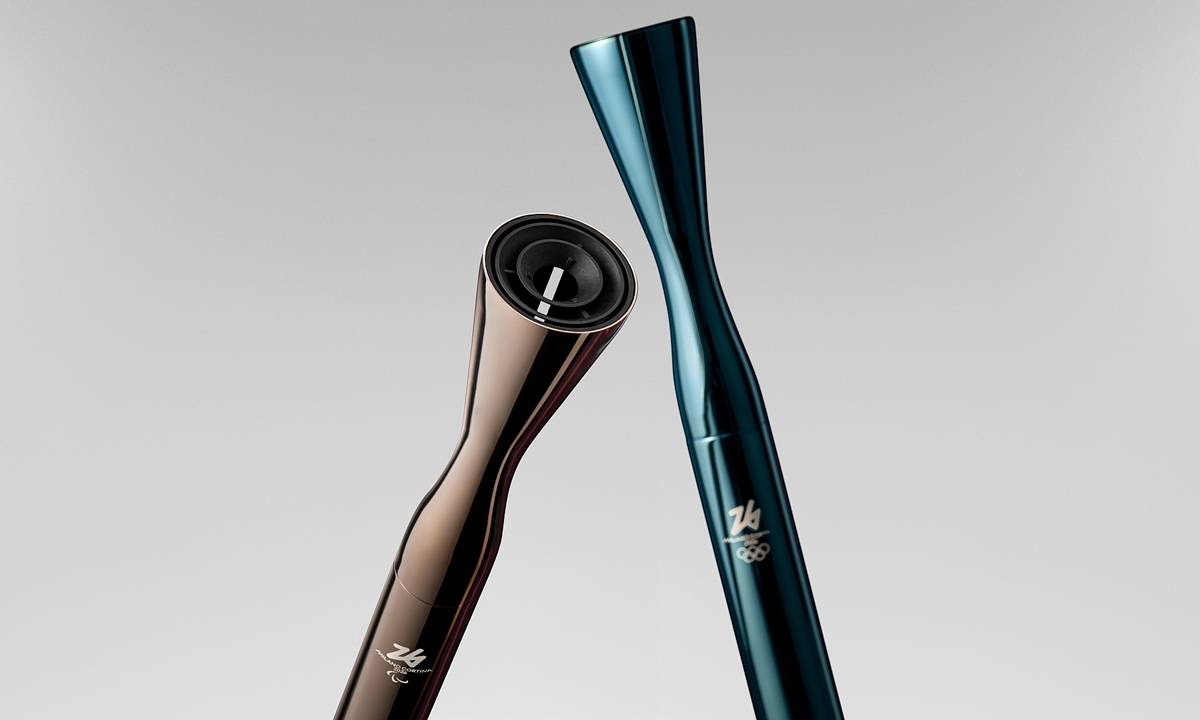
The Olympic torches for the Milano-Cortina 2026 Winter Olympics Photo: VCG
As the 2026 Milano Cortina Winter Olympics draw closer, the anticipation for the Games is quietly building as winter sports athletes enter their final preparatory phase toward the quadrennial marquee event.
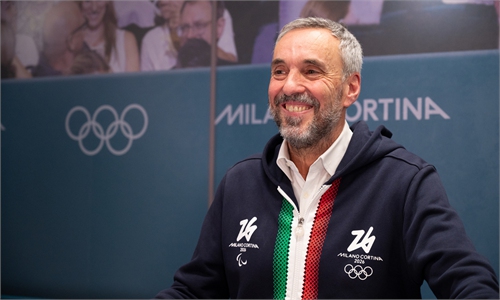
Beyond the competitions, however, another symbol of the Games, the Olympic torch, has already captured global attention with its minimalist design. Carlo Ratti, chief designer of the torch "Essential" who visited Beijing recently, told the Global Times that sustainability is at the heart of the torch.
At the Beijing 2022 Winter Games, the Olympic torch attracted global attention for its pioneering use of hydrogen fuel, ensuring a zero-emission flame. For Milano Cortina, Ratti and his team took a different route by employing biofuel and recyclable materials such as aluminum and brass.
"Evolution and sustainable is not only about relying on one solution, but trying many approaches," Ratti told the Global Times. "After Beijing, we thought it was interesting to choose another route, equally sustainable - in this case biofuel."
What mattered most, he stressed, was not just the source of fuel but the broader philosophy of design: Using less.
"The key thing about sustainability today is if you can consume less," Ratti told the Global Times. "This torch is the minimum shape you can put around the burner. It's not about creating a folly around the flame, but keeping only the essential. The flame should be the protagonist."
The "less is more" ethic is expressed not only in the fuel and materials, but also in the form of the torch itself. The sleek, minimal silhouette aims to reduce environmental impact while highlighting the flame as the true centerpiece of the Olympic ritual.
A vertical slit runs along the body of the torch, allowing viewers to observe the burner in action, where fire is quite literally born. This openness invites people to look through the object, not just at it, Ratti said.
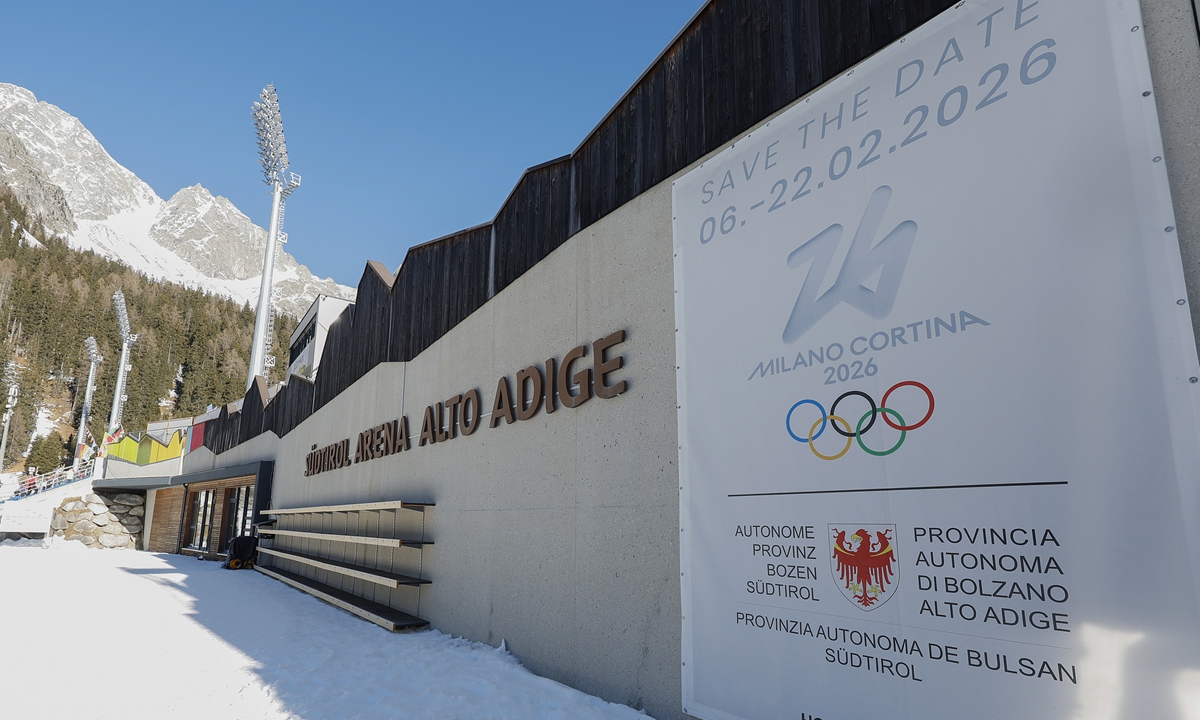
A view of the Biathlon Arena where the biathlon will take place during the Milan-Cortina 2026 Winter Olympics, in northern Italy, on January 25, 2025 Photo: VCG
Mountains as inspirationColor plays an equally important role. The color of the Olympic torch celebrates the bond between humans and nature with a sky-colored blue-green shade, "inspired by Italy's ever-changing landscapes," while the Paralympic torch glows with Mountains of Light, honouring the inner strength of Paralympic athletes and the power of their courage to reshape the world.
Ratti, who grew up spending time in the Italian Alps, said that the mountains became a source of inspiration for the torch's color palette and surface treatment.
"These two torches have different colors, going more into blue or more into green," he told the Global Times. "They are really the colors of the mountains. Through the seasons, the Alps change: Greener in the summer, bluer in the winter. The torch reflects those natural hues, bringing the mountains into the world."
The surface coating uses advanced physical vapor deposition (PVD) technology. This allows the metal molecules to be arranged layer by layer, producing a reflective finish that not only captures Alpine colors, but also mirrors its surrounding environment.
The decision to embrace minimalism, Ratti emphasized, was more than an aesthetic preference.
"The ultimate decision was more about ethics than aesthetics," he said. "The Essential torch reflects values of sustainability and of making the flame the protagonist. The best way to be sustainable is by using less. That's why we called it Essential."
He also cited the Italian architect Carlo Mollino, who once said that to be authentically global, one must first be authentically local. "That's what the torch tries to do by starting from the Alps next to Milan and Cortina," Ratti said.
Relay as storytelling
The torch relay is often considered one of the most visible expressions of Olympic symbolism, combining ceremonial tradition with technological innovation.
The flame lighting ceremony will be held in Olympia, Greece, in November 2025 before the flame travels to Italy for a 63-day relay across 110 provinces, involving over 10,000 torchbearers before reaching the opening ceremony at Milan's San Siro stadium on February 6, 2026, according to the official website of the Milano Cortina Games.
The Beijing 2022 Winter Olympics introduced memorable moments such as an underwater robot relay segment, blending ritual with cutting-edge technologies.
Ratti views this as a natural extension of national identity.
"The relay is about conveying the country, its landscapes and its values," he said. "I thought it was very interesting that Beijing used robotics and technology in its relay, because those are areas where China is leading. Each country tells its own story through the relay."
For Milano Cortina, the relay will feature a diverse group of torchbearers, among them are Chinese basketball hall of famer Gong Xiaobing, boxing heavyweight fighter Zhang Zhilei, and skiing athlete Gu Ailing, according to media reports.
The Milan-Cortina 2026 Olympics is the third Winter Olympics to be held in Italy, following Cortina d'Ampezzo in 1956 and Turin in 2006.
Shared values
Beyond design and ceremony, Ratti highlighted the shared values between China and Italy in their commitment to sustainability.
"Today, China is one of the global leaders in the environmental revolution, decarbonizing the world, producing solar panels, wind energy, and more," he noted. "I hope these are shared values that the torch can embody."
For Ratti, this means the torch is not a final answer but an experiment in imagining a more sustainable future.
"There's never just one design," he said. "It's about experimenting together to design the future."
This spirit, he added, reflects a broader Italian tradition.
"For me, the highest tradition of Italian design is about innovation," he said. "It goes back to the Renaissance, and in the 20th century, Italian design has always embraced innovation. I hope that this can leave a legacy in this tradition of Italian design."

Carlo Ratti, chief designer of the torch "Essential" Photo: Lu Wenao/GT
RELATED ARTICLES