Putin, Modi meet on sidelines of SCO summit; one-on-one discussion inside car lasts about an hour
Indian leader describes meeting as excellent, vows to deepen cooperation
By Published: Sep 01, 2025 09:24 PM

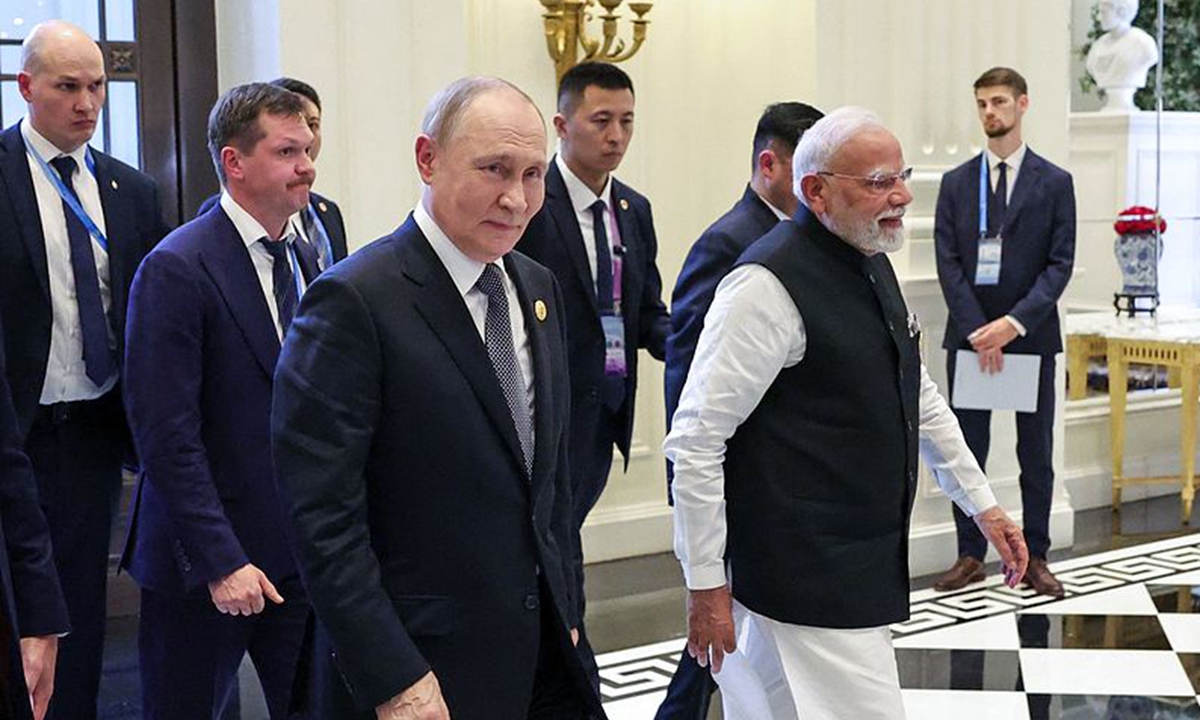
Russia's President Vladimir Putin and Indian Prime Minister Narendra Modi hold a meeting on the sidelines of the Shanghai Cooperation Organisation (SCO) Summit in Tianjin on September 1, 2025. Photo: VCG
Russian President Vladimir Putin and Indian Prime Minister Narendra Modi held talks on the sidelines of the Shanghai Cooperation Organization (SCO) Summit on Monday in Tianjin, which the Indian leader described as "excellent" in his X account on Monday.
The two leaders "discussed ways to deepen bilateral cooperation in all sectors, including trade, fertilizers, space, security and culture," according to Modi's X post. "We exchanged views on regional and global developments, including the peaceful resolution of the conflict in Ukraine," Modi said in the post, noting that a special and privileged strategic partnership between India and Russia remains a vital pillar of regional and global stability.
"Even in the most difficult situations, India and Russia have always walked shoulder to shoulder," Modi said, Reuters reported. "Our close cooperation is important not only for the people of both countries but also for global peace, stability and prosperity," the Indian leader said, per Reuters.
At the bilateral meeting, Putin addressed Modi in Russian as "Dear Mr Prime Minister, dear friend," according to Reuters.
Some US media outlets also closely followed the meeting between Modi and Putin. According to Bloomberg, Modi declared that India and Russia share a "special" relationship, standing by each other in difficult times, in a defiant show of ties as Washington criticizes New Delhi over oil purchases.
Modi and Putin meeting comes at a time when their relationship is under global scrutiny, as US President Donald Trump has publicly lambasted India for buying oil from Russia, Bloomberg said.
Last week, the Trump administration imposed 50 percent tariffs on Indian goods bound for the US — the highest in Asia — to penalize it for those energy purchases, according to the US media report.
Some Russian media said that during their talks on the sidelines of the SCO summit, the two leaders stressed that the strategic partnership between their nations is expanding across various sectors.
Before the delegation-level talks, Putin and Modi reportedly spent about an hour in a one-on-one conversation in the Russian leader's Aurus vehicle, RT said.
"They communicated both in the car while driving and then continued their discussion inside the car," Kremlin spokesperson Dmitry Peskov told TASS.
India looked forward to welcoming Putin in December for an annual summit, according to some Indian media reports.
"At this time, 1.4 billion Indians are waiting with eagerness to welcome you for our 23rd [annual] summit in December," Modi said, speaking in Hindi, during the meeting, according to Hindustan Times.
The Modi government firmly opposes the US administration's tariff war while continuing friendly ties with Russia. This shows that India highly values Russia, Tian Guangqiang, an assistant research fellow with the National Institute of International Strategy at the Chinese Academy of Social Sciences, told the Global Times on Monday.
It demonstrates that Russia serves as a strategic asset for India—allowing New Delhi to negotiate with the US, engage with Central Asia, and maintain a dynamic balance among China, Russia, and India, Tian said.
Modi's meeting with Putin underscored New Delhi's stance that India prized its old and reliable strategic partners and has sufficient strategic autonomy in its foreign policy to maintain and strengthen its multi-dimensional partnership, Sreeram Sundar Chaulia, an international affairs expert at New Delhi's Jindal School of International Affairs, told the AP News.
At the same time, the Indian government hopes the present rough weather between India and the US is a temporary aberration, Chaulia added.
On the Ukraine crisis, Putin also appreciated the efforts and proposals from China and India aimed at facilitating its resolution, according to Reuters.
"It is expected that following the Tianjin meeting, Russia and India will continue exchanges at various levels. Meanwhile, US pressure on India also serves as an important driving force encouraging closer dialogue between Russia and India," Zhang Hong, a research fellow at the Institute of Russian, Eastern European and Central Asian Studies under the Chinese Academy of Social Sciences, told the Global Times on Monday.
RELATED ARTICLES