ARTS / ART
300 manuscripts on display in Beijing reveal China’s wartime resilience
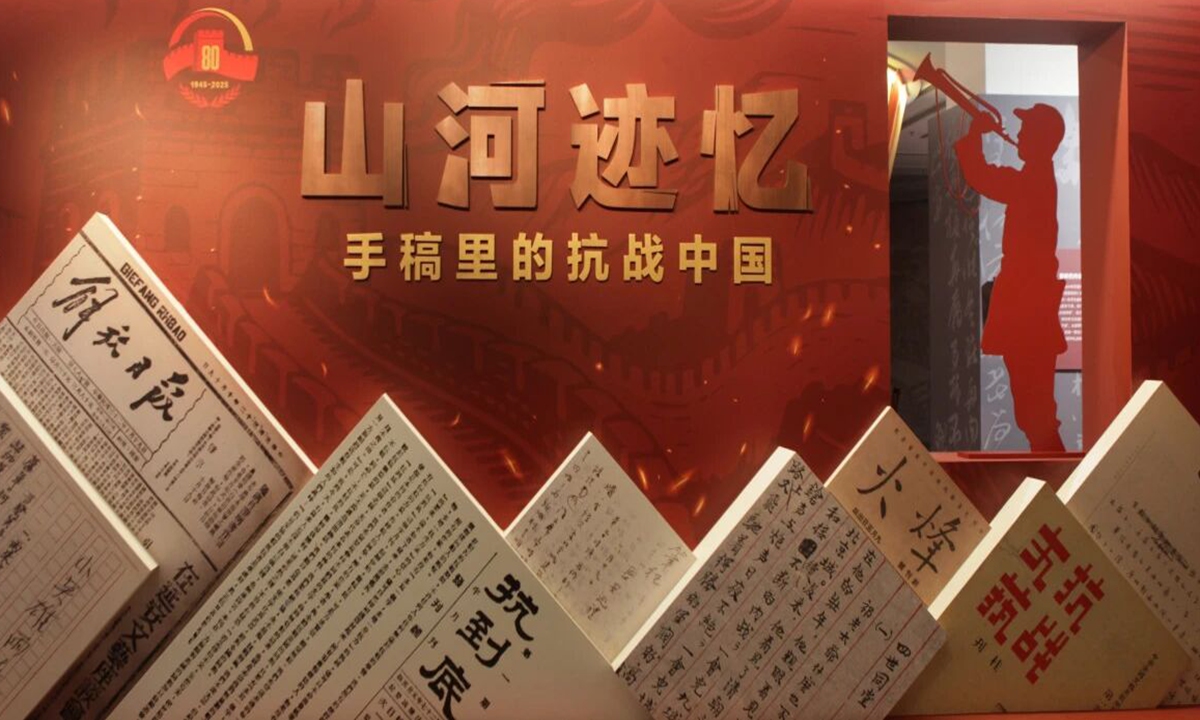
A poster of the exhibition themed "Chinese People's War of Resistance Against Japanese Aggression in manuscripts" at the National Museum of Modern Chinese Literature in Beijing. Photo: Courtesy of the National Museum of Modern Chinese Literature
Featuring rare manuscripts such as Lao She's Four Generations Under One Roof, an exhibition themed "Chinese People's War of Resistance Against Japanese Aggression in manuscripts" has recently debuted at the National Museum of Modern Chinese Literature in Beijing.The exhibition offers nearly 300 pieces of historical documents, mainly manuscripts, that bear witness to how "Chinese patriotic writers across the nation took up their pens to depict the nation's wartime resilience," Zhang Hongsen, the chairman of the China Writers Association, told the Global Times.
The exhibition is dedicated to the 80th anniversary of the victory in the Chinese People's War of Resistance Against Japanese Aggression and the World Anti-Fascist War.
"Wartime literature and art possess a power that transcends time and space. This exhibition aims to engage the audience in a profound dialogue through a literary lens. We also hope that contemporary readers and viewers will get a glimpse of the true history hidden behind the fading ink of these manuscripts," Zhang noted.
Nearly 300 paper relics are on display in the exhibition's five sections, which include the "National Awakening," the "Fighting for Human Justice" and the "The Right Path for Humanity" sections.
The section "National Awakening" offers visitors historical documents relating to the Battle of Songhu and the December 9th Movement, for which Beijing university students protested in 1935 to urge the government to resist Japanese invaders in 1935. This part aims to "reveal modern China's journey from its pain to awakening," Wang Shi, one of the exhibition's curators, told the Global Times.
Featuring manuscripts of literature classics such as Xu Guangyao's "Xiao Bing Zhang Ga" (lit: Little Soldier Zhang Ga) and Guan Hua's "Xiao Yingxiong Yulai" (lit: Little Hero Yulai), the final section, "The Right Path for Humanity" calls the visitors' attention toward ordinary people's contribution to peace during wartime.
Such a curatorial logic is aimed at leading the public to "not just review history, but also reflect on the importance of peace," Wang noted.
Other highlighted exhibits also include the manuscripts of Lao She's most renowned Four Generations Under One Roof, Xiao Hong's novel of The Field of Life and Death.
In order to better engage with the public, and especially with children and young visitors, the history-themed exhibition provides interactive displays. One of these, called "My Statement of Peace" consists of a photography display that allows visitors to write their own reflections on China's wartime history.
"Being able to leave a message on the screen has made me realize that wartime history does not only belong to the heroes of the past. Even today, it continues to move and inspire students like me, enduring as a form of our national spirit," Huang Fengni, a 24-year-old visitor who has traveled to Beijing from Shantou, Guangdong Province, told the Global Times.
The exhibition is co-organized by the China Writers Association and the National Museum of Modern Chinese Literature. It will be open until August 31, 2026.
RELATED ARTICLES