History must not be forgotten: Chinese delegation of WWII victims' families demands Tokyo's apology
New testimonies and records about Unit 731 crimes unveiled
By and Published: Sep 02, 2025 07:08 PM Updated: Sep 03, 2025 12:40 AM


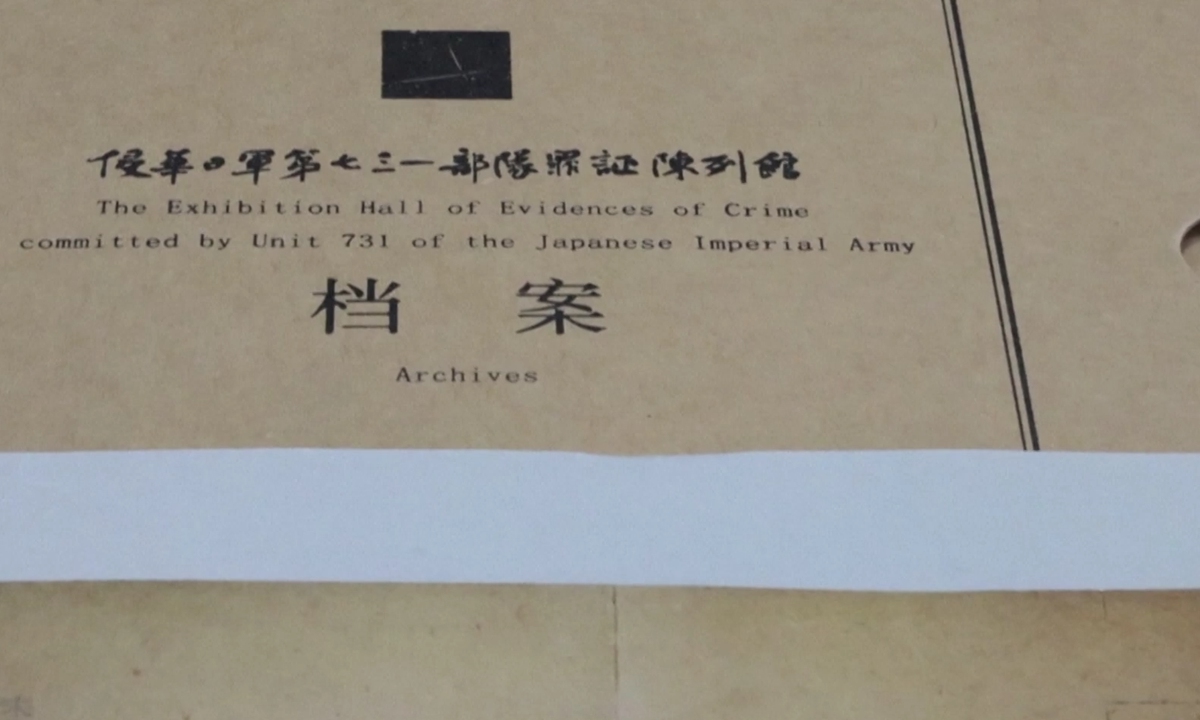
The archives of evidences of crime committed by Japanese Unit 731 Photo: VCG
80 years ago on September 2, the second world war ended when Japan officially surrendered. Yet 80 years later, when China marks the 80th anniversary of the victory in the Chinese People's War of Resistance Against Japanese Aggression and the World Anti-Fascist War, some Japanese politicians have long attempted to distort history and deny war responsibilities. Meanwhile, fresh Japanese testimonies and evidence found in China continue to expose the atrocities of past aggression that Japan has sought to conceal.
A Chinese association of descendants of Chinese civilian victims of the war, sent a delegation to Japan and submitted a petition to Japan's Ministry of Foreign Affairs, demanding that the Japanese government issue a formal apology to the Chinese people and to the civilian victims of its war of aggression, CCTV News reported on Monday evening.
"Our main demand is for Japan to apologize. We ask the Japanese government to sincerely reflect on its responsibility and apologize to the victims," Guan Jianqiang of the Society for Safeguarding the Historical Facts of China's War of Resistance against Japanese Aggression was quoted as saying in the report.
Ma Yan, descendant of a bacteriological warfare victim, said the Japanese government must shoulder its responsibility as the aggressor state, CCTV News reported.
Mizuho Fukushima, leader of Japan's Social Democratic Party and member of the House of Councilors, together with Masataka Mori, a Japanese expert on the issue of germ warfare, and other figures, attended the event, according to the media report.
In response to attempts by some Japanese politicians to conceal or downplay the history of Japan's aggression, they emphasized that the Japanese government should face up to its history of invasion, learn from it, and avoid repeating past mistakes, the media report said.
Recently, the Exhibition Hall of Evidences of Crime Committed by Unit 731 of the Japanese Imperial Army in Harbin, Northeast China's Heilongjiang Province, unveiled new evidence and records, detailing the crimes of Japanese bacterial warfare. Particularly noteworthy are the oral testimonies of former members of the Unit 731 youth corps, Kyuta Sunaga and Hisao Naganuma, CCTV News reported in another article on Tuesday.
Jin Shicheng, deputy secretary-general of the Harbin research association on the history of Japanese bacterial and chemical warfare, explained that from 1937 to 1945, there were a total of six cohorts of the youth corps, comprising over 230 members.
In April 1943, Sunaga was recruited into the Unit 731 youth corps and participated in the production of ceramic bacterial bombs. "The ceramic bacterial bombs were about 1.8 to 2 meters tall and contained vectors such as plague fleas," Sunaga said.
Naganuma also joined the Unit 731 youth corps in April 1943. He witnessed detainees referred to as "Maruta" and was taken to visit the dissection room. "It seemed like they were cutting open a skull at the time. After seeing it, I left," Naganuma said.
After arriving in Harbin, members of the Unit 731 youth corps first underwent several months of intensive training. This training was not only about learning bacteriology but also a harsh mental conditioning aimed at making them accept the dehumanizing concept of treating live humans as experimental materials, CCTV News reported.
The Global Times reporters also conducted an exclusive interview in Nagano, Japan recently with another member of Unit 731 youth corps - Hideo Shimizu. In March 1945, Shimizu, not yet 15 years old then, was sent to Harbin. Seventy-nine years later, the 94-year-old Shimizu returned to Harbin to repent and apologize in 2024.
Yet, his public testimony about historical truths has subjected him to immense pressure. Shimizu told the Global Times that numerous Japanese right-wingers have attacked him, calling him a "liar." His once-close daughters have severed ties with him. Shimizu said that many Japanese politicians would prefer him stay silent. But "I don't regret apologizing! Because I've always believed it was something I had to do!"
The Japanese war of aggression left thousands of Japanese children orphaned and displaced in China. Adopted by compassionate Chinese civilians, they rediscovered life through love and peace.
Takayoshi Utsunomiya was one of many Japanese children left behind in China after 1945. Utsunomiya received an exclusive interview with the Global Times recently in Tokyo when his fluent northeastern Chinese dialect fills the room with memories of a childhood in China's Heilongjiang Province.
Utsunomiya recalled that his adoptive Chinese parents cared for him with utmost devotion, as if he were the apple of their eye. Despite the family's financial struggles, they did their best to support his education, for which he remained profoundly grateful. Utsunomiya believes that the bond they shared was stronger than any blood relation.
His adoptive parents passed away in his young age. Utsunomiya returned to Japan in 1981. However, after his return, he faced challenges such as language barriers and differences in lifestyle, even considering going back to China.
During his time in Japan, Utsunomiya actively participated in China-Japan friendship exchange activities.
When asked about his psychological identity and sense of belonging, he said: "I am Japanese by origin, but more importantly, I am Chinese. My heart has always been with China."
"If Japanese militarism had not launched the war of aggression, my family would not have been torn apart and my homeland destroyed," Utsunomiya told the Global Times.
RELATED ARTICLES