ARTS / CULTURE & LEISURE
Beijing pigeon fanciers share pride, honor for preparing 80,000 doves for V-Day release
Soaring for peace
By Jiang Li, and Li Yuche Published: Sep 04, 2025 08:12 PM

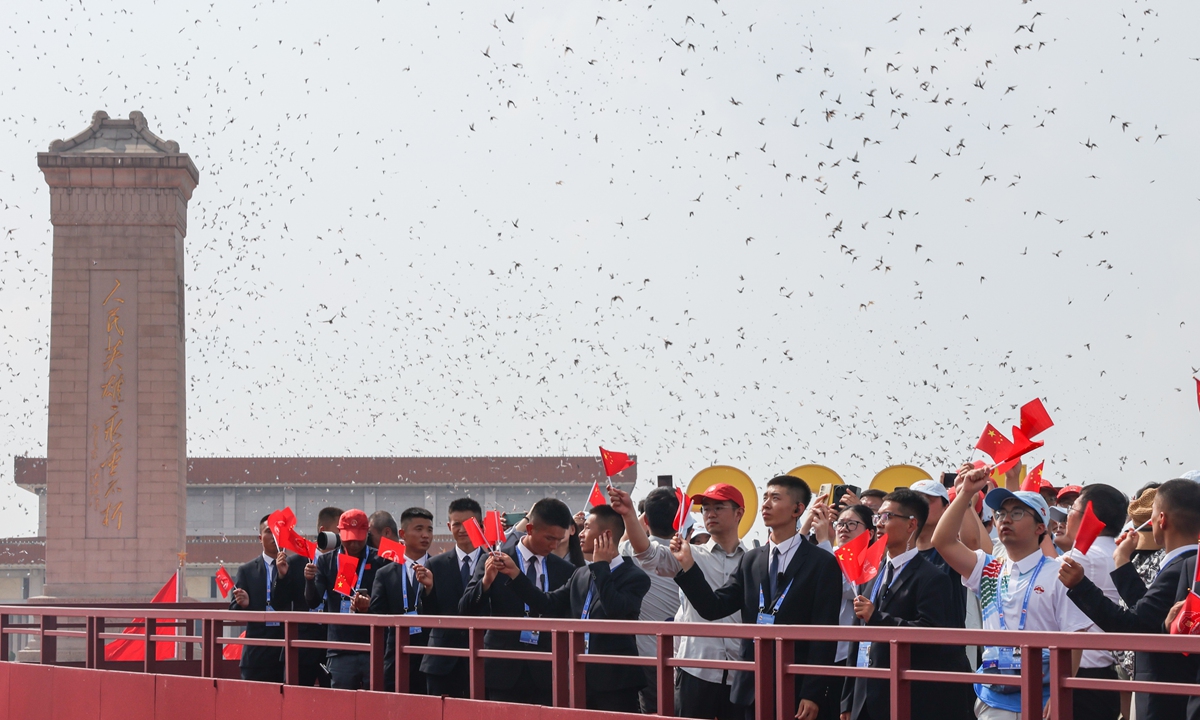
People wave China's national flags as doves fly over Tian'anmen as part of the V-Day commemorations in Beijing on September 3, 2025. Photo: VCG
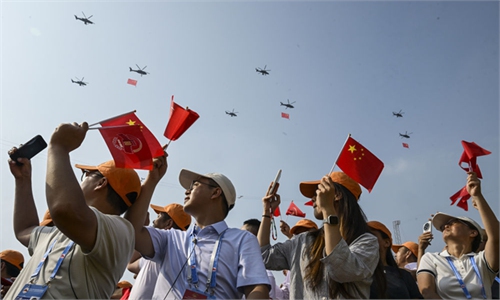
As many in China and beyond continue to recollect their favorite moments of the spectacular military parade marking the 80th anniversary of victory in the Chinese People's War of Resistance Against Japanese Aggression and the World Anti-Fascist War on Wednesday, a group of Beijing residents in particular take pride in their important role in the grand gathering that garnered global attention.
Following the military parade showcasing Chinese troops' flawlessly synchronized marching and advanced military equipment, the V-Day commemorations concluded with 80,000 doves and 80,000 balloons released into the sky over Tian'anmen Square in central Beijing. All 80,000 doves released at the event came from pigeon fanciers in Beijing. After the event, some pigeon owners posted photos of their doves coming home on social media.
In interviews with the Global Times on Thursday, several pigeon fanciers in the capital city recollected the meticulous work to ensure the success of the release and shared their feelings of pride and honor for having made their contribution to such an important day.
Hou Pengcheng, deputy secretary-general of the Beijing Municipal Bureau of Sports, told the Global Times that preparations for the dove release began half a year ago. "We worked with the Beijing Racing Pigeon Association to call on fanciers across the city to raise high-quality doves, ensuring a sufficient and reliable source," he said.
Hou revealed that while most donors came from 10 core districts, including Dongcheng, Xicheng, Chaoyang, and Haidian, fanciers from other districts also joined in nearby.
"Their enthusiasm was overwhelming. Originally scheduled to collect doves until 6 pm on September 2, many districts had filled up all cages by 4 pm, leaving some fanciers waiting in line unable to donate."
Flight of honor
To match such passion, organizers placed equal care on ensuring the quality of the flock. Each dove was carefully checked for health, strength, and vitality.
"The selected doves had to be healthy, strong, and disease-free, and mostly 2 to 3 years old as this age group has the best physical fitness to adapt to large-scale events," Sun Peng, secretary-general of the Beijing Racing Pigeon Association, told the Global Times.
He compared the doves to athletes, noting that fanciers trained them daily to maintain their stamina. "Doves with poor flying ability, weak health, or illnesses were strictly excluded to prevent cross-infection during centralized keeping."
Sun emphasized that the doves used in the celebration were mostly "retired racing doves," known as "color doves" in the industry.
He also highlighted Beijing's long-standing pigeon-raising tradition, with many families passing down the hobby through the generations. To carry this tradition forward and bring it onto a larger stage, local pigeon associations took on an important role.
As early as April, Hu Yilei, president of the Pigeon Association of Beijing's Xicheng district, was already busy preparing to send 7,500 doves to participate in China's V-Day commemorations. Selecting so many doves was "like examining every single bean on a sieve" - a task requiring meticulous care and patience.
These doves underwent comprehensive health checks three months before the event, including examinations of their oral cavities and droppings to ensure they were in good health. Hu told the Global Times that judging whether a dove meets the standards is something a bird amateur would never be able to discern.
"First, the doves couldn't be too plump, nor could they have drooping wings. Each bird's feathers also needed to be glossy," Hu explained, adding that these doves are not just animals but also carry cultural symbolism representing "peace and vitality."
The 7,500 doves were gathered by the association from countless bird enthusiasts. Hu recalled that he once encountered a fan who donated his top-grade racing pigeon worth thousands of yuan, even though he still had many more that worth much less money.
The dove enthusiast also shared an interesting detail with the Global Times, noting that thanks to the particular kind of bird's unique homing instinct, many owners saw their beloved doves "return home gloriously" within an hour after the parade's conclusion. This detail, though small, carries profound meaning as interpreted by Hu. He remarked that the homing instinct of the doves is much like "every ordinary Chinese national's attachment to their motherland" - always moving homeward.
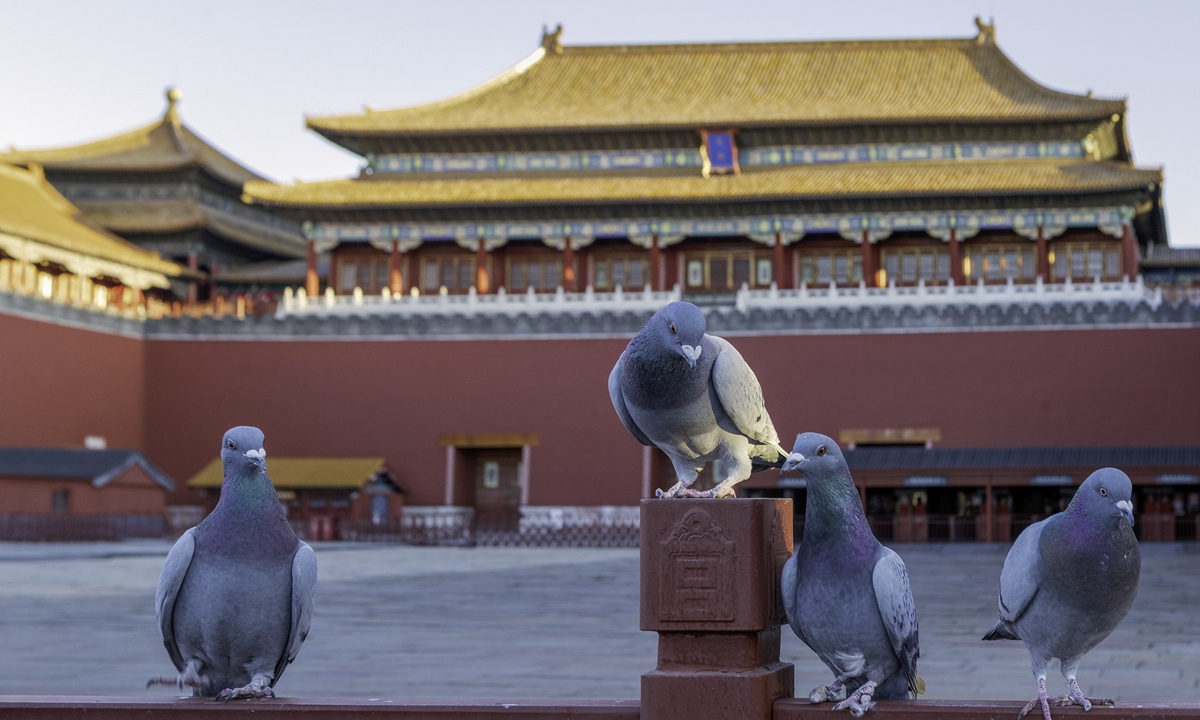
Doves rest in front of the Meridian Gate of the Palace Museum in Beijing.
Wings of belongingBuilding on the dedication of individual pigeon keepers in Shunyi district, pigeon keeping is not just a pastime but an organized system that blends tradition with precision.
"Every bird chosen for the event carries an 'ID card.' Each registered pigeon wears a leg band that records the owner's name, the bird's age, and its birthplace," president of the Pigeon Association of Beijing's Xicheng district, Huang Zigang, who has been keeping doves for over 30 years, told the Global Times.
"Only association members with valid membership cards could submit doves, ensuring that every participant was traceable and every dove reliable," Huang said. "It's like checking passports at the border, but for doves."
According to Huang, maintaining the doves' health and activity is a daily practice. Birds are carefully selected for vitality, usually under three years old, and during collection, they are protected from heat with long canopies, kept cool with industrial fans, and continuously monitored.
Such measures are built on years of experience managing both routine care and large-scale releases, ensuring that each bird can thrive under stressful conditions.
"Training the doves to return home presents another set of challenges," Huang noted. "Urban environments can disrupt their navigation, with electromagnetic interference, loud noises, and high-rise buildings complicating their routes."
To address this, the associations organize targeted trial releases, allowing birds to familiarize themselves with different areas. Keepers also conduct simulated disturbances during routine feeding and training to enhance the birds' resilience.
"I believe that pigeon keeping goes beyond hobby or spectacle," Huang said. "Their instinct to return home mirrors humans' sense of belonging, while their flight represents resilience and hope."
RELATED ARTICLES