ARTS / CULTURE & LEISURE
Second, third-tier cities’ low-cost international flights fuel tourism boom
Budget fares, long journeys
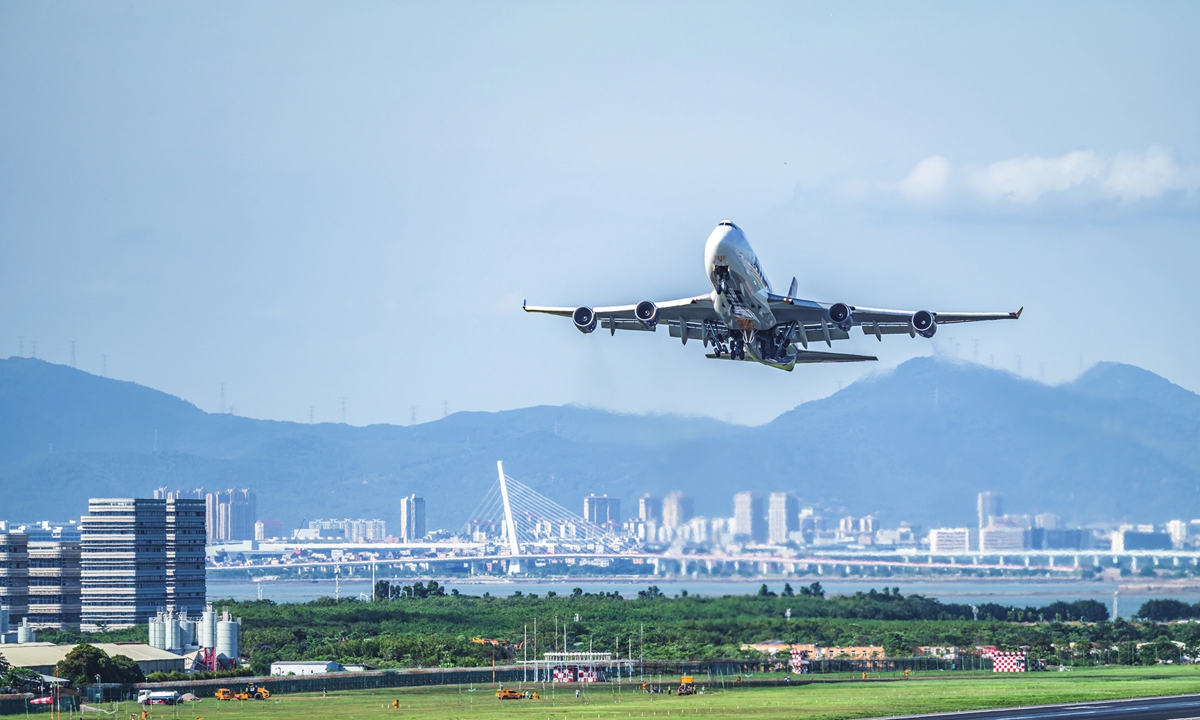
A large aircraft takes off at Xiamen Gaoqi Airport in East China's Fujian Province Photos: VCG
This summer, Datong City in North China's Shanxi Province has once again captured widespread attention. However, different from the viral buzz surrounding the video game Black Myth: Wukong, the latest spotlight comes from an unlikely source - budget-friendly international flights.With Datong Yungang International Airport adding direct connections to Moscow, Bangkok and Seoul, the city has rapidly expanded its international aviation network. Compared with hubs like Beijing or Shanghai, Datong's flights are mostly operated by smaller carriers, offering travelers affordable options with surprisingly high value.
On Chinese social media, young travelers have begun posting their "Datong outbound hacks," marveling at ultra-cheap fares. Liu Mengling, a freelancer, told Global Times that the bargain fares opened new routes and inspired him to travel solo more often.
Convenient access
For many travelers, including Liu, the combination of cheap fares and convenient access has made Datong a "sweet spot" for international departures, offering extraordinary price advantage over first-tier cities.
Take Seoul as an example. In September, online travel agencies listed Beijing-Seoul flights at 800 to 1,000 yuan ($112 to $140), while a Datong-Seoul ticket could be purchased for as cheap as 400 yuan. The difference creates a clear price gap that is drawing attention nationwide.
Datong is not alone. Many second- and third-tier Chinese cities are extending their reach overseas. Yuncheng in Shanxi Province offers convenient flights to Nagoya, Japan; Linyi in East China's Shandong offers routes to Osaka, Mandalay and Bangkok; while Jinan in Shandong Province operates flights to Seoul. Across the board, fares are markedly cheaper than those from first-tier cities.
For Beijing resident Zhou Huanzhi, who studied in Linyi, the difference is stark. "In the past, when I took my family abroad, I usually booked flights from Beijing Capital International Airport or flew via Hong Kong to save money. Even then, the prices were steep, sometimes over 2,000 yuan per ticket," Zhou told Global Times. "But recently I found a Linyi-Osaka round trip for just over 500 yuan on September 1. It was a shock."
Industry experts say the phenomenon is no accident. "Government policy support and financial subsidies are a major driver," said Zhang Yi, CEO of iiMedia Research Institute. "To develop local culture and tourism, cities such as Datong and Linyi introduce cost-effective international routes and provide subsidies to airlines, which help lower operating costs and make fares more competitive."
How these flights are marketed also plays a significant role in the determination of ticket prices. Liu Yong, marketing director at Jinan Yaoqiang International Airport, explained that many low-cost seats are sold through a charter system, travel agencies purchase blocks of seats for tour groups. When demand falls short, the leftover tickets are sold online at steep discounts.
At Datong, the airport's market department confirmed that cheap fares are the result of coordination among airlines, travel agencies and the airport itself. "The idea is to lower prices and maximize seat use. Each flight only releases a limited number of special fares. It's impossible to sell the entire plane that cheaply, otherwise the route would not survive," a staff member from the airport said.
Geography also gives Datong and other similar cities an edge. Located just a two-hour high-speed rail ride from Beijing, the airport can draw passengers from across the Beijing-Tianjin-Hebei region.
Combined with the recovery of international air capacity and the strong tourism base, this creates a sustainable operating model.
The results are clear. Global Time confirmed that during summer vacation, several of Datong's international routes have reached full capacity, with average load factors near 90 percent. In Jinan, international flights averaged 75 to 85 percent.

Passengers check in at Yuncheng Yanhu International Airport in Shanxi Province for a direct flight to Bangkok. Photo: VCG
Inbound tourism dividend
The rise of low-cost outbound travel is also closely tied to China's booming inbound tourism market. Earlier this year, the National Immigration Administration extended the visa-free transit policy from 72 or 144 hours to 240 hours, adding Datong as an eligible city. The move slashed both time and paperwork for foreign visitors.
Policy incentives, the restoration of international air capacity, and the global appeal of Chinese culture have combined to revive inbound tourism. In the first half of 2025, China recorded 170 million cross-border trips, including 38.05 million foreign entries, up 30.2 percent year-on-year.
For students, this has created new opportunities on the outbound side as well. University students and budget-conscious travelers, who value flexibility over convenience, are especially drawn to Datong. "Spending the least money to travel the furthest" has become a motto for many.
Industry insiders point out that red-eye flights and discounted seats not only fill gaps on popular routes but also offer tangible convenience. "Inbound passengers create the need for return flights. When many foreign tourists arrive in cities like Datong, airlines offset the costs of their outbound trips by selling the return seats cheaply. This cycle strengthens the price advantage for outbound travelers," Zhang explained.
The ripple effects extend beyond aviation. Airports are upgrading to meet growing demand. Liu noted that new facilities, such as SIM card and bank card service counters at international arrivals, are part of a broader push to enhance visitor experience. These upgrades improve Jinan's competitiveness and, in turn, expand the market for international routes.
"Places such as Datong and Jinan mainly serve as transit hubs," Zhang said. "But as passenger flows grow, their cultural and tourism appeal will also increase, drawing more inbound and outbound visitors alike."
For cities like Datong, once known primarily for ancient grottoes, the low-cost flight phenomenon has opened a new chapter. What began as an experiment in aviation subsidies has now become a symbol of how regional airports can integrate air travel with tourism, benefiting global travelers.
RELATED ARTICLES