ARTS / CULTURE & LEISURE
Archaeological site parks turn history into tangible experiences
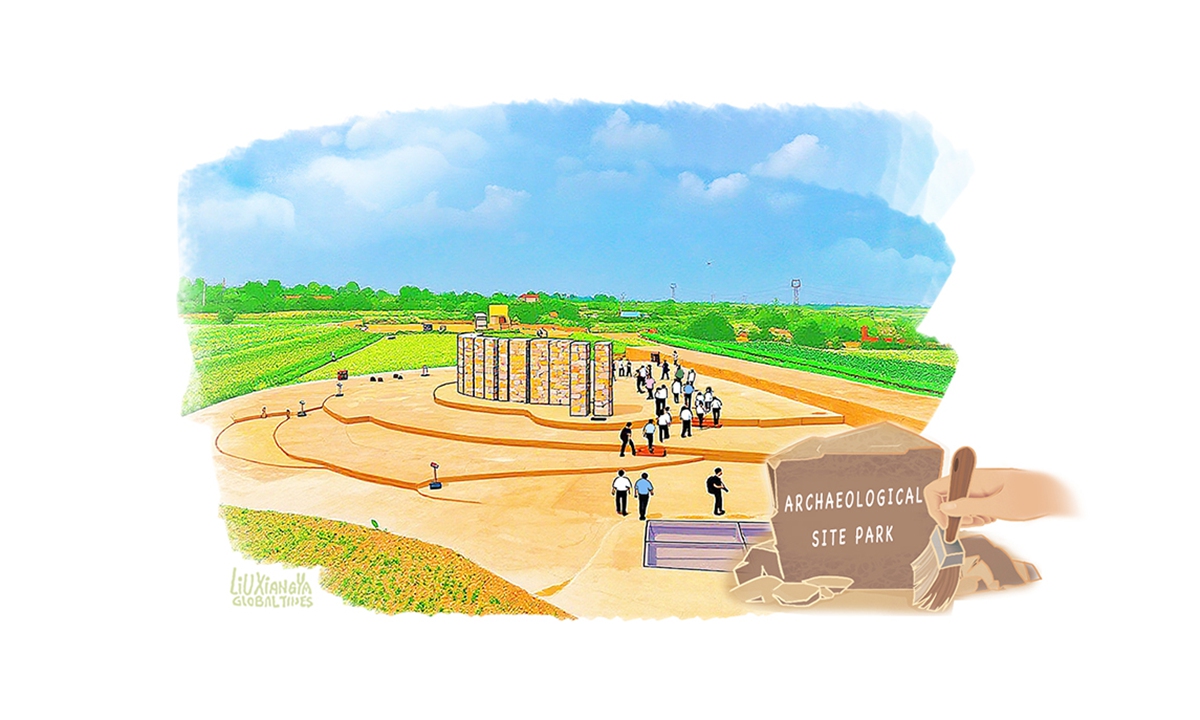
Illustration: Liu Xiangya/GT
Located in Jingzhou, Central China's Hubei Province, the Zoumaling site is one of China's many Neolithic ruins. What sets this 5,300-year-old ancient site apart? While one might find answers from historical texts, nothing compares to truly stepping into it for a first-hand experience.Recently, an archaeological park dedicated to the Zoumaling site was officially approved for construction, marking a step toward opening its gates to not just archaeologists, but also the masses. The shift from an "archaeological site" to an "archaeological site park" reflects not just an attempt to revitalize archaeological heritage, but also a new trend in the conservation and utilization of these heritage sites in China to preserve the sites' historical value through interaction with people.
Including the newly initiated Zoumaling site park, a total of 11 archaeological site parks across the nation have been designated by the National Cultural Heritage Administration (NCHA) as national-level site parks this year. They constitute the fifth batch of sites belong to this agenda. With the 2025 addition, China now boasts a total of 65 such parks in total, and this number continues to grow annually.
The structured and expanding scope of these site parks actually denotes China's strategic approach to preserving its archaeological resources: systematically protecting the country's most representative archaeological remains step by step.
Take the fifth batch's Taosi site in North China's Shanxi Province as an example. It epitomizes the earliest form of a Chinese capital city. In Jinhua, East China's Zhejiang Province, the Shangshan site represents China's role as the origin of global rice agriculture. Meanwhile, the Dawenkou site in East China's Shandong Province reflects how the ritual system developed in ancient China.
Though these scattered sites do not form a continuous timeline, they serve as anchors, allowing people to pinpoint pivotal moments in the development of Chinese civilization while traversing the country's grand history. In other words, archaeological site parks act as shortcuts for one to grasp China's multilayered past.
Yet, the goal of establishing an archaeological site park should extend beyond merely informing people about the country's multilayered history to fostering tangible visitor experiences.
In this sense, an archaeological site park should not be just able to offer facilities such as museums, excavation areas and more, but must also incorporate creative approaches to make archaeological culture visible and tangible. It should be like "a large open-air amusement park steeped in history," where archaeological culture is "presented through a modern lens," cultural policy expert Xu Jinlong told the Global Times.
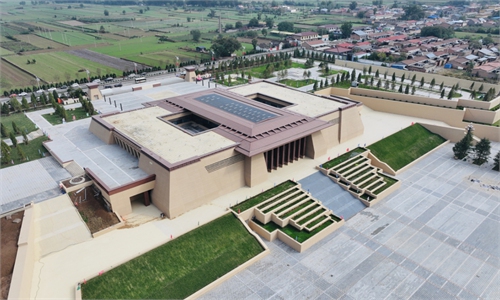
For instance, in recent years a growing number of sites like the Dahecun archaeological site park in Central China's Henan Province have been exploring their own unique creative paths. Through the use of sunken loess wall design and an 8-meter-high water screen, the Dahecun site park immerses visitors in history the moment they step through the gate. As they venture deeper into the park, AR technology allows them to restore painted pottery from the Yangshao Culture, or step into 3D simulated scenarios to personally experience the excavation of artifacts.
By offering on-site interactive events, people are getting closer than ever to ancient civilizations. However, the interactions between archaeological site parks and their visitors contribute not only to public historical education but also enable the parks to analyze visitor preferences, thereby uncovering opportunities for cross-sector expansion.
Examples include partnering with the cultural and creative industries to develop IP such as the keychain with oracle bone inscriptions at the Yin Ruins National Archaeological Site Park. Alternatively, like the Lingjiatan National Archaeological Site Park in East China's Anhui Province, a site park can partner with the education sector to establish itself as a learning base while simultaneously developing cultural tourism. Since launching its educational programs, which have particularly attracted families, the Anhui site park received over 5,000 visitors on the first day of the May Day holidays alone.
Through novel operational models and collaborations, archaeological site parks are increasingly integrating with modern consumer culture, forming a mutually reinforcing relationship with today's cultural consumers. This dynamic is also redefining the enduring value of archaeology. It is not a niche academic interest, but something that belongs to the public.
While the creative approach of site parks can provide more entertaining experiences, it is equally important to avoid excessive commercialization and ensure the accurate representation of archaeological history.
For example, when developing cultural and creative products based on a ritual vessel, the focus should not merely be on pleasing visitor's senses, but on thoughtfully interpreting the object's historical narrative. Similarly, when using 3D technology to recreate historical settings, greater emphasis must be placed on authentic archaeological details.
An archaeological site park is an integrated entity comprising both the historical site and its public spaces. Therefore, when developing cultural and tourism initiatives, it is essential to prevent large-scale tourism activities from attracting sudden surges of visitors, which could potentially damage fragile archaeological remains.
"The core advantage of a national site park lies in its immersive cultural experiences and the integration of multiple functions. However, this must be firmly grounded in the preservation of its historical authenticity and the integrity of both its natural landscape and cultural heritage," Zhang Yinglan, a professor at the School of Art and Archaeology of Zhejiang University, told the Global Times.
The author is a reporter with the Global Times. life@globaltimes.com.cn
RELATED ARTICLES