ARTS / CULTURE & LEISURE
Owner of tomb in Shaanxi possibly Rui State queen consort, likely of Qin origin
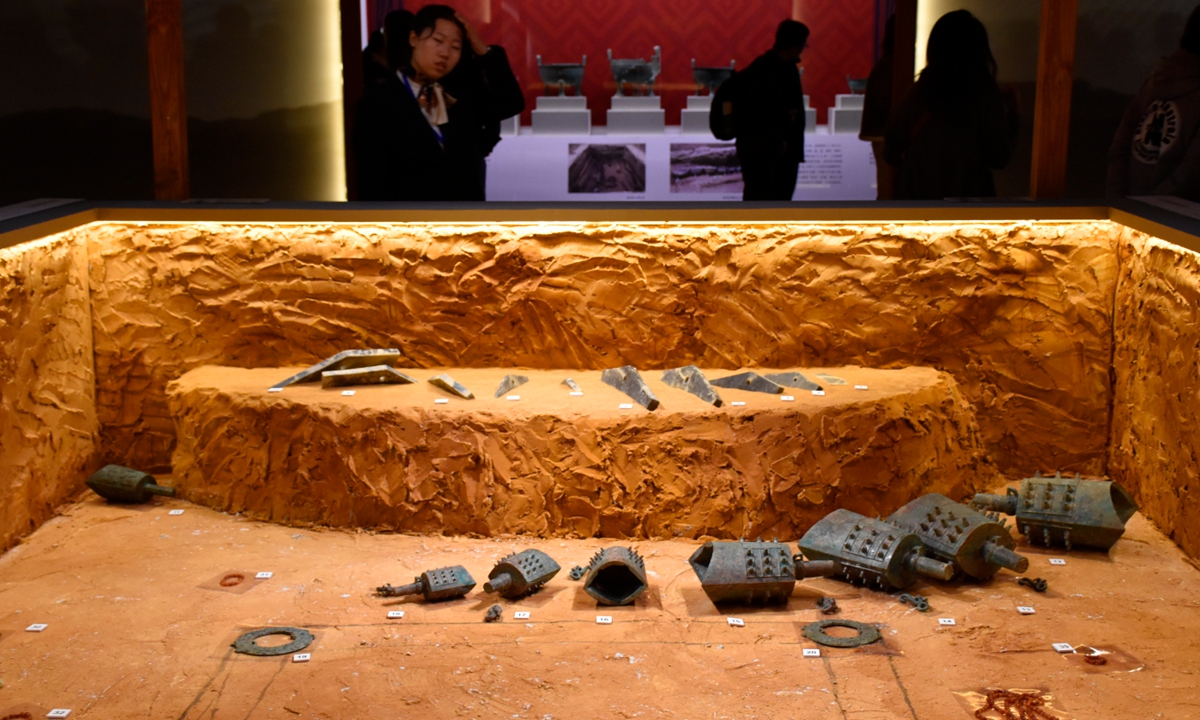
Relics from the Liujiawa site of the Rui State in Chengcheng county, Shaanxi Province Photo: VCG
Archaeologists recently unveiled that the Liujiawa site of the Rui State in Chengcheng county, Shaanxi Province, may be the tomb of a queen consort, with evidence suggesting she likely came from the neighboring state of Qin.The finding, published in the latest issue of Archaeology and Cultural Relics, centers on Tomb M3 in the site's eastern cemetery. Though looted, the tomb still yielded rich artifacts and displayed unique burial practices. Researchers say these features align with Qin cultural traditions from the early to middle Spring and Autumn Period (770BC-476BC).
"The identification is mainly based on the nine niches along the four walls of the tomb chamber and the presence of human sacrifices, which are also found in Qin elite burials of this era. The discovery of bronze ritual vessels without bronze weaponry further supports the inference that the tomb belonged to a woman," Liu Zheng, a member of the China Cultural Relics Academy, told the Global Times on Thursday.
The Liujiawa site, about 60 kilometers from the better-known Liangdai village site in Hancheng, was first exposed in late 2016 after being looted. Excavations beginning in early 2017 revealed it to be a major urban center of the Rui State during the early to middle Spring and Autumn Period. Among the site's four cemeteries, the eastern sector holds the highest-ranking burials. There, two large zhong (中)-shaped tombs with twin passageways stand alongside M3, a single-chambered pit tomb without ramps. Despite lacking passageways, M3 is the largest and most sophisticated of the no-ramp burials at Liujiawa.
M3 is a north-south rectangular shaft tomb, measuring 11.5 meters deep with a floor area of 33.4 square meters. At a depth of around 8 meters, nine niches were cut into the chamber walls, each containing female human remains.
Looting had damaged the site, yet archaeologists recovered 173 sets of artifacts, including 96 from original positions. The collection spans bronze vessels, jade and stone ornaments, bone and shell items, and lacquered wood. Among the most notable are jade pieces carved with both Zhou and Qin motifs, including dragon patterns with the angular, tightly arranged lines typical of Qin craftsmanship.
The Shaanxi Academy of Archaeology stressed that M3 is the only tomb at the site with both niches and sacrificial victims, making it distinctive even among tombs of the Zhou nobility.
Previous studies suggested the occupant of M3 was the wife of a Rui ruler buried nearby in M1 or M2. Current evidence points more strongly to being M2's consort, given the spatial proximity, close dating, and shared Qin-style artifacts. This, combined with the heavy Qin stylistic influence in M3's jade and bronzes, reinforces the theory that the Rui consort came from Qin.
Further, the archaeologists identified that the practice of human sacrifice is a hallmark of Qin high-ranking burials before the mid-Warring States Period (475BC-221BC), until Duke Xian of Qin banned the custom after relocating the capital to Liyang.
Historical records note Qin's growing sway over Rui politics from the late early Spring and Autumn Period until Rui's eventual demise. Archaeologists say M3 represents a vivid example of cultural fusion, uniting the traditions of Zhou's Ji lineage with those of Qin's Ying lineage in one tomb.
RELATED ARTICLES