SPORT / TENNIS
Growing number of international tennis events in China fuels local participation

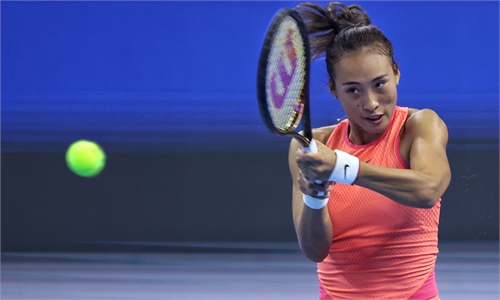
Zheng Qinwen interacts with fans after the semi-finals of the 2024 Wuhan Open on October 12, 2024. Photo: IC
For tennis enthusiast Li Wei, playing tennis on a weekly basis has become a habit after seeing Chinese player Zheng Qinwen winning the Paris 2024 Olympic women's singles.
"I am a late starter and I find tennis to be a sport that quite motivates me," Li told Global Times, noting that her first time watching professional tennis events in person was at the 2025 ATP Shanghai Masters, where she witnessed world No1 Jannik Sinner defeating 24-time Slam winner Novak Djokovic in the final.
As Li's hometown Chengdu, Southwest China's Sichuan Province, will host the ATP Chengdu Open later in September, Li said that she is "definitely going to watch" the games though the competition level is "not the most competitive one."
Li's growing passion reflects a wider phenomenon across China, where an expanding tennis season is reshaping both professional and grassroots participation.
Blossoming tennis season
Beyond the marquee names of the China Open in Beijing and Shanghai Masters during the tennis China swing, a wave of new tournament cities has emerged.
Cities like Guangzhou, Wuhan, Hangzhou, Ningbo, Jiujiang, and Hong Kong are going to host ATP or WTA Tour-level events, while Changsha in Central China's Hunan Province, Huzhou in East China's Zhejiang Province, as well as Jingshan in Central China's Hubei Province are among the places that are going to host events under 250 ranking points.
Significantly, the Billie Jean King Cup Finals, an elite women's team competition, will be held in Shenzhen from September 16 to 21. Shenzhen will host the event through 2027, marking the first time the finals come to China.
The strong home presence in 2024 proved how the China season could fuel domestic talent.
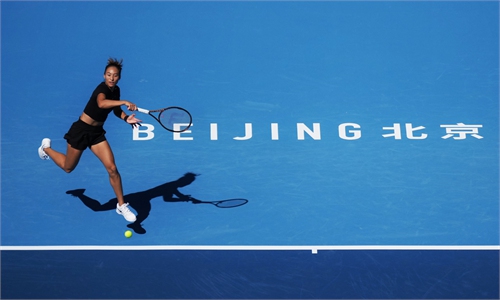
At the China Open, Zheng Qinwen advanced to the women's singles semifinals, before reaching the final at the Wuhan Open, where compatriot Wang Xinyu also made it to the semis.
Among the male players, Bu Yunchaokete was the dark horse, breaking into the semifinals, defeating two top-20 players and rising to 69th in world rankings in Beijing. Shang Juncheng won his first ATP tour championship at the Chengdu Open, and Zhang Zhizhen reached the final in Hangzhou too.
Beyond the athletes, the wider ecosystem of Chinese tennis has also been rapidly expanding. Hosting those below-Tour level events could also further increase competitive paths for rising Chinese players, said Ge Xiaoqian, a Chinese tennis columnist.
"Many of the professional players on the tour are also struggling with financial difficulties due to travel expenses and training costs," Ge told Global Times. "For young domestic players, competing at home could significantly decrease the expense while honing their skills under the intense competition calendar."
A report by the Chinese Tennis Association (CTA) revealed that, by August 2024, China's tennis courts had grown to 53,805, a growth of over 8 percent from 2021, indicating rising public engagement.
The CTA also released an ecosystem plan in August that targets cultivating more than 10 Chinese players ranked in the world's top 100, alongside local coaches and professionals active in international competition.
It also aims to create 10 "strong tennis provinces" and 100 "strong tennis cities," supported by youth training centers and thousands of grassroots clubs.
Hosting high-level events in multiple regional centers creates not just matches, but also local economic momentum by boosting visitor numbers, tourism, food, lodging, and related services, particularly in cities outside the traditional hubs.
The CTA estimated that the tennis China season is expected to attract more than 1 million spectators, and the associated consumption it drives in sectors such as catering and accommodation will exceed 2 billion yuan.
Bai Xilin, vice president and secretary general of the CTA, said that the entire industrial chain driven by tennis events not only promotes the construction and development of cities, but also serves as a new window for cities to showcase their development.
Blending culture and sports
Suzhou, one of the emerging tennis event host cities, illustrates how local tournaments blend tennis with cultural appeal.
Zhou Yunsong, tournament director of the WTA Suzhou Open, told Global Times that beyond competitions, Suzhou aims to offer the participants an unforgettable cultural experience.
"All the entrants are ranked inside the world's top 100, with international athletes making up 80 to 90 percent of the field," he said, before noting that the rich culture and history of Suchao has been very popular among the registered athletes.
Zhou told Global Times that some of the players even inquired about watching the local popular Jiangsu City Football League, more widely known as Suchao, during the Suzhou Open.
He Yifei, WTA Asia-Pacific Director of Operations, said at a press conference on Friday that Suzhou's unique natural environment could also enhance the players' overall experience of the tournament.
Speaking of how the domestic tournaments could boost domestic talent cultivation, Zhou said that with the multi-tiered system of tennis events being held in China, the young domestic players will for sure grow.
"A significant part of the overall improvement in Chinese tennis, including junior tennis, stems from the continuous increase in the number of our international tournaments," Zhou told Global Times.
"These tournaments allow more players to experience high-level tennis first-hand, and enable more young people to subtly enjoy the fun of tennis. I believe that in the future, we will see more young players deliver excellent performances on the international stage."
In Zhou's view, China now hosts a large number of top-tier professional tennis tournaments. Beyond these high-level events, the "blooming of diverse tournaments at different levels" is also of great importance.
"The organization of tournaments at various levels can attract more players to compete in China, not just those with top rankings."
"From marquee events to grassroots tournaments, the 'China Swing' has evolved into a comprehensive platform that supports both world-class competition and local player development."
RELATED ARTICLES