ARTS / CULTURE & LEISURE
How cool to have a name with millennia of history
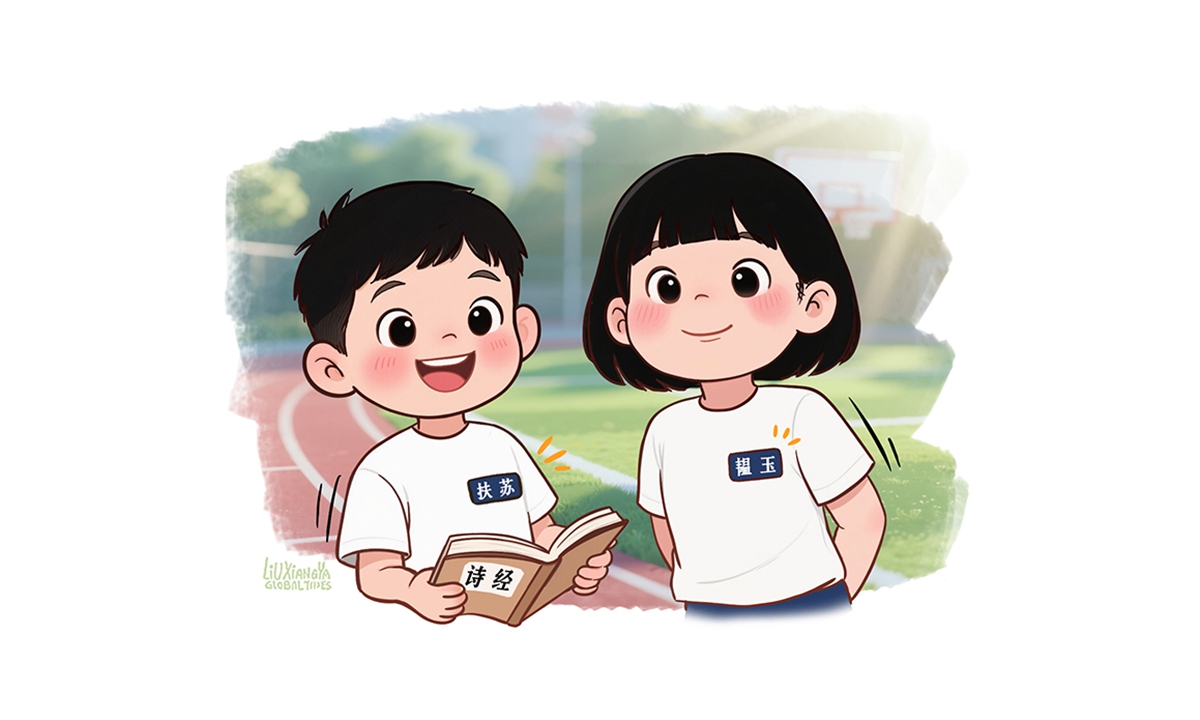
Illustration: Liu Xiangya/GT
Aprimary school in Dezhou, East China's Shandong Province, recently caught the attention of netizens nationwide, thanks to the given names of its first-grade students. One of them, "Fusu" (扶苏), the name of a student at the school, has historical roots since it appeared in the Classic of Poetry, China's oldest poem anthology."Fusu," which was also the name of the oldest son of Emperor Qinshihuang, the first emperor to unify China, is far from an isolated example of cultural naming.
A mother who was born in 1997 and now resides in Beijing told the Global Times that she named her new born daughter "Yunyu" (韫玉). It was inspired by the Chinese idiom Taoguang Yunyu, meaning hide your sharpness and keep the gem within. Including these examples, names inspired by classical poetry and literary allusions have accounted for 38.7 percent of all newborn names since 2024, and the proportion continues to grow, according to a survey conducted by Beijing Language and Culture University.
These names are a glimpse into a growing trend in which a new generation of Chinese parents are mining the rich veins of the country's tradition to give their children names filled with cultural depth.
Prior to "Fusu" or "Yongxi," there was a time when elegant-sounding but extremely common names, or eye-catching four or five-character names, were in vogue. Names like "Zixuan" and "Zihan" do not have clear literal meanings, but they convey a sense of romance. These names emerged from post-1980 parents drawing inspiration from romance novels and dramas, such as those written by Qiong Yao.
Names with cultural depth have become a nationwide phenomenon. The major cause is actually tied to the shifting cultural attitudes among younger parents, especially when they have in recent years experienced how traditional Chinese culture has deeply integrated with popular culture and become a visible part of everyday life.
Imagine, whether it's parents of first-graders or newborns, most of them belong to the post-1990 or even post-1995 generations. They grew up during an era that witnessed China's fast-paced modern growth. The nation's swift development instilled in these people the confidence to express themselves, and rather than longing after cultural inspirations from overseas, they began to turn inward in search of their roots.
Whether through the Hanfu clothing revival or Guochao (China chic) aesthetics permeating clothing, food, and lifestyles, creative expressions of traditional culture are woven throughout these post-1990 parents' lives, and this naturally includes the naming of their children.
In other words, names with traditional roots are more than just "interesting" or "special," they represent a generation's growing cultural confidence.
And, what is even more heartening to think is that these post-1990 parents are currently the major voices speaking about social change, so their growing cultural confidence is going to not just be reflected in the naming of their children, but also influence the next generation's education at both home and school.
With new names, contemporary parents actually aim to convey the importance of inheriting Chinese culture to their children. This is maybe also the reason why the Beijing mother told the Global Times that she has always been waiting for the day when her daughter grows up and "can find her name in the dictionary and realize that Chinese culture has made her special."
Throughout history, Chinese people have deeply valued passing down family heritage and their aspirations for their descendants' futures through naming conventions.
Then, what can we learn from the distinct naming choices of each generation? The answer to this question is, in fact, deeply intertwined with the changing social landscape of different eras.
Looking back, older generations' names like "Jianguo" (lit: build the nation) and "Aimin" (lit: love the people) emerged as reflections of the people's hope and passion for building the nation following the founding of the People's Republic of China in 1949. Later, as a fresh social landscape was formed through efforts such as China's reform and opening-up, society began to emphasize strength. Characters such as qiang (lit: strong) were then common to see in names. Chinese names such as "Kaili," a transliteration of the English name "Kelly," also appeared. These reflect the growing overseas exchanges among Chinese people.
The evolution of naming practices has continued from generation to generation, all the way to names like "Fusu" today. They are not just what people are called, but serve as mirrors of evolving values across eras, reflecting what people longed for in different times.
While a name carries the weight of an era, its fundamental purpose remains to identify a person in social scenes. It must therefore be easy to read, recognize, and write. While an increasing number of culturally meaningful names are gaining popularity today, it is also important to strike a balance between distinctiveness and practicality.
The author is a reporter with the Global Times. life@globaltimes.com.cn
RELATED ARTICLES