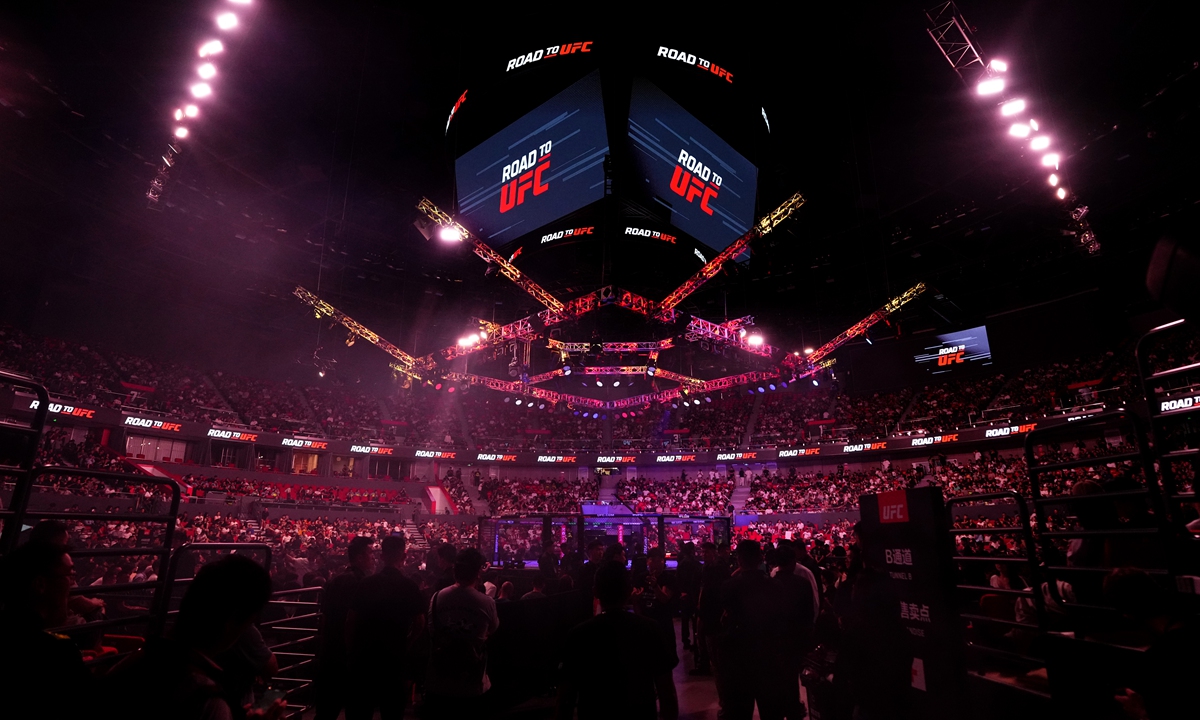
A general view during the Road to UFC event at Shanghai Indoor Stadium on August 22, 2025 in Shanghai. Photo: VCG
Just a decade ago, mixed martial arts (MMA) in China was little more than online highlight clips shared among niche fans. Today, packed arenas and roaring crowds mark its transformation into a popular sport, a shift that MMA enthusiast Wang Yizhou felt firsthand when he attended the UFC's Shanghai event."From China's fighter Li Jingliang's TKO victory in 2017 when he shouted the slogan 'China Power,' to Zhang Weili's 42-second knockout win in 2019 to claim the UFC strawweight world title, these milestones brought the sport into the spotlight in China," he said.
Nowadays, spectators attend live MMA events and cheer for takedowns and precise strikes. "They truly understand the techniques and strategy of the sport," Wang noted.
For Wang, the maturation of the fan base indicates that MMA is taking root in China, gradually forming its own culture and market. At the center of this cultural rise stands Zhang Weili, whose success continues to inspire fighters and fans.
Champion's mindset
At the UFC Shanghai event in late August, Zhang appeared as a guest commentator. Standing at the edge of the octagon, she cheered, offered strategic advice to fighters inside the cage.
On August 29, UFC CEO Dana White announced that Zhang would vacate the 115-pound title and move up to challenge Valentina Shevchenko for the women's flyweight belt in the co-main event of UFC 322, scheduled for November 15 at Madison Square Garden in New York, the US.
White called it "an incredible battle" between two of the great fighters. He said Zhang had done everything in the strawweight division and it was time to challenge Shevchenko, the dominant flyweight champion since 2016.
According to White, if Zhang wins, she will become only the second female fighter in UFC history to hold two titles simultaneously.
"Shevchenko is technically brilliant, but in MMA, mindset is key. If your mindset collapses, your strategy falls apart," Zhang told the Global Times. "No matter the circumstances, patience, focus, and confidence must always guide you."
In February, Zhang decisively defeated American fighter Tatiana Suarez, successfully defending her strawweight title for the fourth time and further solidifying her dominance in the division.
She added that in MMA, the more you fear your opponent's strengths, the more you limit your own performance. "That's why I never back down from a challenge."
Beyond her displays of power in the octagon, Zhang also shows warmth outside the cage. She often interacts with fans on social media, showing her softer side: "Inside the octagon, we are opponents; outside, we can be friends."
Between training and competitions, Zhang also reflects on how to pass her experience to the younger generation.
She revealed plans to conduct educational programs and organize events to guide young athletes, helping them avoid pitfalls and benefit from both competition and personal growth.
Her vision aligns with broader changes in Chinese MMA, as the sport prepares to enter a new era of official recognition.
Eyes on the future
MMA will be included as an official event at the 2026 Asian Games in Nagoya, Japan with six weight divisions: Men's modern 60kg and 71kg, men's traditional 65kg and 77kg, and women's modern 54kg and traditional 60kg.
"The 2026 Asian Games will be our first real test. Our goal is not gold medals, but to earn recognition from international judges for the technical quality of Chinese fighters," Yang Yu, head coach of China's national MMA team, told the media.
China's 2025 national MMA championships which concluded last month drew 38 teams from across the country, and a total of 160 participants, including athletes, referees, and coaches.
The results of the tournament serve as an important reference for selecting national team members for both the 2025 Asian MMA Championships and the MMA event at the 2026 Asian Games, according to the China News Service.
"Following events like the 2025 national MMA championships, our athletes and referees are already starting to adapt ahead of the Asian Games," Beijing-based MMA coach and referee Liang Runxuan told the Global Times
For Liang, the Asian Games will not only broaden MMA's visibility, but also bring higher standards for athletes, coaches, and officials in China.
"For the past couple of years, MMA in China has mainly developed through commercial events and private gyms," Liang said.
"Being part of the Asian Games means our athletes will now have more structured pathways, from provincial teams to the national squad, under the same system as Olympic sports."
According to Liang, by then, athletes will have adapted to unified rules, weight management, and anti-doping regulations, while referees and judges will have been trained to the same level as other combat sports. "It brings stricter international standards."
"The Asian Games gives young fighters a clear target to aim for. It's not just about chasing a belt in a commercial event anymore, but about representing the country on an official stage," he said.
Echoing Liang's view, Wang said the upcoming debut of MMA at the Asian Games is a milestone highlighting the progress MMA has made in China.
"For years, MMA in China felt distant, as if the real action seemed to mostly happen overseas. Now, with Chinese athletes preparing to represent the country at the Games, MMA is truly becoming part of our own sporting landscape."
RELATED ARTICLES