ARTS / CULTURE & LEISURE
China adds 4 more sites to World Heritage Irrigation Structures list; total reaches 42
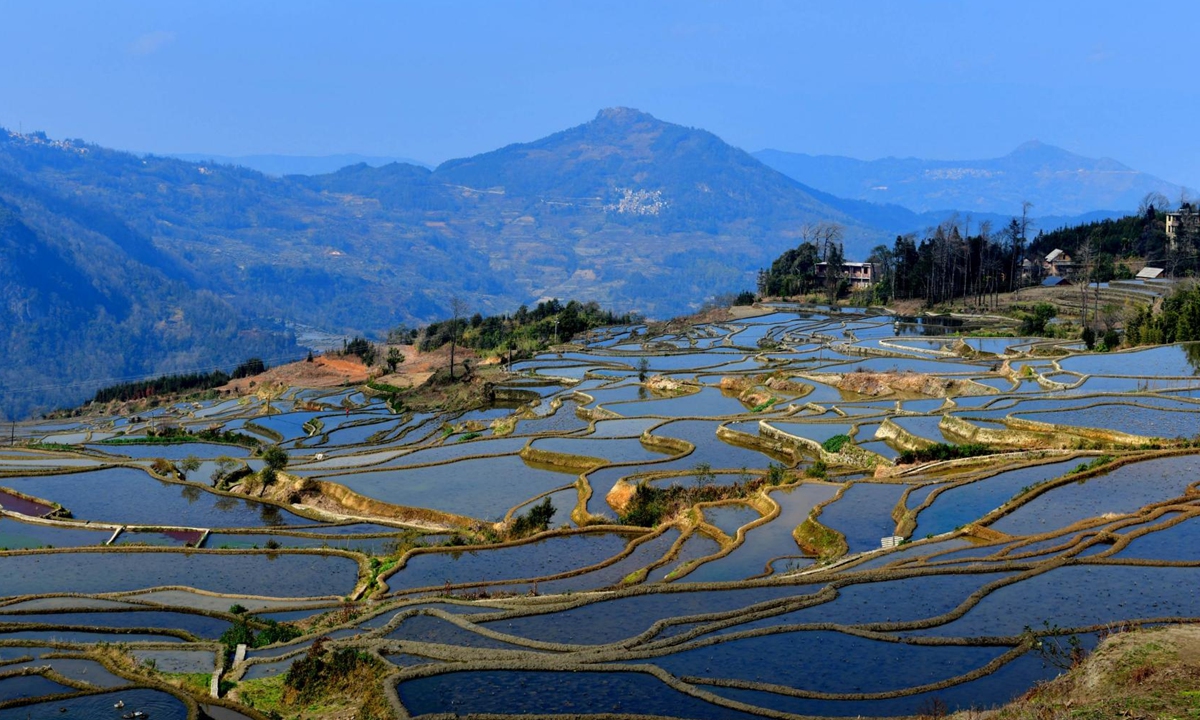
A view of the Yuanyang Hani Terraces in Southwest China's Yunnan Province Photo: Screenshot from CCTV
Four ancient irrigation projects in China have been added to the World Heritage Irrigation Structures (WHIS) list, bringing the country's total to 42, the International Commission on Irrigation and Drainage announced Wednesday at its 76th International Executive Council Meeting, according to the Ministry of Water Resources.Through China's 42 irrigation projects, the international community is "essentially witnessing the development of Chinese agricultural civilization," Zhang Yiwu, a professor of cultural studies at Peking University, told the Global Times on Wednesday. He said that many of China's irrigation systems were established in ancient times and served as fundamental foundations for "crop cultivation and the formation of villages."
The continuity of these irrigation systems, exemplified by those that remain functional since ancient times, is also strongly reflected in the evolution of Chinese civilization. Thus, the international community "can see a microcosm of China's civilizational development through its irrigation heritage," the expert noted.
The newly recognized sites are the Yuanyang Hani Terraces in Southwest China's Yunnan Province, the Chishan Lake Irrigation Project in Jurong city, East China's Jiangsu Province, the Jianjiang Dam in Pengzhou, Southwest China's Sichuan Province, and the Ancient Canal Irrigation Project of Yongding River in the Mentougou district of Beijing.
The Yuanyang Hani Terraces, located on the southern slopes of Ailao Mountain, cover 56,100 mu (about 3,740 hectares). First built during the Tang Dynasty (618-907), the terraces integrate forests, villages, farmland and waterways into a sustainable ecological system.
Forests on the mountaintops conserve water, while channels divert it through villages to irrigate terraced fields. The water then converges into rivers, and through evapotranspiration returns as rainfall, forming a complete natural cycle. This system is not only an outstanding example of the people of Hani ethnic group's adaptation to nature and survival, but also deeply intertwined with their culture, religious beliefs and irrigation management practices.
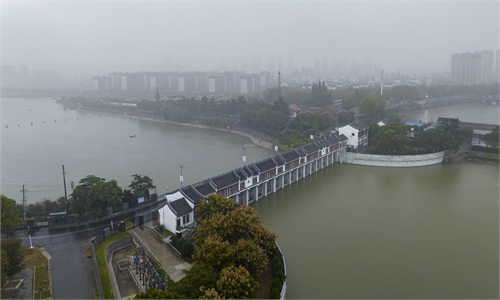
The Chishan Lake Irrigation Project, constructed in AD239, has a history of more than 1,700 years. It remains a key irrigation and flood-control project on the upper reaches of the Qinhuai River, serving 77,000 mu of farmland.
In the plain polder areas, the project mitigated flooding and drought in low-lying areas by building ponds that formed lakes, using dual water-storage systems and bidirectional sluice control. In the hilly uplands, dams and canal systems were constructed to provide both irrigation and navigation.
The Jianjiang Dam, dating back to the late Western Han Dynasty (206BC-AD25), still irrigates 162,000 mu of farmland. It enables coordinated irrigation, flood discharge and sediment drainage, making use of both surface water and groundwater, forming a "dual water-source" system. In addition to water diverted from the Jianjiang River, more than 300 natural spring weirs were built in the area to secure irrigation during droughts, showcasing the advanced wisdom of ancient multi-source water management.
The Yongding River Ancient Canal Irrigation Project in the Mentougou district of Beijing consists of five ancient canals along with historic springs and wells. Drawing water from bends in the Yongding River, the canals were designed to divert floods and prevent sedimentation, reflecting ancient wisdom in harmonizing human activity with nature.
The most distinctive feature of China's irrigation systems is their "extensive scale and diversity," Zhang told the Global Times. Different regions developed unique irrigation methods tailored to their local cultural practices and natural conditions. These projects reflect the distinct ways of life of people across various geographical areas.
The WHIS designation, established by the ICID in 2014, aims to protect and promote irrigation projects of historical value and scientific experience. With this year's additions, the global total has reached 200 sites.
RELATED ARTICLES