ARTS / CULTURE & LEISURE
China discovers highest-altitude Qin Dynasty engraved stone
‘Relic site fills a gap in history,’ says NCHA official
By Published: Sep 15, 2025 10:51 PM

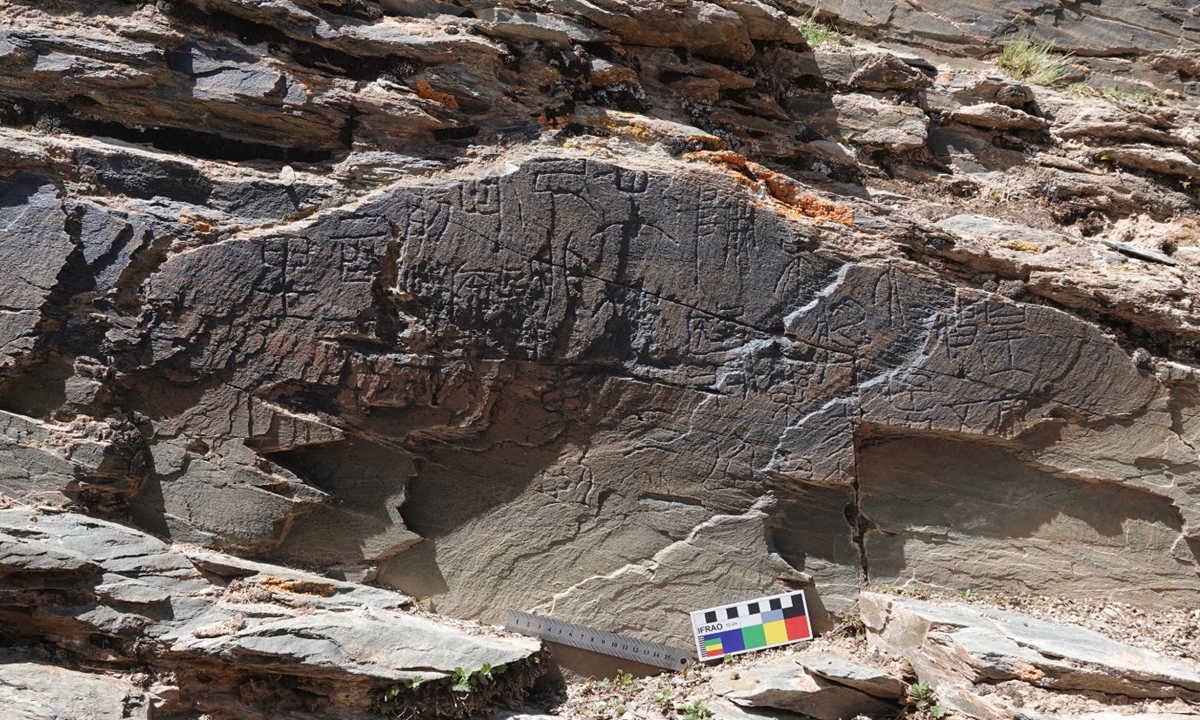
The only known Qin Dynasty (221BC-206BC) engraved stone still preserved at its original site and the one located at the highest altitude during the historic period Photo: Courtesy of National Cultural Heritage Administration
China's National Cultural Heritage Administration (NCHA) announced on Monday that an engraved stone, discovered on the Qinghai-Xizang Plateau, is the only known Qin Dynasty (221BC-206BC) engraved stone still preserved at its original site and the one located at the highest altitude during the historic period.The inscription, carved into a cliff face at 4,306 meters above sea level near the shores of Qinghai Province's Zhaling Lake, represents the only known Qin-era stone carving still in its original location and the highest-altitude relic from China's first imperial dynasty, said Deng Chao, an official from the NCHA, at a press conference in Beijing.
"Dubbed the 'Garitang Qin Rock Inscription,' the relic site fills a gap in history and is of great significance, possessing important historical, artistic, and scientific value," Deng added.
Wang Jinxian, an expert from the Qinghai Provincial Institute of Cultural Relics and Archaeology, told the Global Times that historical documents and research findings in historical geography indicate that the Zhaling Lake area served as an entry point to what is today the Xizang Autonomous Region during the Sui (581-618) and Tang (618-907) dynasties.
"The newly discovered cultural relic suggests that the Zhaling Lake area, where the inscribed stone is located, had been an area of ancient human activity since the Paleolithic era, rather than an uninhabited or scarcely visited region," he added.
Despite enduring over two millennia of harsh high-altitude weather, the inscription remains largely legible.
The finding has once ignited both excitement and skepticism among historians nationwide following an article published by Tong Tao, a research fellow from the Chinese Academy of Social Sciences' Institute of Archaeology who encountered the inscription during a cultural survey in June.
"The inscription and its geographic context help resolve long-standing questions regarding the 'true' location of Kunlun… It also corroborates historical records about Qinshihuang's expeditions in pursuit of immortality," wrote Tong Tao in his original article published in the Guangming Daily on June 8.
For centuries, the exact location of Kunlun Mountains has been one of sinology's great puzzles. Described in texts from the Classic of Mountains and Seas to Records of the Grand Historian as a divine realm where gods resided and where rare medicines grew, its real-world correlate has long been debated.
After Tong's article was published, some scholars questioned the dating of the stone inscription.
There were also those who noted that, after more than 2,000 years in a high-altitude and cold region, the stone inscription should be severely weathered, but the characters are still relatively clear, which sparks doubt about their age.
In response, China Academy of Cultural Heritage and Qinghai Provincial Institute of Cultural Relics and Archaeology conducted two field studies in June and July, employing high-resolution imaging, mineral analysis and environmental assessment techniques.
Li Li, deputy director of the China Academy of Cultural Heritage, told the Global Times that the team developed a tailored exploration methodology for the site, employing scientific and technological means to conduct comprehensive verification covering aspects such as rock hardness, strength, and the geological environment.
Li added that laboratory analysis confirmed the inscription was carved using period-appropriate tools and showed natural weathering patterns consistent with its claimed antiquity. She added that the quartz sandstone material and protective microclimate created by the lakeside location contributed to its preservation.
According to Deng, NCHA has designated the site as a county-level protected cultural property and announced broader plans for rock inscription conservation during China's 15th Five-Year Plan period (2026-2030).
These include creating a specialized database for rock artifacts, developing comprehensive research methodologies based on the techniques used to study this inscription, and drafting a national conservation plan for stone carvings and grottoes.
The discovery was made during China's Fourth National Census of Cultural Relics, which has documented over 11,000 new rock art sites nationwide since its inception, said Deng.
RELATED ARTICLES