ARTS / CULTURE & LEISURE
Pottery relics reveal artistry, beliefs of prehistoric China
Majiayao culture artifacts debut at exhibition
Majiayao culture Photo: VCG
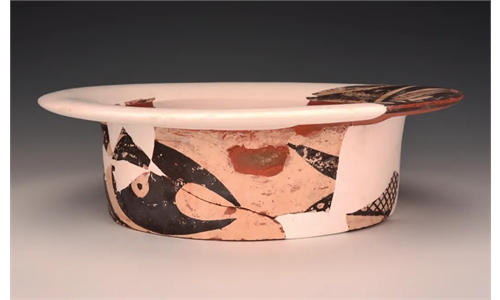
Featuring a pottery bowl adorned with an indescribable motif, a set of pottery artifacts debuted at the Chinese Archaeological Museum in Beijing on Wednesday. These relics look surprisingly modern, but they belong to China's around 5,000-year-old Majiayao culture.Among the artifacts on display, a color painted pottery bowl stands out as a stellar highlight due to its black-pigment motif. The motif is at the ware's center. It consists of a horizontal base line topped with three vertical lines extending upward. To the relic's left and right, there are two sickle-shaped motifs.
Liu Guangyu, a color-painted pottery expert at the Gansu Provincial Museum, told the Global Times that these patterns closely resemble a "petal motif" and likely form part of a larger decorative design.
Noting this was his "first time encountering such motifs," Guo Zhiwei, the lead archaeologist behind the pottery's discovery, told the Global Times that the design may be "a bird soaring into the sky" while also bearing similarities to plants.
"Due to the increasingly advanced craftsmanship and the unique cultural beliefs of ancient people, we can observe that the motifs on pottery became more abstract," Liu said, adding that these "indescribable" patterns actually embodied ancient people's response to nature and their spiritual aspirations.
Although not fully preserved, another fragment of a painted pottery vessel was also unveiled at the exhibition. This artifact features human-face patterns that were painted by ancient people using thick black lines. Below both eyes of the figure are three vertical lines resembling teardrops.
While some netizens have described it as an "ancient crying emoji," Guo explained that the design may reflect Chinese ancestors' reverence for water and symbolize a prayer for "irrigating the land and thriving through reproduction."
Another vessel at the exhibition is adorned with evenly spaced lines and circular patterns across its surface. The endpoints of the lines taper into sharp, deliberate angles, indicating that the ancient artisans intentionally preserved the "brushstrokes" in their creative process. "Such a design reflects the refined and sophisticated aesthetic sensibility of the craftspeople at that time," said Zhao Zhigang, the deputy director of the Majiayao Cultural Institute in Northwest China's Gansu Province.
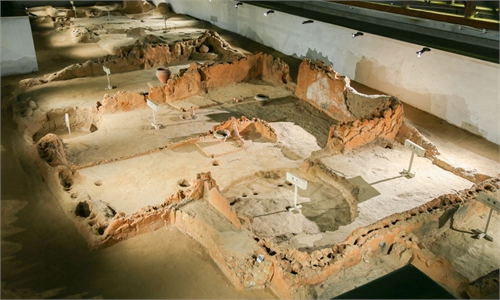
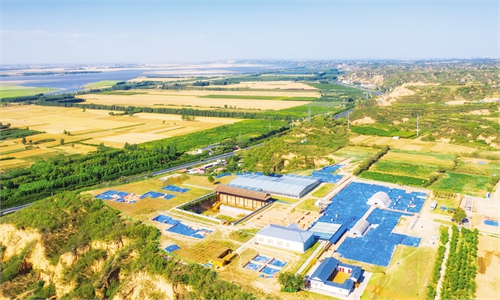
Including these three pieces, all the items on display were excavated from the Siwa site in Gansu. The site covers an area of 2 million square meters and is where a large number of house foundations, pottery kilns, pottery-making remains, and remains of stone processing have been discovered.
This site features a Majiayao culture settlement dating back about 5,000 years. The Majiayao culture is one of the key research subjects for China's national-level project to trace the origins of Chinese civilization.
The culture is important due to how it showcases the developments in "prehistoric Chinese handicrafts development, agricultural farming, and civilization exchanges," Liu told the Global Times. It exerted influence across an extensive geographical area, spanning from central and western Gansu Province to northwestern Sichuan Province, with its cultural impact extending as far as China's Xizang and Xinjiang Uygur autonomous regions. The Majiayao culture represents one of the earliest instances of cultural exchanges between ancient China and Central Asia.
"The culture demonstrates that the prehistoric culture of China had already began blending through civilization exchanges," said Liu, adding that the Siwa site is the culture's "most iconic physical representation" and its pottery tradition is "one-of-a-kind."
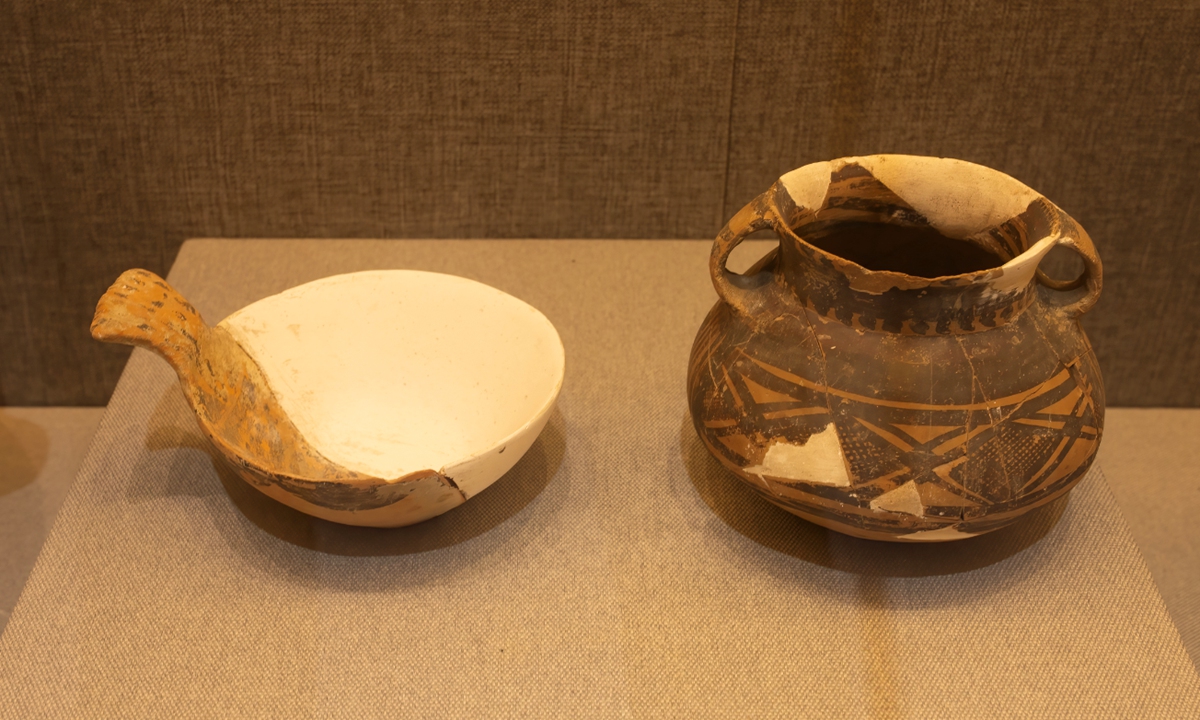
Unlike ancient pottery from other regions, pottery pieces unearthed from the Siwa site are primarily characterized by their painted motifs such as wave patterns, grid motifs, and human-like or floral figures. These motifs were painted by ancient people using black, white, and red pigments on orange-yellow clay.
"Due to the high firing temperature, these pottery pieces have been remarkably well-preserved over thousands of years, with their colors remaining vivid and unfaded," Liu told the Global Times.
He also added that pottery pieces unearthed from the Siwa site "show the pinnacle of prehistoric painted pottery art in China."
In 2024, the Siwa site was recognized as one of China's Top Ten Archaeological Discoveries, and several new findings were also unveiled. These include a large-scale pottery production area and a major settlement from the Banshan phase of the Majiayao Culture.
"These discoveries fill a critical gap in research on the origins of Chinese civilization in the northwestern region," said Guo. He added that exploration of the Siwa site is ongoing, with much more yet to be uncovered.
RELATED ARTICLES