ARTS / CULTURE & LEISURE
Archaeological finding unveils Ming Dynasty lamp’s mixed fuel formula
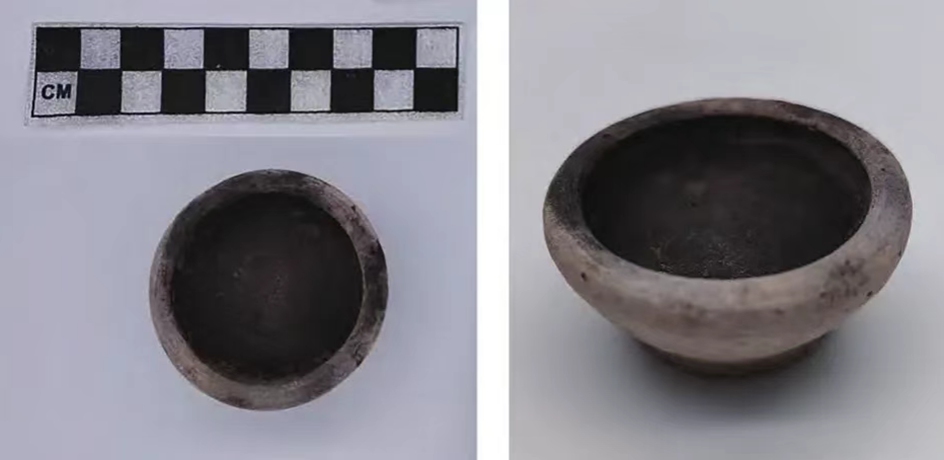
Photo: Courtesy of Shanxi Provincial Institute of Archaeology
After analyzing a ceramic lamp unearthed from a Ming Dynasty (1368-1644) tomb in North China's Shanxi Province, researchers have identified its fuel components, providing rare physical evidence for the study of ancient Chinese lighting technology and social life, according to a report by the China News Service (CNS) citing the Shanxi Provincial Institute of Archaeology.Lamps in ancient China were not only everyday lights but also symbolic objects placed in tombs to light the way for the deceased. Following funerary traditions, they were often set in the center or corners of a burial chamber, according to a post from the institute's WeChat account.
One such porcelain lamp was uncovered in 2021 in a Ming Dynasty tomb in Nantou village, Wutai county. Discovered on the chamber's east side, the small, bowl-shaped vessel is thick-walled and unglazed, with a plain gray surface. It measures 5 centimeters across the mouth, 3.3 centimeters at the base and 2.3 centimeters in height. Black traces on the inner wall and rim are believed to be residue left behind by burning fuel.
In previous archaeological finds, traces of lamp oil have been rare.
"Lamp oil residue is not easily preserved as it is organic matter that decomposes rapidly, while soot deposits are more often preserved," Liu Zheng, a member of the China Cultural Relics Academy, told the Global Times on Wednesday.
According to the institute, records show that plant oil-pressing technology did not appear until the Wei (220-265), Jin (265-420) and Northern and Southern Dynasties (386-589), meaning earlier lamps likely relied on animal fat as fuel. Common options in ancient China included mutton tallow, beef tallow, whale oil and lard, all of which had relatively low melting points, generally between 45 and 55 C. Lard, the most widely used, melts at a temperature lower than that of the human body. Adding wax, however, can raise the melting point, reduce smoke, improve stability and slow spoilage.
Researchers used advanced methods, including microscopic infrared spectroscopy, to conduct a detailed analysis of the tiny carbonized traces inside the lamp. Analysis showed that the lamp had been fueled with a mixture of linseed oil, mutton fat and beeswax. Linseed oil is a plant-based fuel, mutton fat is animal-based, and beeswax is a wax. The combination of fuels was likely intended to improve lighting quality, reduce smoke and extend burn time, reflecting a level of technical knowledge in fuel preparation during the Ming Dynasty, said the CNS report.
The development of oil-pressing technology made it possible for plant oils to replace animal fats as lamp fuel. By the Yuan (1279-1368) and Ming periods, cultivation techniques for oil-producing crops were well established, providing a rich source of plant oils. Experience with lamp fuel, along with health considerations, led people to favor plant oil for lighting. The invention of more efficient fuel formulas reduced consumption, lowered costs, and even produced brighter flames with pleasant aromas, meeting users' preferences for light quality and color. The use of multiple fuel components in excavated lamps reflects the Ming-era pursuit of both practicality and a higher quality of life, according to the institute.
The discovery not only confirms that northern China had mastered the use of mixed fuels for lights during the Ming Dynasty, but also provides important clues for studying crop cultivation, animal husbandry and the handicrafts of the period, offering valuable insight into social and cultural practices of the time, noted Liu.
RELATED ARTICLES