ARTS / CULTURE & LEISURE
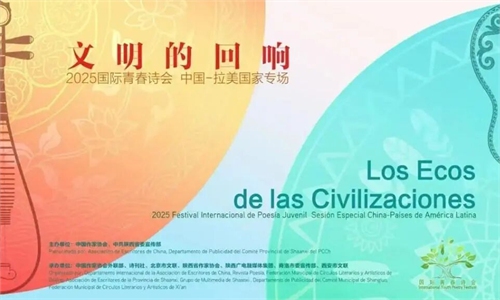
Hearing ‘echoes of civilizations’ at Beihai Park international poems exchange event
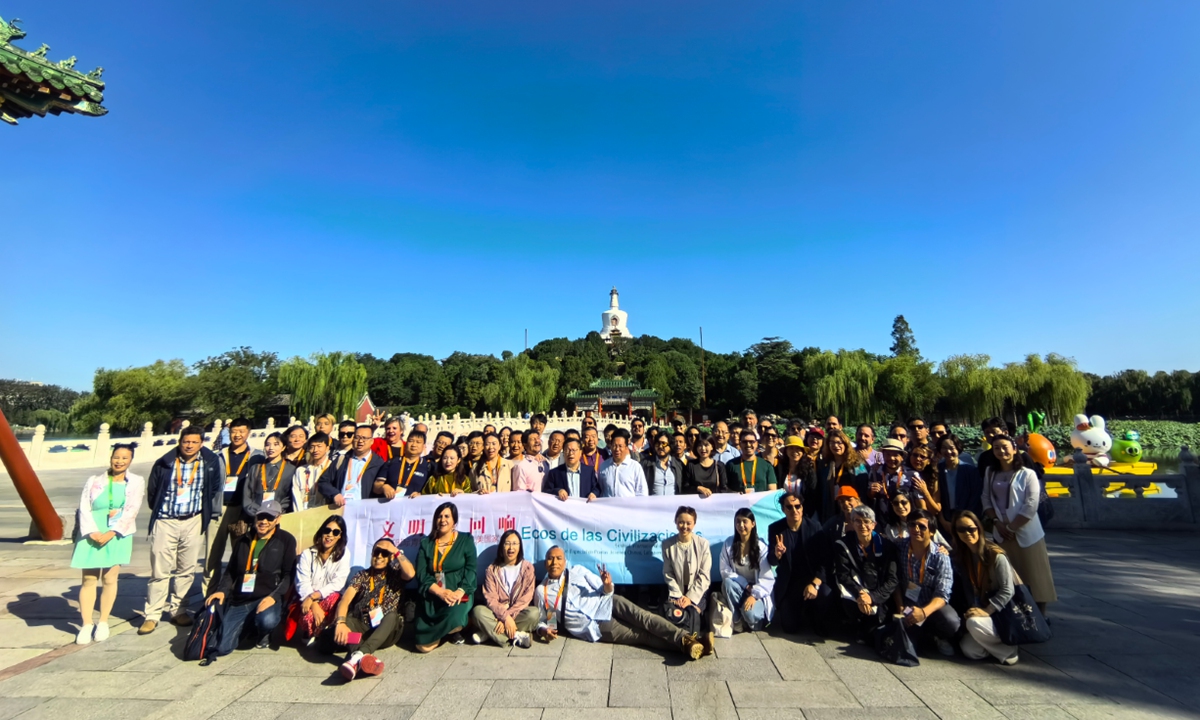
Photo: Dong Feng/GT
During the sunny morning on Saturday, 77 poets from Latin American countries and China gathered at Beihai Park in Beijing. Over the past week, they have overcome language barriers to make new friends."I read my poem on the Great Wall!" Rodrigo Escobar Vanegas, a poet from Colombia, said proudly.
The year 2025 marks the 100th year of public service for Beihai Park. Located in the park, Yilan Hall is famed for its ancient and simple architecture and beautiful environment. Amid the natural beauty and the charm of history here, poets started a new journey with a game: exchanging each other's poems using mystery boxes.
Zhang Huijun, a poet and translator, told me that she happened to draw Escobar Vanegas' Spanish poem titled "Fire Fire."
"We discussed the image and symbolic meaning of 'fire.' He [Escobar Vanegas] believes that fire is a universal element that represents origin. Fire is the original, the beginning, the awakening, the sun; it is also the end, because fire can be the final nuclear explosion," she said.
Escobar Vanegas also suggested tweaks for the Chinese translation of his poem to make it easier for Zhang to get his concept. This type of exchange was not unique, with some poets even having conversations using AI tools.
Carlos Ordóñez, a poet, philologist, editor and director of the publishing house for the National Autonomous University of Honduras, showed the reporter how he converted his Spanish paragraphs into Chinese and shared them with his counterpart, Zhou Wenting, a poet from Jingbian, Northwest China's Shaanxi Province.
Zhou said that in their discussion, she answered Ordóñez's questions by using Doubao, an AI-powered assistant developed by ByteDance, to translate her words into Spanish.
"Thus, we didn't have to worry about language barriers and exchanged ideas for poetry," Zhou said.
"This festival and its title, 'Echoes of Civilizations,' is not just a gathering or a theme, but a diagnosis of reality. We don't create the echo; we listen to its reverberation. In a world troubled by the noise of monologues, this festival was an act of deep listening. Dialogue among civilizations is not a political courtesy; it is a biological and metaphysical necessity. A civilization that speaks only to itself is writing its own epitaph," Ordóñez told me.
Escobar Vanegas shared a similar concept, noting that we are living in a multipolar world, which means there are diversified civilizations we can appreciate, instead of only one voice from one civilization. "Deep understanding of civilization takes more than one night, it might take years," he noted.
At the poetry reading session, Tong Zuoyan, a member of the Chinese Writers Association from Kunming, Southwest China's Yunnan Province, shared his thoughts provoked by a rain shower encountered while they were traveling in the Qinling Mountains in Xi'an, Shaanxi Province.
"Maybe one raindrop has traveled by evaporation through the Pacific Ocean's circulation and ultimately reached Latin America. Thus, perhaps the drizzle you walk through in Latin America is also what we'd walk through in China," said Tong.
During their stay in the Qinling Mountains, the 77 poets wrote a poem together to pay their tribute to Qinling called "Dragon Vein," a term from the classic Zhou Yi, or the Book of Changes.
Horacio Cavallo, a writer and poet from Uruguay, said he finds it "incredibly important for countries around the world that are so far apart to be in contact, because ultimately there are a lot of shared concerns and things we can do together, especially with the goal of world peace, justice, integration, and cultural diversity."
Sharing his ideas on how poets could create an imagery system that has both civilizational distinctiveness and universal human relevance and how poets could leverage such a creation as a key to break down contemporary civilization barriers, Cavallo said, "I believe that poets generally have one characteristic: Their sensitivity revolves around the fundamental themes of human life. This is what makes it possible for the poems of someone who lives in South America to resonate with Chinese poets."
While traveling together across a lake by boat, the Latin American and Chinese poets sang a song together. I am convinced that the poets have established contacts to maintain communication from one end of the world to the other with the aim of continuing to build a better world together.
"Through conversations, we have built bridges of communication and understand each other's unique civilizations," Zhang said.
RELATED ARTICLES