ARTS / CULTURE & LEISURE
China’s first women’s art museum debuts conversing with Mosuo tradition
‘Art, where the heart resides’

The Museum of Women's Art (MOWA), China's first museum dedicated to women artists, beside Lugu Lake in Southwest China's Sichuan Province Photo: Courtesy of MOWA
Straddling between Southwest China's Sichuan and Yunnan provinces, Lugu Lake is not only a deep freshwater lake, but is also of cultural depth, since it is home to nearly 50,000 Mosuo people.The Mosuo people are known for their matriarchal tradition passed down through generations. They hold deep respect for women's creativity and life-nurturing power, and as a result, life-nature elements such as stones, mountains, and homes are often imbued with feminine symbolism in Mosuo culture.
Inspired by such a tradition, the Museum of Women's Art (MOWA), China's first museum dedicated to women artists, was recently opened by the lakeside. With artist Luo Mingjun's installation of La barca leggera, also known as the "Light Boat" as its centerpiece, MOWA's director Luo Yi said the new space is where "contemporary art converses with Mosuo tradition."
'Stitching the distance'
Although defined as women's art museum, Luo told the Global Times that "this does not mean the space excludes male artists." She envisions MOWA as a platform where artists of different backgrounds can co-create, and believes "women's art conveys shared human emotions and themes."
At MOWA's inaugural exhibition, the director's vision had already begun to take shape. It features contemporary artist Luo Mingjun and Swiss male poet Alberto Nessi. The poet translated his cross-cultural imagination of indigenous Chinese culture into literary expression. Among several pieces of Luo's artworks, the boat-shaped installation emerged as a highlight.
Before coming to Lugu Lake, the artist had intended to create the work entirely alone, making it an artistic soliloquy. Yet, that plan was "completely overturned" after she had face-to-face exchanges with the Mosuo people, the artist told the Global Times.
She visited a local village called "Walabi." There, the artist found a pig-trough boat. It was not just a vehicle on water, but the Mosuo people's lifestyle heritage. They use the boat to transport their fishing catches and also for ceremonial events like their iconic "walking marriage" occasion. "The boat to us is what the horse to the nomads," Duoji, the director of Mosuo Museum, told the Global Times.
Knowing the boat is the local's cultural symbol, Luo the artist used it as a prototype for her installation. The longer she lived among the locals, the clearer it became that Mosuo culture is not "an outsider-imposed narrative," but needed "co-creation with the local community," Luo told the Global Times.
Thus, she lined the boat's interior with terra-brown sculpting foam clay, an aesthetic mirroring of the very soil that nurtures the Mosuo community. Then, she invited local women to stitch patterns freely into the clay with beading needles.
"Every stitch seems to mend the distance between our cultural distance," said Luo. Looking closer the patterns within the boat, one can find the "airplane" that symbolizes modern technological society alongside the Mosuo "fishbone" textile patter, emblems of ethnic folk tradition.
To generations of Mosuo "Ama" and "Ajie" (elder mother and sister), the tradition of making textile and embroidery crafts runs deep. This is why "Mosuo Ajie" Zhuoma, who co-created the installation, told the Global Times that such a "stitching" practice felt "easy and familiar" to her, as it resonates with her daily life experiences. But, the artist runs a deeper thought to such a stitching approach.
"The act of stitching itself carries a slight sting, such a sensation serves as a reminder, drawing viewers' attentions to the stories embedded in women's thinking and their coming-of-age journey," Luo remarked.
Filled with stories, the artist's installation of soliloquy turned into a dialogue with Mosuo women, most of whom had rarely encountered contemporary art. Zhuoma used blue, purple, and red bead pins to trace the waters of Lugu Lake that nurtured her while Lamu created several patterns that are iconic to Mosuo textiles.
"This [creating a piece of contemporary art] is new to me, but it made me realize how inspiring our culture is to the world outside," Zhuoma told the Global Times.
"Through creating co-narratives, I hope they [the Mosuo women] will develop a greater sense of pride while gaining fresh perspectives for their own culture," Luo Yi, the director, who is also the curator of the exhibition, told the Global Times.
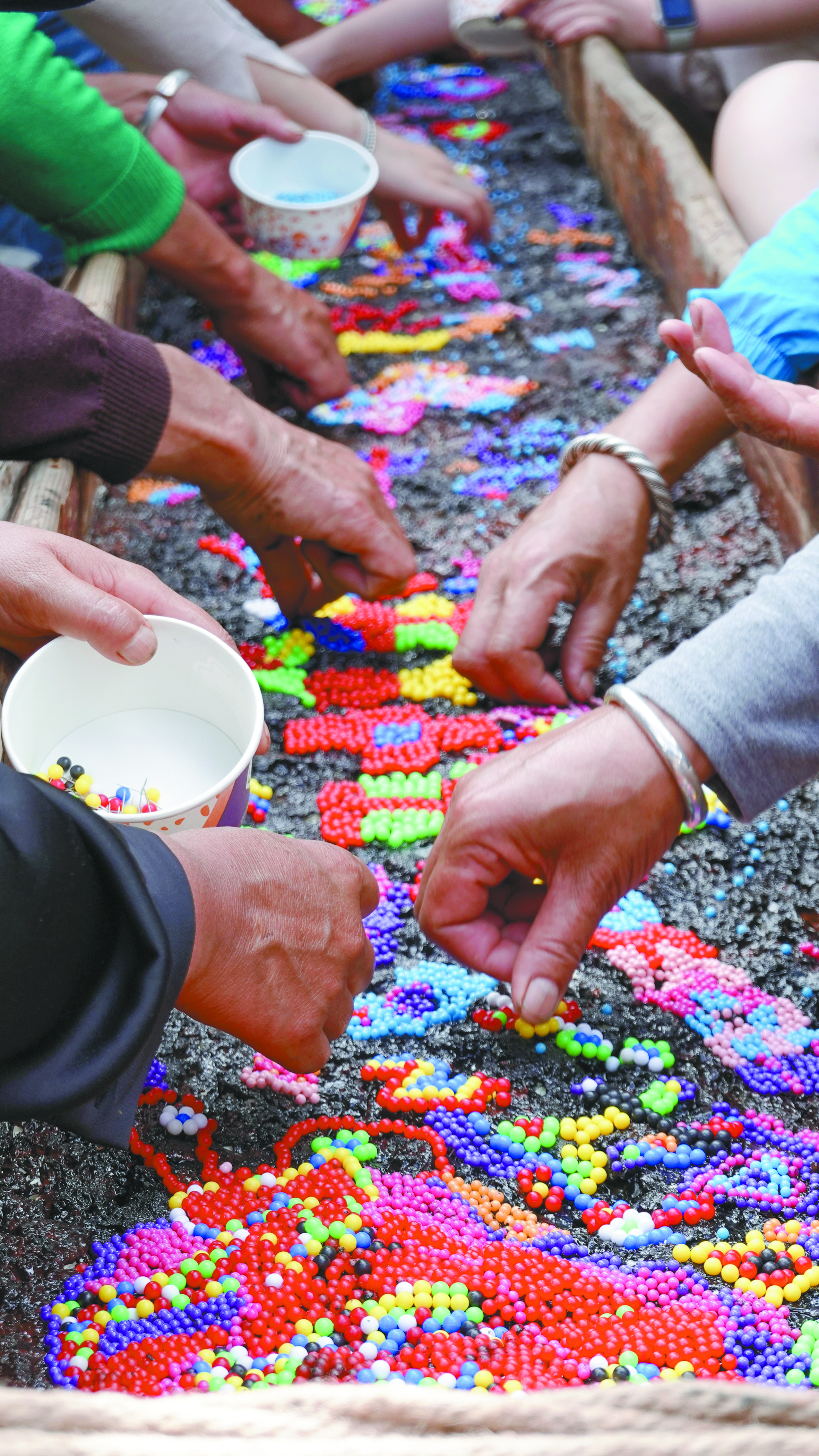
Local women co-creators stitch patterns onto a boat-shaped installation called La barca leggera. Photo: Courtesy of MOWA
Beyond locality
Including Zhuoma and Lamu, these Mosuo artists were invited to the opening ceremony by director Luo Yi. Besides guiding tours for the on-site audience, the director also shared the museum's future plans at the event, for which it has a goal to present women's art and Mosuo culture on international platforms.
On behalf of MOWA, Luo and Carlos Marreiros, an award-winning architect and the founder of the Women Artists International Biennale of Macao signed a strategic cooperation agreement.
Moving forward, the two parties will integrate resources from both the Lugu Lake region and the Macao Special Administrative Region to collaborate in areas including "culture, art, architecture, and cultural heritage preservation," Marreiros told the Global Times.
Professor Shahbaz Khan, the director and Representative of the UNESCO Regional Office for East Asia, joined MOWA's opening through video connection. Acknowledging the newly launched museum aligns with the UNESCO's vision of "placing women's empowerment at the heart of sustainable development," Khan said UNESCO is willing to collaborate with the new space supporting women artists in areas such as "skills enhancement" and "art exhibitions."
The opening of the exhibition also marks one of the cultural events commemorating the 75th anniversary of the establishment of diplomatic relations between China and Switzerland. Jürg Burri, the Swiss Ambassador to China and poet Alberto Nessi also shared their thoughts on the opening of the museum via videos.
"Reflected in the waters of your lake are not only your mountains, but also our ranges," said Nessi, metaphorically highlighting art's power to dissolve cultural and geographical differences.
Although the 500-square-meter MOWA seems already crowded with exhibitions and collaborations coming along the way, Luo Yi told the Global Times that it is going to not just focus on exhibitions, but will also establish China's first Women's Art Archive and Research Center.
A total of 400 publications have already contributed to the archive, most of which were donated by Chinese women artists. They are: Cai Jin, Chen Ke, Chen Qiulin, Hong Ying, Jiang Jie, Li Linlin, Li Jie, Li Shurui, L iao Wen, Luo Mingjun, Liang Yuanwei, Ma Qiusha, Peng Wei, Shen Yuan, Tong Wenmin, Xiang Jing, Xing Danwen, Xiao Lu, Yin Xiuzhen, Yu Hong, Zhou Li, and Zhai Yongming.
"Art is where the heart resides," Luo told the Global Times, adding that given the surrounding cultural diversity - which includes the Mosuo community, Yi, Naxi ethnic groups and more - the museum will engage diverse groups in artistic practices in the future.
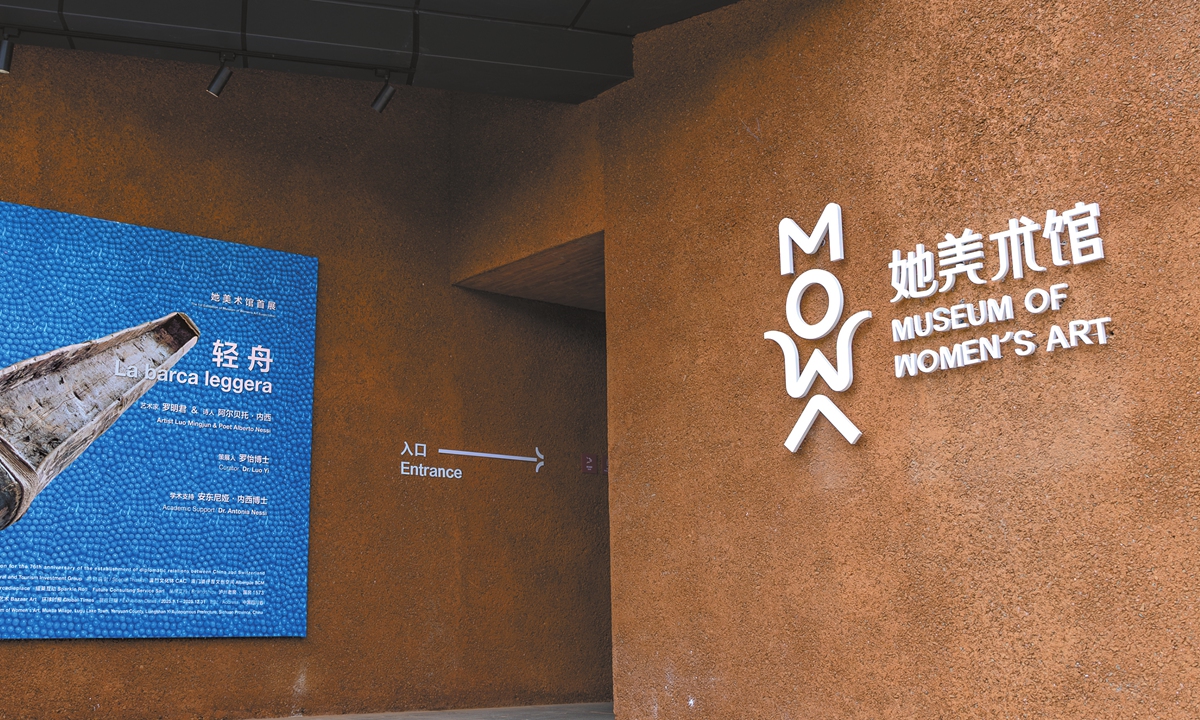
The entrance of MOWA Photo: Courtesy of MOWA
RELATED ARTICLES