SPORT / MISCELLANY
International exposure vital for young athletes after Tokyo World Athletics Championships
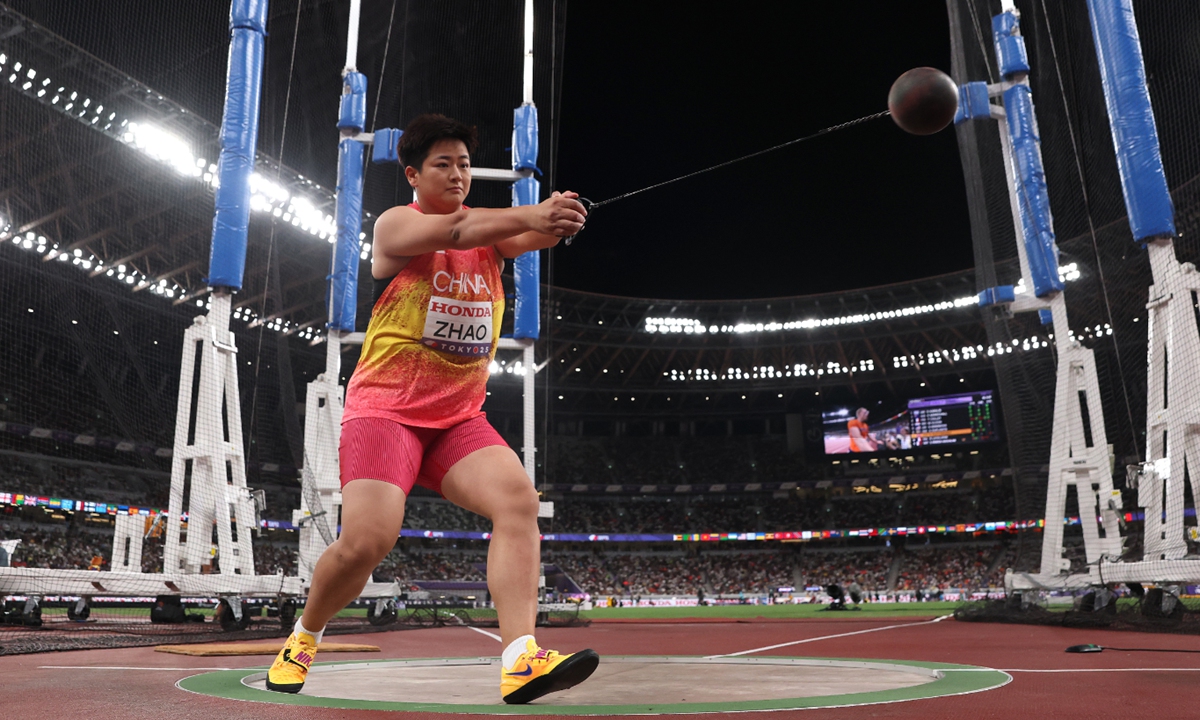
Chinese athlete Zhao Jie competes during the women's hammer throw final of the World Athletics Championships on September 15, 2025 in Tokyo, Japan. Zhao won silver with a personal best throw of 77.60 meters, while her compatriot Zhang Jiale took bronze with 77.10 meters. Photo: VCG
Zhao Jie claimed silver in the women's hammer throw with a personal best of 77.60 meters, while her 18-year-old teammate Zhang Jiale took bronze with 77.10 meters, showcasing the team's strength in this event. In the men's long jump, 26-year-old Shi Yuhao earned bronze with a season-best 8.33 meters, while Wang Zhaozhao rounded out the medal haul by winning silver in the men's 20km race walk in 1:18:43, matching China's best-ever result in this event in the last five worlds and ending a 10-year medal drought for Chinese male race walkers on the global stage.
Beyond medals, team events and technical disciplines also showed signs of depth. Some of the most promising developments were seen among China's young athletes. A sprinter born in late 2008, Chen Yujie is now widely noted as a rising star for Chinese athletics. She has already broken the Asian youth record and won national titles. Her entry into senior competition at 16 years old suggests an investment in long-term talent rather than purely immediate returns.
Another highlight involves the Chinese men's 4x400m relay team. At the World Athletics Relays in Guangzhou in May, the quartet of newcomers, Liang Baotang, Li Yiqing, Zhang Qining and Fu Haoran, ran 3:01.87 to set a national record to secure their qualification for the Tokyo worlds. And then in Tokyo, the quartet ran 3:00.77, an even faster national record in the 4x400 meters men's relay heats. This shows that relay programs are improving not just in isolated performance, but in consistency and upward trajectory.
In the men's 110 meters hurdles, three Chinese hurdlers, Liu Junxi, Xu Zhuoyi and Chen Yuanjiang, all advanced into the semifinals. Though none of them made it into the finals, the achievement itself is historically significant as it is the first time Chinese hurdlers have accomplished the feat since Liu Xiang led a three-man Chinese squad in 2011.
Why this deserves separate emphasis is because in championships, depth is often more telling than isolated medals. When multiple athletes from the same country begin to reach late rounds in highly competitive events like the 110 meters hurdles, it's a sign that coaching, youth development, and athlete pipelines are working in coordination. It gives hope that someday soon, one of them might reach the finals, or even challenge for medals, considering the Chinese trio Liu, Xu and Chen are around 20 years old .
Nevertheless, gaps remain. While national records and youth breakthroughs are cause for optimism, they are not yet substitutes for consistency. China still trails in many sprint events and certain field events where global competition is fierce. The jump from promising semifinals or national records to medals under pressure is steep. For relay events, clean baton work, depth in every leg, and psychological resilience in the final rounds are still areas that need attention.
In view of the upcoming 2027 Beijing World Championships, as well as the 2028 Los Angeles Olympics, this period is critical. To build on the momentum, there must be investment in not only raw talent but also coaching, competition exposure and the mental aspects of competition.
Young athletes need more international meets and injury prevention, all essential to avoid burnout or plateauing. International competition provides growth opportunities that even the most extensive training cannot replicate.
The Chinese athletes' performance in Tokyo was a step forward, compared to what the team achieved at the Budapest worlds in 2023. But what impressed most was the emergence of young talent and record-breaking relay improvements. If those can translate into greater consistency, then the expectations for Beijing in 2027 are no longer wishful, but grounded.
The author is a reporter with the Global Times. life@globaltimes.com.cn
RELATED ARTICLES