BRASIL 247 / MORE
Chinese automakers gain ground, surpassing 10% of passenger car sales in Brazil
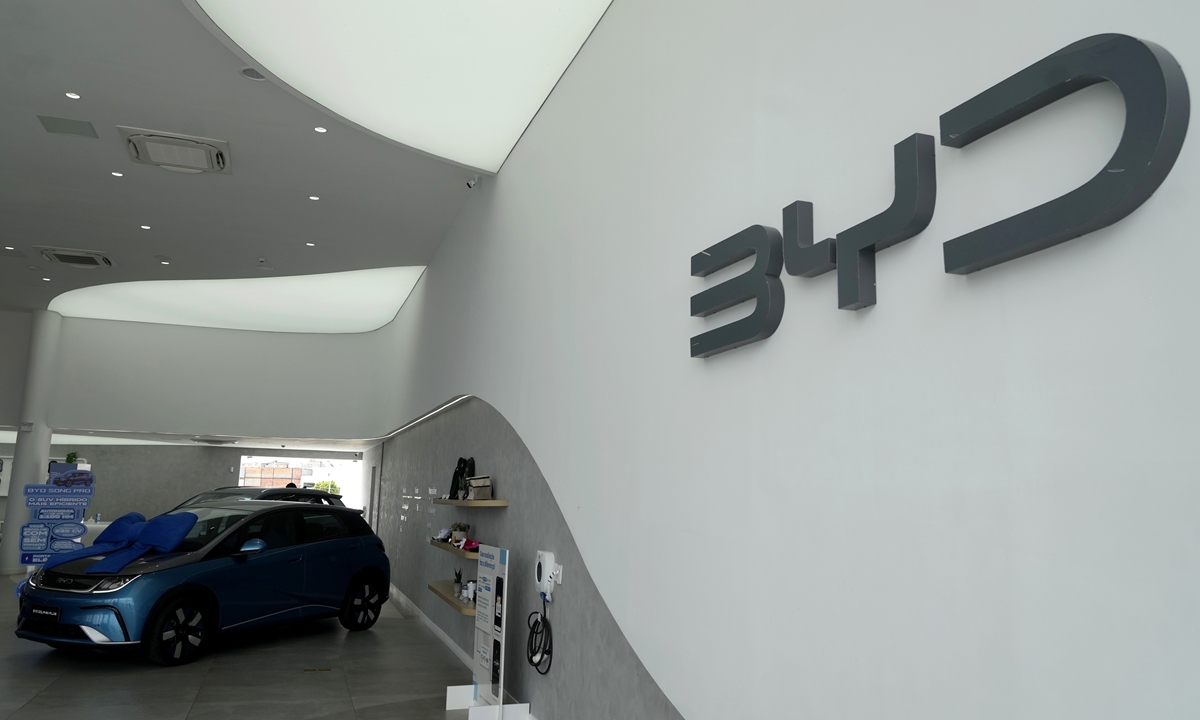
File photo: BYD vehicles are for sale in a dealership in Camacari, Bahia state, Brazil, on March 7, 2025. Photo: CFP
By Brasil 247 - Chinese automakers have cemented a strong presence in Brazil's automotive market. According to a report published by Estado de S. Paulo, in less than four years since BYD and GWM entered the country, Chinese brands now account for more than 10 percent of passenger car sales.Data from consultancy K.Lume shows that between January and August, Chinese manufacturers reached an 11 percent market share. That puts them ahead of traditional brands such as Toyota, Renault, Hyundai and Honda, which have had industrial operations in Brazil for decades.
Expanding dealership networks
A survey by Neocom found that BYD, GWM, Omoda & Jaecoo (O&J) and GAC together already operate 347 retail points, including dealerships and showrooms. This places them behind only Stellantis, with more than 1,000 locations, General Motors (565), and Volkswagen (443).
Much of this network has been fueled by imports, but some companies are already investing locally. GWM operates a factory in Iracemápolis, São Paulo, while BYD is preparing to begin production at its massive complex in Camaçari, Bahia.
Ambitious strategies
BYD is already among the country's top seven automakers and aims to break into the top five. GWM projects sales of up to 300,000 vehicles in Brazil, although its initial local production will be limited to 50,000 units per year.
But the rapid rise of Chinese brands is facing pushback. Stellantis, GM and Volkswagen are accelerating their own launches of hybrid and electric vehicles in Brazil.
A survey by Webmotors indicates that nearly half of Brazilian consumers still cite charging infrastructure and uncertainty over resale value as barriers to purchasing electric vehicles.
Regulatory hurdles
Chinese automakers multiplied their sales in Brazil sevenfold over the past three years.
Projections by Bright Consulting suggest that by 2025, Chinese brands could surpass 260,000 units sold in Brazil, maintaining roughly a 10 percent market share, including light trucks.
Yet challenges are mounting. Under pressure from the industry group Anfavea, the Brazilian government has gradually reintroduced import tariffs on hybrids and EVs. The maximum 35 percent rate will be reinstated in July 2026, and starting in 2027, it will also apply to vehicles assembled locally with imported components.
Rising competition
According to Alexandre Ayres, CEO of Neocom, traditional automakers are moving aggressively to defend their ground.
In São Paulo, Fiat's Fastback hybrid accounted for nearly half of the growth in electrified vehicle sales during the first half of the year, underscoring how competition is heating up.
Outlook
With stronger competition, higher tariffs and persistent structural hurdles, the expansion of Chinese automakers in Brazil is likely to slow in the coming years. Even so, capturing more than 10 percent of the market in such a short period signals the growing power of China's auto industry — and its ability to reshape mobility in one of the world's largest car markets.
(Reported by Brasil 247 on September 23, 2025)
