ARTS / CULTURE & LEISURE
China’s first ‘PhD candidate robot’ joins college in real-scenario test
By Sun Langchen and Published: Sep 25, 2025 10:18 PM
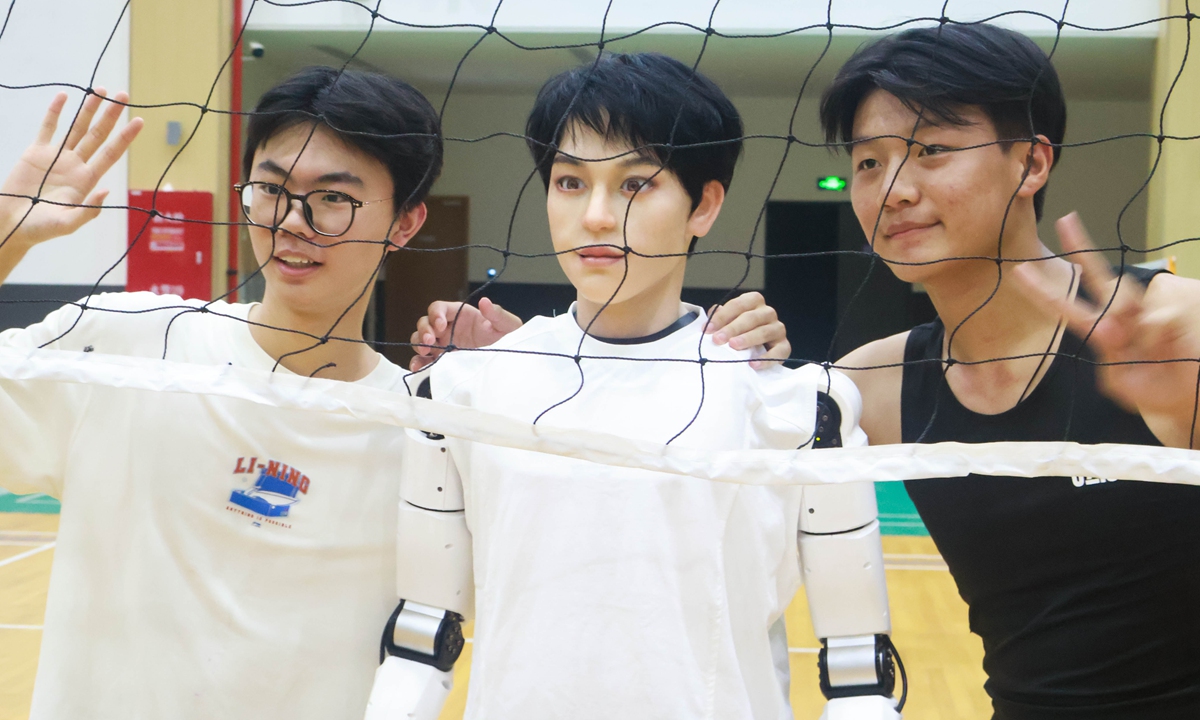
Robot "Top Scholar 01" (center) in a physical education class with other students from Shanghai Theatre Academy (STA) Photo: Courtesy of STA
When the Shanghai Theatre Academy (STA) opened its new academic year in September 2025, the spotlight did not fall on a star actor or a promising playwright, but a newcomer unlike any in the institution's 80-year history.Standing at 1.75 meters tall, weighing just 30 kilograms, fitted with expressive eyes that can blink and frown, and along with mechanical arms, "Top Scholar 01," China's first humanoid robot "PhD candidate student," walked into the auditorium and accepted his admission letter. For many, the moment felt less like a routine ceremony but more like a glimpse into the future of art education.
Questions immediately arose from the audience as the robot's enrollment video went viral on the internet: How does a robot navigate the PhD process? What does its training involve? And is this a publicity stunt or a pioneering experiment at the intersection of technology and art?
A real test scenario
Indeed, the initial idea of a humanoid robot PhD program came from a trial by the design team exploring Human-Robot Interaction (HRI) with real scenario tests.
When the robot was first brought into STA's rehearsal hall, staff played music to test his motion algorithms. To their surprise, he danced energetically, syncing closely with the rhythm. "He just started moving, keeping perfect time with the beat," Yang Qingqing, his advisor at the academy, recalled.
As "Top Scholar 01" has been assigned to a doctoral track in digital performing arts design, a field that seeks to merge stagecraft with artificial intelligence and robotics, he will take courses in stage design, directing, and acting fundamentals, and is even slated to attend traditional opera classes.
"We want him to gain a comprehensive artistic sensibility. He will study acting techniques, body expression, and even the subtleties of emotional presentation," she explained. "His eyes, for example, are cameras that can follow motion, blink naturally, and show concentration by frowning. These features allow him to practice performances in a way that feels remarkably human."
The robot's day-to-day routine will resemble that of his peers. He will attend classes, participate in rehearsals, and join student workshops. Behind the scenes, however, a dedicated technical team ensures that his batteries are charged, his data updated, and his sensors calibrated. "He is enrolled as a student, but supported like a laboratory," Yang noted.
When he is away from class, he will be in a specialized laboratory being fed datasets, but when he needs to attend seminars, he will walk independently to the classroom based on an uploaded predefined path, or controlled remotely when crowds come. One charge can hold it for about five hours of learning and working.
Under the guidance of his AI brain, he can rehearse, innovate, and even introduce subtle variations in each performance. His fluid, algorithm-driven movements allow it to emulate the elegant water sleeves of Peking Opera, a feat human performers can achieve only with years of painstaking practice.
"The software integrates large language models with image and speech recognition, allowing him to respond naturally in conversations. He can even crack a joke, though we've limited his vocabulary to keep interactions polite," Li Qingdu, head of "Top Scholar 01"'s design team from the University of Shanghai for Science and Technology, told the Global Times.
But still, human students remain skeptical: As AI and robots are expected to replace dirty, tiring, and menial work, are these creative, artistic and performance work experiments even necessary for a humanoid robot?
From art to elderly care
At the 2025 Beijing Culture Forum on Tuesday, Wang Xingxing, founder of Unitree Robotics, shared his views on the integration of robots and film production. He noted that by 2026, robots are expected to begin attempting stunt performances in movies and could also be applied to stage performances and related fields.
Former examples aren't rare as Unitree's robots mounted a performance at the 2025 Spring Festival Gala.
The fact that they are doing this program shows the technology has reached a critical threshold, and this is not just this robot. Historically, people referred to the Turing test, and in the next five years, you may not be able to tell whether the person sitting opposite you is actually a humanoid robot, Zheng Shuliang, an expert from the Department of Computer Science and Technology at Tsinghua University, told the Global Times.
Humanoid robots from some Chinese companies are trying out real scenarios, interacting with humans through performances or face-to-face conversations.
"Systems like ChatGPT can already perform at a doctoral level. In that context, HRI has become a crucial breakthrough, and theatrical performance is itself a natural, simulated scenario for testing and advancing that interaction," Li said.
He highlighted that this is never about a humanoid robot replacing humans in the art and film industries, but rather an area where AI's Turing test can be mostly reviewed, finally leading to the mastery of dangerous forms of work like stunt performances, or even elderly care.
Kong Peipei, deputy director and researcher at the institute of Chinese opera studies at the Chinese National Academy of Arts, echoed this from the audience's perspective.
She noted that the participation of robots in traditional opera performances is experimental in nature and can serve as an exploratory display.
"However, beyond the technological showcase, the constant emotional exchange between opera actors and the audience is a key reason why people are willing to step into the theater and embrace this form of artistic appreciation. Just as technologically advanced opera films can never replace live opera performances," Kong told the Global Times.
By acting as interactive performers, robots help digitize intangible cultural heritage and finally understand human emotion. Looking further ahead, the project could influence how society uses AI companions in elderly care, education, and hazardous professions.
"Rather than a rival, Scholar 01 is more like a catalyst," Huang Shenwen, a student at the academy who interacted with the robot, told the Global Times. "He pushes me to think about what makes human creativity irreplaceable. Technical tasks may be automated, but the core of art - imagination, empathy, and cultural context - remains uniquely human."
Of course, ethical questions linger. The "uncanny valley," the discomfort some feel when robots appear too human, remains a challenge. And as AI grows more sophisticated, society must define boundaries for creativity, authorship, and responsibility.
"AI evolves at a pace no one can fully predict," Yang said. "In four years, we don't know how far he will have progressed. But the process itself, documenting how a machine learns art alongside humans and reaches developed HRI for further use of robots, is the most valuable outcome."
RELATED ARTICLES