ARTS / CULTURE & LEISURE
Yunyang World Geopark reaches across borders, attracting swarms of visitors
A global geological laboratory
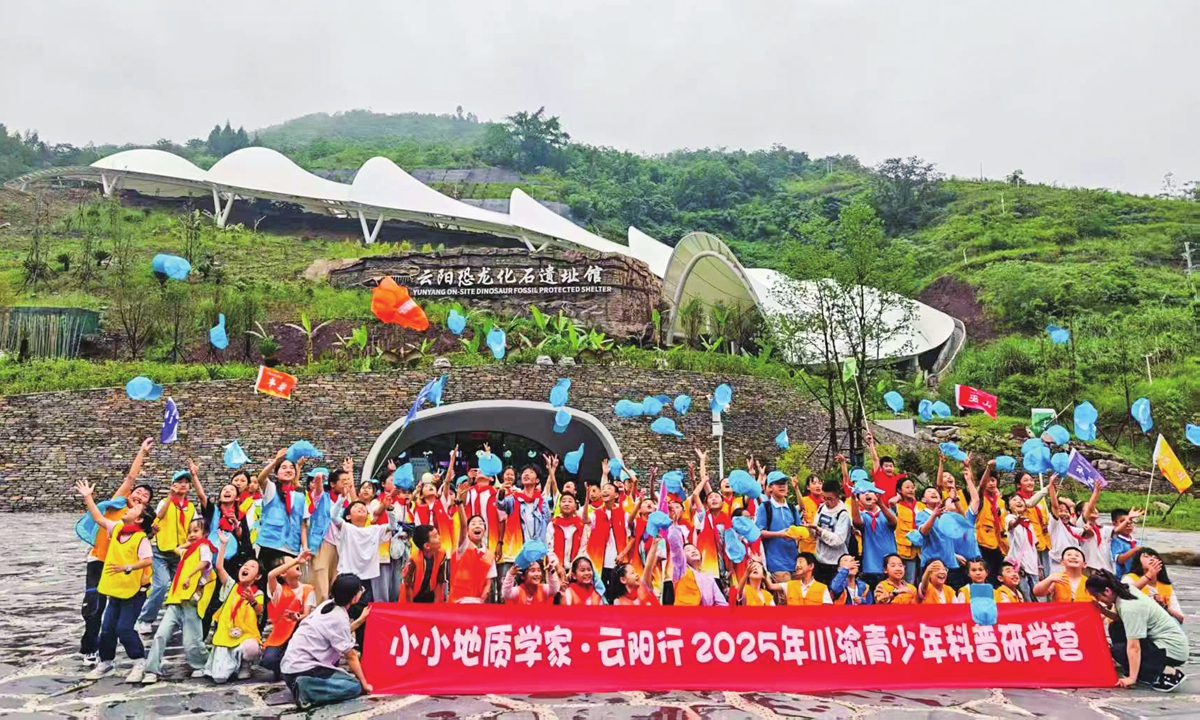
Students throw caps in front of the gate of the Yunyang Global Geopark during their field trip on June 7, 2025. Photos: Courtesy of the Yunyang Global Geopark
On a breezy afternoon in Chongqing's Yunyang World Geopark, children hunched over pieces of plaster, carefully pressing and joining them together to form the shapes of dinosaur bones. "It feels like I just brought a dinosaur back to life," Fan Jiahui, a student from Fengdu County, told the Global Times, as she cradled her handmade fossil model. "It's just magical."Around her, classmates carefully arranged rock samples into specimen boxes, noting their textures and hues. Others polished their own chosen stones into keepsake fossils. For these young explorers, the park had become not just a field trip, but a time machine stretching back millions of years.
This happened during a field trip arranged by the Geopark this summer. The highlight of the day awaited at the dinosaur fossil site museum in the park, where students found themselves standing before a colossal relic of Earth's history: Asia's most complete dinosaur fossil wall.
This rare paleontological exhibit is the world's largest single Jurassic fossil panel and the world's longest of its kind, stretching for an impressive 18.2 kilometers. Together, they map out the evolutionary arc of Asian dinosaurs, filling critical gaps in the global fossil records.
According to paleontologists, the region once bordered the ancient Bashu Lake. Catastrophic floods, landslides or storms likely swept herds of dinosaurs into the river deltas, where sediments entombed them for eternity, according to Beijing Daily.
"The local biodiversity made Yunyang a global-level Geopark, and now we are making another step by building connections with other global Geoparks," said Zhang Songlin, a representative from the Yunyang Global Geopark who leads the designation process.|
Biodiversity lab
Yunyang's significance is not confined to prehistoric remains. According to Zhang, the park is also home to Panshicheng, a 13th-century fortress known as the "First Stronghold of the Yangtze," which once resisted the Mongol cavalry during the Southern Song Dynasty (1127-1279). Its stone ramparts, water reservoirs, and ancestral halls stand as a living testament of mountain warfare.
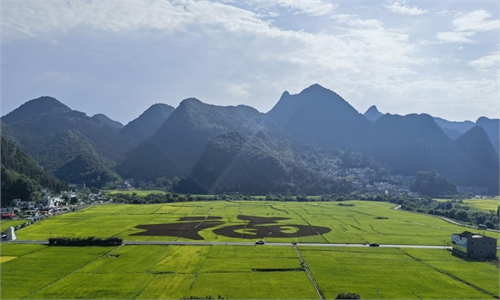
Another fascinating historical site is the Liming Ancient village, where Qing-era ancestral halls and farmhouses seamlessly blend with golden rapeseed fields. Tourists now ride a mini train through patchwork farmland, while villagers run guesthouses and restaurants. "It used to be that young people had to leave for work," said local resident Peng Ning, who now operates a popular homestay. "Now, staying here can also bring prosperity."
For residents, Yunyang's identity has always been tied to dragons. Ancient texts spoke of "immortals raising dragons in Yunyang," and the county's Dragon Ridge is said to resemble a serpent dipping into the Yangtze. The discovery of dinosaur fossils has only deepened this mythology, making the "land of dragons" a reality both legendary and scientific.
For university students like Meng Li, the park is as much a laboratory as a playground. On a recent geology field trip, she marveled at the karst formations of Longgang: honeycomb rocks, natural dams, stalactites, and yawning caves welcomed the curious visitors, who eagerly hopped on a sight-seeing train to better explore the surrounding areas.
The experience was not without thrills. "Sitting at the back of the train, the ride felt like a roller coaster," she laughed. "We rattled downhill with the wind howling, after hiking more than ten kilometers."
After the rain, the atmosphere became even more enchanting: clouds clung to the mountaintops, forming shapes that resembled hats and ribbons, while monkeys at the Xihou Terrace provided comic relief, squabbling over snacks tossed by visitors. "They don't bite, they're not aggressive," Meng told Global Times. "Here you can see a diverse and intriguing landscape steeped in ancient history," she said, admiringly.
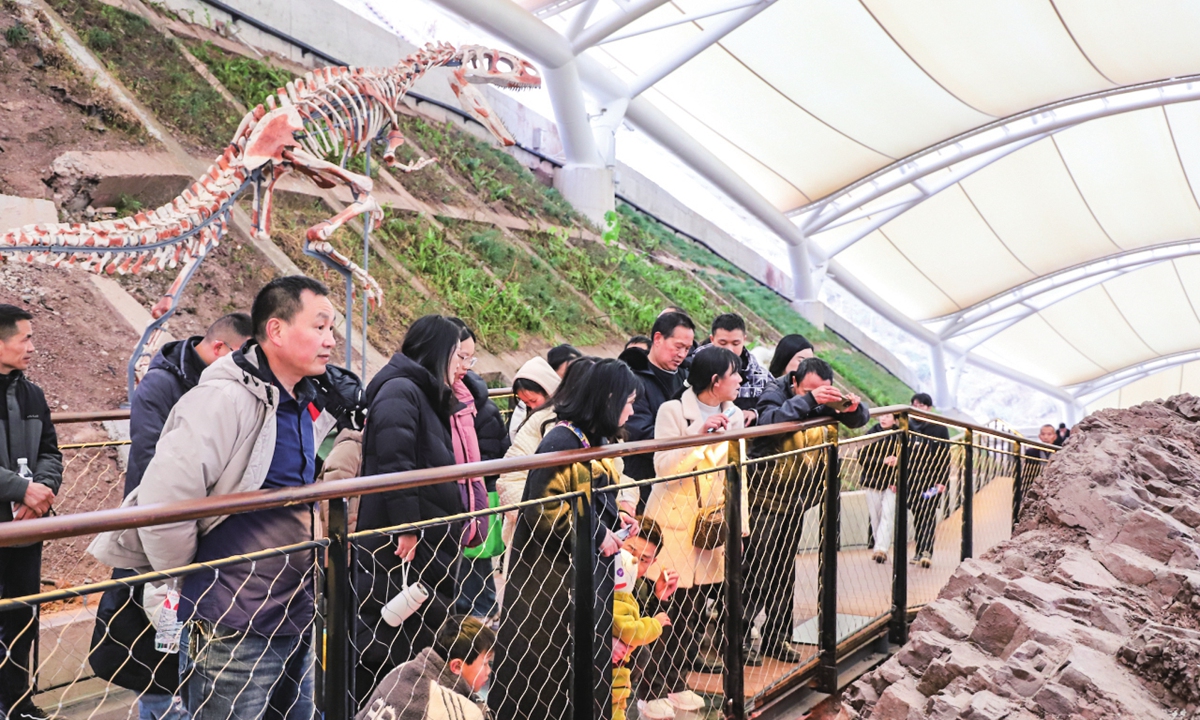
Toursits visit the Dinosaur Fossil Site Museum in Chongqing's Yunyang Global Geopark in September 2025.
Shared classroomsAt the 11th International Conference on UNESCO Global Geoparks in Chile this September, Yunyang signed sisterhood agreements with Hateg Global Geopark in Romania and M'Goun Global Geopark in Morocco. The collaboration spans fossil protection, scientific research, student exchanges, and sustainable tourism.
According to Zhang, the Yunyang, Hateg, and M'Goun UNESCO Global Geoparks, all renowned for their dinosaur fossil resources, have broad prospects for cooperation. They will collaborate in paleontological research and fossil conservation by sharing expertise and findings, jointly promote geo-tourism development through cross-border dinosaur-themed routes and branding, and strengthen science education and cultural exchange by hosting traveling exhibitions, youth study programs, and expert exchanges. Such cooperation would combine scientific value with tourism benefits, fostering a sustainable international partnership.
The move follows Yunyang's official recognition this April as a UNESCO Global Geopark, alongside Kanbula Geopark in Qinghai. This honor marked Chongqing's first title of its kind and placed Yunyang among the world's premier geological heritage sites.
Now, its new sister-park ties promise to carry these lessons far beyond China, extending field trips into Romania's Carpathians and Morocco's Atlas Mountains.
"Beyond geological studies, what excites us most is how this cooperation will provide bigger platforms for young people," Zhang said. "Our students will be able to explore the wider story of dinosaurs, ecosystems, and environments, not just here, but across continents."
It is not only Yunyang: China's UNESCO Global Geoparks such as Lushan and Kanbula have forged partnerships with international counterparts, working together in areas such as natural heritage conservation, science education, and green development.
Lushan has formed sister park ties with 15 geoparks across 16 countries, including Spain, Chile, and South Korea. These partnerships span sites famed for volcanic activity, glaciers, tidal flats, and rich cultural legacies, highlighting Earth's geological diversity and advancing global cooperation in heritage protection.
While on the Qinghai-Xizang Plateau, Kambala Global Geopark has signed a cooperation agreement with Langkawi Global Geopark in Malaysia, officially establishing them as sister parks. This marks Kambala Geopark's first collaboration with an international geopark.
"This international network is about more than science," Wu Kui, deputy director at the Hubei Institute of Geological Sciences, told the Global Times. "It connects museums, field trips, and young people across oceans. This means richer resources for our collections, and greater opportunities for global dialogue."
RELATED ARTICLES