ARTS / CULTURE & LEISURE
Global audiences join memorial to celebrate Confucius' birthday
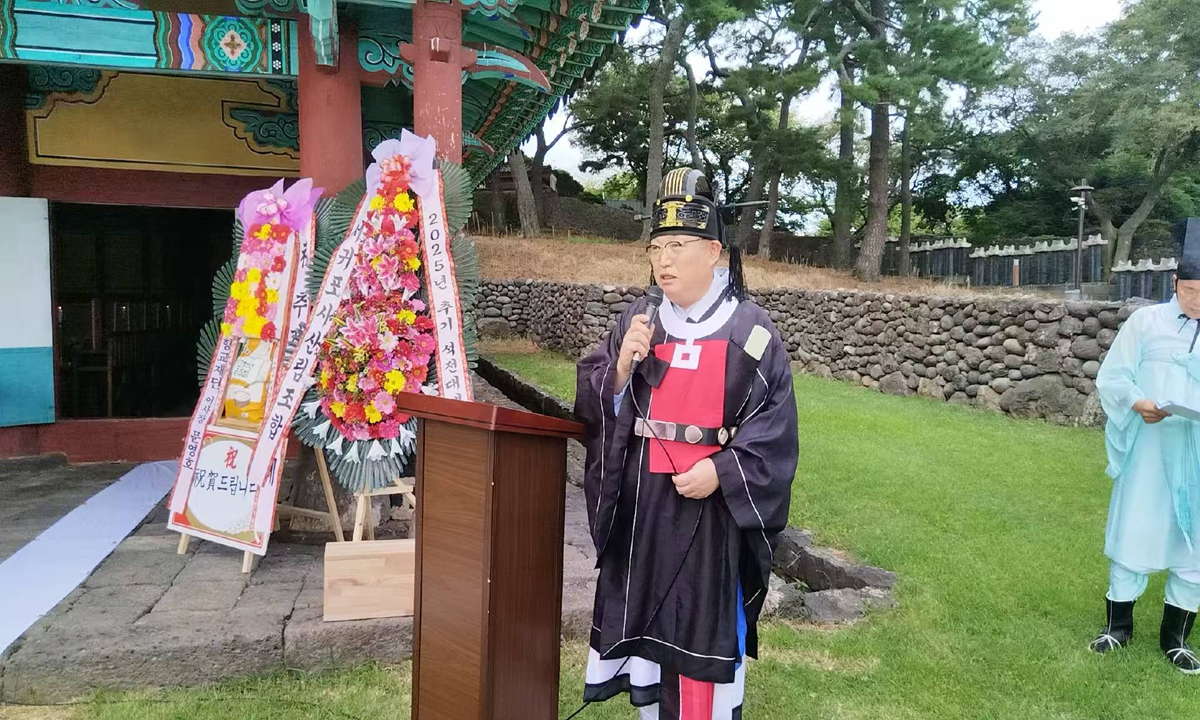
Piao Hongying, president of the Confucius Cultural Center in Seoul, South Korea, hosts a memorial ceremony for Confucius on September 25, 2025. Photo: Courtesy of Piao Hongying
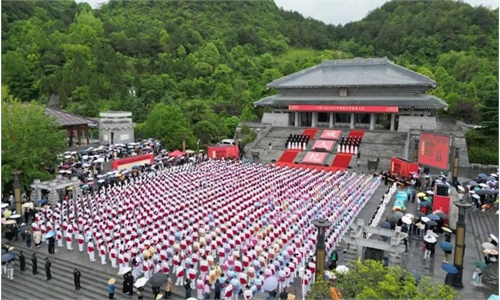
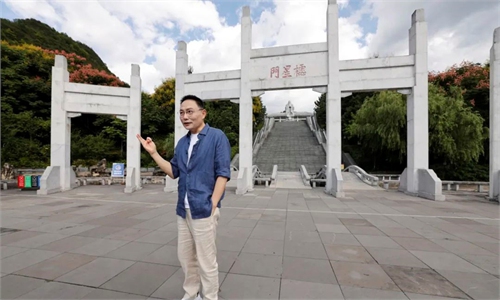
To commemorate the 2,576th anniversary of Confucius' birth, a Global Online Memorial Ceremony for Confucius was held in Qufu, the hometown of Confucius in East China's Shandong Province on Sunday, to share the charm of Chinese ritual and music culture with a global audience and explore the contemporary value of Confucian wisdom.
As a significant part of the 2025 China International Confucius Cultural Festival (CICCF), the online ceremony connected over 70 domestic and international Confucian temples, academies, and other Confucian institutions, attracting 35 million viewers to participate and jointly create a cultural symphony that transcended time and connected the world, according to a press release sent to the Global Times by the organizers.
Yu Jianfeng, an executive director of the online ceremony, told the Global Times on Sunday that the online event was a showcase of the profound heritage and contemporary vitality of Confucian culture, and even more, a striking implementation of integrating China's outstanding traditional culture into the modern era and bringing it to the world.
Confucian institutions in countries including Japan, South Korea and Indonesia took part in the overseas ceremonies, demonstrating the cross-cultural integration of Confucian thought.
Piao Hongying, president of the Confucius Cultural Center in South Korea, was selected as the chief ritual officer for the ceremony at Jeju Hyanggyo this year. Piao told the Global Times on Sunday that Confucianism is a common culture that connects the Chinese and South Korean people. "This was the first time Jeju Hyanggyo had a foreign chief ritual officer. The ceremony was a great platform to promote and carry forward Confucian culture. Over 200 institutions hold memorial ceremonies for Confucius in South Korea every year," Piao said.
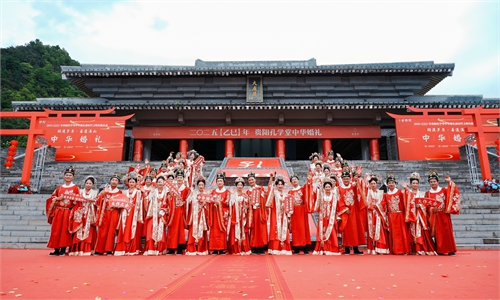
One of the highlights of the ceremony was the diverse presentation of Chinese ritual and music culture by Confucian institutions in different regions of China, said Yu.
Li (ritual) and Yue (music) are hailed as the "heart of Chinese culture" and serve as symbols of traditional Chinese civilization. Rituals aim to regulate outward behavior, while music cultivates inner character and sentiment. The spirit of Li-Yue culture permeated many aspects of ancient China, including laws and institutions, ethical principles, and individual cultivation of body and mind, establishing a shared set of behavioral norms and values for the Chinese people, according to the Nishan World Center for Confucian Studies.
Themed "Benevolence and Rites for All, Harmony and Great Unity," the ceremonies held at different cites showcased Confucian thought and culture through music and dance performances.
Fang Wei, an associate research fellow at the China Confucius Research Institute, said after the event that the memorial was more than a ritual of worship of Confucius. "What we saw more prominently was a display of the resilience and continuity of Chinese culture as a whole."
"Participating in an online live broadcast for the first time, I felt both novelty and excitement. Seeing people around the world honoring Confucius simultaneously filled me with a spontaneous sense of cultural pride. I also felt that the responsibility of promoting traditional culture and Confucianism is a challenging one," Yu shared Fang's remarks with the Global Times.
Another highlight of the ceremony was the participation of Confucian institutions in border regions such as the Guangxi Zhuang Autonomous Region and Yunnan Province. It showcased the vibrant integration of Confucianism with ethnic minority cultures, fostering mutual understanding and harmonious coexistence among different cultures, according to the press release.
Since 2016, 10 editions of the global memorial ceremony have been held. It has become a shining symbol of carrying forward historical traditions, strengthening cultural identity, uniting Chinese communities worldwide, and promoting mutual learning among world civilizations.
RELATED ARTICLES