ARTS / CULTURE & LEISURE
Chinese trail runner Yao Miao calls her UTMB victory is all about persistence and growth
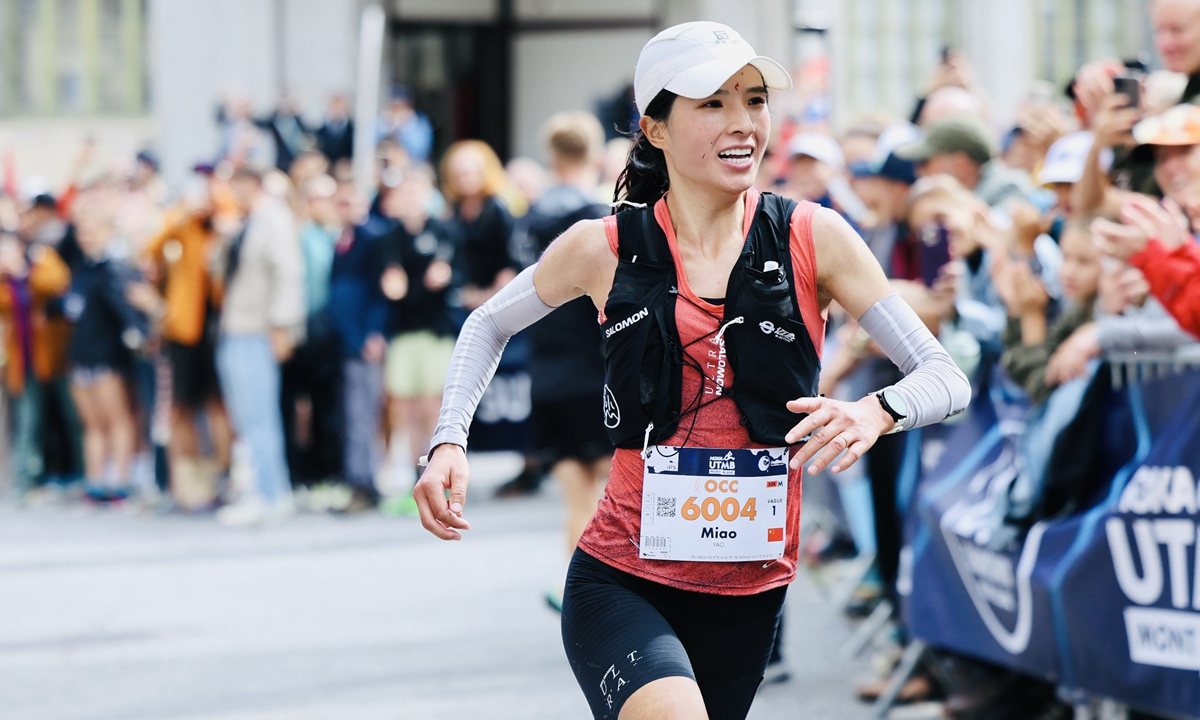
Chinese trail runner Yao Miao sprints toward the finish line at the UTMB race in France on August 28, 2025. Photo: Courtesy of UTMB
When Chinese trail runner Yao Miao crossed the finish line of the Ultra-Trail du Mont-Blanc (UTMB) Orsières-Champex-Chamonix race in France in August, she thought she had secured a hard-fought silver medal in the women's group.
A week later, news broke that the Kenyan runner who had finished ahead of her was disqualified for a doping violation, elevating Yao to first place.
"For an athlete, the race is already over the moment they cross the finish line, and everything else ceases to matter," the 28-year-old told the Global Times.
Her composure owed much to the way the race unfolded. At one crucial point, the official aid station ran out of supplies, leaving her without water. Instead of panicking, she pressed on until she found a farm shed, mixing electrolyte powder with water meant for livestock.
For Yao, it was a raw, unscripted moment that captured what trail running is really about: resilience, improvisation and sheer willpower.
Even when she was locked in a fierce back-and-forth battle with her Kenyan rival, Yao never lost her rhythm. "I didn't think too much at the time," she said. "I just kept moving forward."
Mountains as beginning
Born in Southwest China's Guizhou Province, Yao grew up surrounded by towering mountains that would one day become her training ground.
Her introduction to trail running was less about dreams of glory than about survival.
"At the beginning, it wasn't just about life choices," she recalled. "I felt stuck. I tried studying makeup to make a living after graduation from the sports academy since I didn't manage to enter any professional teams, but I soon got tired of it."
And her earliest races came natural: There was the track with which she was familiar, and there was prize money.
After a 30-hour train across China with her borrowed registration fee for her first 100-kilometer high-altitude race in Zhangye, Northwest China's Gansu Province, she withdrew midway, exhausted.
But instead of breaking her, the failure ignited something in her. "Why could others do it and I couldn't?" she asked herself.
She has always carried that attitude ever since. "When I want to do something, I just go and do it," she said.
From there, her journey was marked by both hardship and breakthrough.
The leap from local races to international stages demanded sacrifices: Punishing training schedules, financial strain and long stretches away from family. But her talent was finally discovered.
In 2018, she stunned the world by seizing victory at an international event. This is what she called "the chance to compete with top athletes from around the world."
Early in 2019, Yao was hailed by the Runner's World magazine for her fierce grace, saying the "graceful, virtually unknown Chinese runner has won in brutal style." An amateur runner who became her fan also emulates her style, gear and courage, finding in her story both strength and the truth of progress through struggle.
However, perhaps due to the intensity and frequency of competitions, Yao's body began to show warning signs.
Since 2019, she has experienced recurring eye problems, with doctors unable to pinpoint a cause, attributing it to high training loads.
That year, during the UTMB 168km race, she was forced to withdraw at 120 kms after a sudden brief loss of vision.
Battling physical strain and external pressures, she faced self-doubt and even considered quitting trail running.
Pivoting to marathons with the Hubei athletics team, she earned multiple national and international titles.
After the disruptions, she entered school to receive structured learning, winning major trail races from 2022 to 2024, becoming the first Asian to claim UTMB titles in different categories.
Even as her reputation grew, Yao's relationship with running evolved.
"My mindset is calmer now," she said. "Trail running is no longer just about making a living. Running has become a habit, apart from it, I have very little else."
Yao's daily life reflects this single-minded devotion. She devoted most of her time to training, resting and recovering at home.
On broader trails
Yao's rise mirrors the broader growth of long-distance running in China.
Marathons have become mainstream over the past decade, attracting millions of participants across the country. Trail running, though still less developed, is gaining momentum.
"Trail running is still at an early stage in China," Yao observed. "There are more professional runners and sponsors involved, but it remains relatively immature."
With that in mind, she recommends that newcomers do not jump straight into extreme distances.
"Start with shorter races, on less technical routes. Don't jump straight into 50 or 100 kilometers," she said.
For her, the essentials are stamina management and mental resilience.
"You'll hit limits during races, moments when breathing becomes difficult or your energy crashes. The key is nutrition, breathing and strategy," she said.
At the elite level, many Chinese athletes like Yao are beginning to find their footing on the world stage. Some have secured foreign coaches, and more are competing abroad to gain experience.
Still, Yao believes there is room to grow. "Things have improved a lot in recent years, but we still lack professional knowledge. More athletes are pushing forward on their own."
Her ambitions remain international. After missing out on the World Mountain and Trail Running Championships this year, she is determined to chase future world titles.
"We wanted to be there as it's one of the most important races," she explained. "The dream of becoming a world champion is still there."
At the same time, Yao has turned her attention back to her roots. In Guizhou, she has helped organize races for children from the mountains, hoping to offer them a broader horizon.
"I want to create more paths for kids in the mountains to run out into the world," she said.
RELATED ARTICLES