Takaichi wins vote to become first female president of LDP; China hopes Japan to honor commitments on history, Taiwan question, says FM
By , Zhang Wanshi and Xing Xiaojing Published: Oct 04, 2025 03:48 PM Updated: Oct 04, 2025 06:05 PM

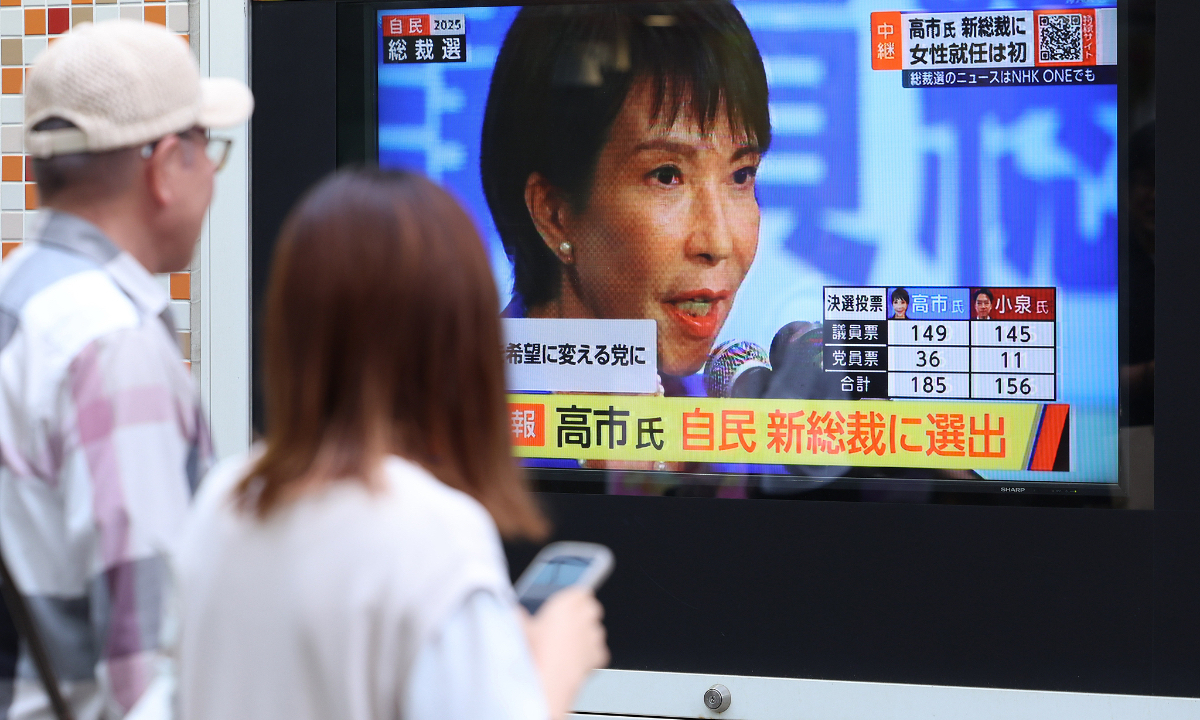
A news program on TV reports that Sanae Takaichi, Japan's former internal affairs minister, won the Liberal Democratic Party's presidential election by a runoff vote against Shinjiro Koizumi, the Minister of Agriculture, Forestry, and Fisheries, in Tokyo on October 4, 2025. Photo: CFP
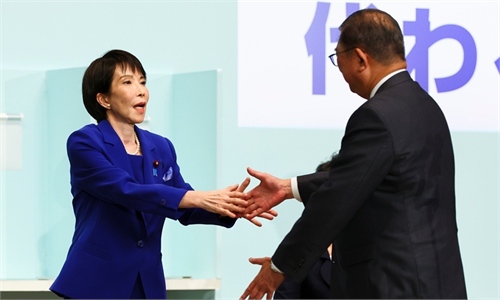
Japan's former internal affairs minister Sanae Takaichi on Saturday won the presidential election of Japan's ruling Liberal Democratic Party (LDP), becoming the first female LDP president. In the parliamentary vote in the coming days to formally elect the country's prime minister, she is likely to become first Japanese female prime minister, according to Japanese media reports.
In response to foreign media inquiry regarding the result of LDP presidential election, Chinese Foreign Ministry spokesperson said on Saturday that "We have noted the election result, which is Japan's internal affairs," adding that we hope the Japanese side will abide by the principles and consensus set out in the four political documents between China and Japan, honor its political commitments on major issues such as history and the Taiwan question, follow a positive and rational policy toward China, and put into practice the positioning of comprehensively advancing the strategic relationship of mutual benefit.
In the LDP presidential election, no candidate secured a majority in the first round. In the runoff, Takaichi defeated farm minister Shinjiro Koizumi by 185 votes to 156, becoming the new party president and the first woman ever to lead the LDP. If elected in the upcoming prime ministerial designation vote in the Diet, she will become Japan's first female prime minister, according to NHK report.
The five contenders for the Saturday race were Chief Cabinet Secretary Yoshimasa Hayashi, farm minister Shinjiro Koizumi and former internal affairs minister Sanae Takaichi, former economic security minister Takayuki Kobayashi and former Foreign Minister Toshimitsu Motegi, according to Kyodo News.
After the LDP chose the leader, a Diet vote will decide who will lead the country. The ruling coalition lacks a majority in the Lower and Upper houses. Meanwhile, senior officials from the Constitutional Democratic Party of Japan, Japan Innovation Party and Democratic Party for the People met Tuesday. While the CDP proposed working together to pick a different Prime Minister, the other parties appeared cool on the idea, according to NHK.
The Diet vote for Prime Minister will likely take place in the coming days, per NHK.
Takaichi's election as LDP president, putting her on course to become Japan's first female prime minister, marks a historic break from political tradition and underscores the party's bid to reinvent itself amid crisis. As Takaichi is a leading figure of Japan's right-wing conservatives, her leadership is expected to bear strong nationalist and conservative tones, Xiang Haoyu, a distinguished research fellow at the Department for Asia-Pacific Studies of the China Institute of International Studies, told the Global Times on Saturday.
Takaichi champions traditional Japanese values, backing aggressive fiscal and monetary stimulus to spur growth and bolster economic security. In foreign and security policy, she takes a hardline stance—pushing constitutional revision, military buildup, and exclusionary policies, said the expert.
Xiang also noted that the new LDP president is highly likely to become Japan's next prime minister. Despite lacking a majority, the LDP remains the largest party, and the opposition's disunity makes it unlikely to rally behind a single candidate.
Still, the incoming leader faces steep challenges. As head of a "double-minority government," lacking control of both houses, she must push political reform, maintain party unity, and lift sagging support rates—all while struggling to pass legislation. To survive, the new administration will need to compromise with the opposition and may even consider forming a broader coalition, leaving Japan's political trajectory highly uncertain, said the expert.
A Kyodo News report noted that former internal affairs minister Takaichi, is known to be a staunch conservative and a policy expert. The report also noted that Takaichi, known for her close ties with former Prime Minister Shinzo Abe, has advocated amending the Constitution so Japan can possess "national defense forces."
It said that known as an admirer of former British Prime Minister Margaret Thatcher, she has held key posts in the LDP and the Cabinet, including the head of the party's Policy Research Council and state minister in charge of Okinawa and Northern Territories issues and Japan's falling birthrate.
A Kyodo News report noted that Takaichi has faced criticism in the past from neighboring countries for her frequent visits to Yasukuni shrine, a war-linked shrine in Tokyo seen by the neighboring countries as a symbol of Japan's past militarism.
Takaichi had previously participated in LDP presidential race, and demonstrated hardline stance, including last year's. In her bid in 2021, she even held an online meeting with Tsai Ing-wen, then regional leader of the island of Taiwan.
In last week's debate among the five LDP candidates, Takaichi declined to say whether she would visit the shrine if elected, but said Japan must not allow other nations to make it a diplomatic issue, according to Kyodo News report.
After Shigeru Ishiba became prime minister, China-Japan relations showed signs of recovery as both sides moved toward broader engagement. If Takaichi becomes Japan's first female prime minister, the key question is how she will handle ties with Beijing, Lü Chao, president and associate professor at the Institute of American and East Asian Studies at Liaoning University, told the Global Times on Saturday.
Japanese politics often sees leaders adjust their stance once in office. Takaichi's approach may evolve once she takes the helm. It is too early to predict her course, but any Japanese leader will inevitably have to weigh the international environment, with relations with China remaining central to Japan's strategic interests, said the expert.
RELATED ARTICLES