LDP chief Takaichi reportedly may skip visit to infamous Yasukuni Shrine for autumn rite; ‘move to pave the way for her win in Japan’s PM election’
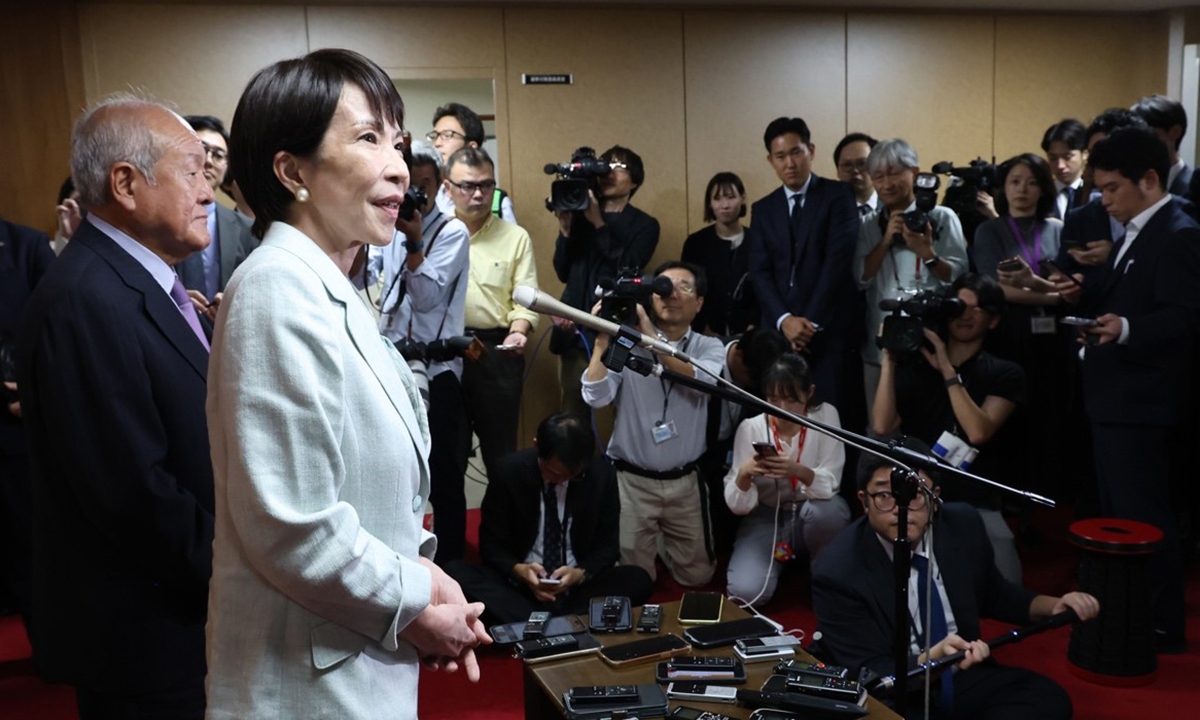
New Liberal Democratic Party (LDP) President Sanae Takaichi speaks to media after meeting with Komeito leader Tetsuo Saito at LDP headquarters in Tokyo on October 7, 2025. Photo: VCG
Sanae Takaichi, leader of Japan's ruling Liberal Democratic Party (LDP), may skip a visit to the war-linked Yasukuni Shrine during its autumn festival later this month, Japan's Kyodo News reported, citing sources close to her, as Takaichi comes under pressure to soften her conservative stance on diplomacy.The report said Takaichi's aides have expressed concern that a visit, even before she formally takes office, expected by the end of October, would almost certainly provoke strong reactions from China and South Korea, prompting her to exercise caution.
During official campaigning for the LDP presidential race, Takaichi claimed to work to "deepen Japan-South Korea ties," while expressing eagerness to engage in dialogue with Chinese leaders, Kyodo News reported.
Takaichi is a regular visitor to the Yasukuni Shrine, Reuters reported on Sunday. The infamous Yasukuni Shrine honors convicted Class-A war criminals who committed atrocities against other nations during World War II. Takaichi visited the Shrine on August 15 this year, the Japan Times reported, the day of Japan's unconditional surrender in the World War II.
In 2024, Takaichi claimed she would continue to visit the shrine even if she assumes the post of prime minister, per Kyodo News.
In this year's LDP presidential election, Takaichi, however, did not make explicit statements regarding visits to Yasukuni Shrine.
When asked whether she would visit Yasukuni Shrine if elected prime minister in the Diet's designation vote, Takaichi said, "I will make an appropriate decision at the proper time on how to honor the war dead and how to pray for peace." She claimed that "this should never be turned into a diplomatic issue," per NHK.
Twofold considerations
On the diplomatic front, Takaichi is set to hold her first in-person talks with US President Donald Trump in Japan, with the two countries arranging a three-day visit from October 27, Kyodo News reported, citing diplomatic sources.
From Takaichi's own perspective, overemphasizing sensitive issues like the infamous Yasukuni Shrine at present would be disadvantageous for the prime ministerial votes, Da Zhigang, a research fellow at the Institute of Northeast Asian Studies at the Heilongjiang Provincial Academy of Social Sciences, told the Global Times on Wednesday.
Visiting notorious Yasukuni Shrine would spark criticism from China, South Korea, and others, hindering the new government's diplomatic outreach, Da said. As a result, Takaichi's position on the issue will likely be more restrained than in the past, he added.
Echoing with Da, Lü Chao, president and associate professor at the Institute of American and East Asian Studies at Liaoning University, also said Takaichi is aware of the consequences of visiting the Yasukuni Shrine and made this choice to avoid impacting her upcoming administration.
However, Lü told the Global Times that this does not indicate that her fundamental perspectives on historical issues have transformed.
Takachi's conservative stance regarding Yasukuni Shrine has also drawn discontent from the LDP's ruling coalition partner. Japan's Komeito Party representative Tetsuo Saito and Takaichi held a 90-minitue meeting on Tuesday, after which Saito said that he conveyed concerns to Takaichi specifically about visits to Yasukuni Shrine and policies regarding foreigners, the Japan News reported on Wednesday.
Some progress was made toward a coalition agreement between the LDP and Komeito, but points of contention remain, per the report.
During Saito's meeting with Takaichi earlier last week, he also expressed concerns including the impact of visits to the infamous Yasukuni Shrine on diplomacy and other fields, saying the formation of the coalition government cannot be pushed forward if these concerns are not addressed, Japanese media Nikkei reported.
Takaichi's consideration are also shaped by domestic political pressures, Da said. Lacking a strong factional base, she must carefully gauge the sentiments of various factions within LDP to win support and consolidate her political footing, he added.
Japan's Jiji News said it is rare for multiple meetings between the leaders of the LDP and Komeito to confirm the continuation of their coalition.
The LDP already suffered a defeat in the House of Councillors election in July. If Komeito withdraws from the coalition government, the LDP's governing prospects will turn grim, Lü said, adding that therefore Takaichi must engage in thorough consultations with Komeito in order to sustain the coalition government.
Another factor she must consider, Da said, is that a united opposition could nominate a candidate for Japan's prime minister and promise cabinet positions, potentially obstructing Takaichi's election.
For the LDP, every decision is now being weighed with heightened caution to ensure the smooth operation of the new government, Da said.
LDP lawmaker Minoru Kihara, who is likely to be tapped as chief cabinet secretary under Takaichi's leadership, has decided to postpone a two-day trip to Taiwan region from Thursday as part of a cross-party group, another source close to him said, per Kyodo News.
Takaichi's temporary shelving represents a strategic adjustment based on multiple practical considerations aimed at achieving her political goals, Da noted. As for her true stance, it remains to be seen whether she will help in improving Japan-China relations.
In response to foreign media inquiry regarding the result of LDP presidential election, Chinese Foreign Ministry spokesperson said on Saturday that "We have noted the election result, which is Japan's internal affairs," adding that China hopes the Japanese side will abide by the principles and consensus set out in the four political documents between China and Japan, honor its political commitments on major issues such as history and the Taiwan question, follow a positive and rational policy toward China, and put into practice the positioning of comprehensively advancing the strategic relationship of mutual benefit.
RELATED ARTICLES