China-built New Demerara River Bridge emerges as symbol of Guyana's modernization
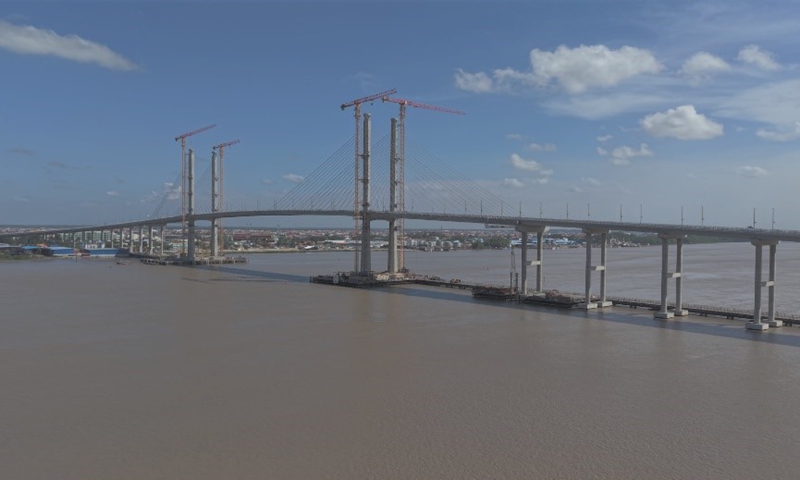
West of Georgetown, the capital of Guyana, the Demerara River flows vigorously into the Atlantic Ocean. Stretching across this 1.8-kilometer-wide estuary is a magnificent reinforced concrete cable-stayed bridge, now a new landmark for the city. This is the New Demerara River Bridge, constructed by China Railway Construction Corporation International (CRCC International), which was officially opened to traffic on October 5 local time.
"Today is a day written in the stars of our nation's history. This bridge we commission today is no ordinary structure; it is a monument of courage, wisdom, and progress," said President Irfaan Ali of Guyana at the opening ceremony.
"This bridge is our pride and it is changing our lives," said the president.
"During peak hours, it used to take an hour to cross the river. Now, with the new bridge, the crossing time has been significantly reduced," said taxi driver Harvey, whose gaze turned to the floating bridge nearby, which was built in 1978 with a design lifespan of only 10 years.
Before the new bridge opened to traffic, the floating bridge served as the critical lifeline for cross-river commuters. "The floating bridge had limited capacity. During peak hours every day, long queues of vehicles caused severe congestion. Additionally, the floating bridge had to open for one to two hours daily to allow ships to pass, further exacerbating traffic issues. With the construction of the new bridge, everything changes," Harvey said.
CRCC International signed a construction contract with Guyana's Ministry of Public Works in 2022, and construction began in January 2023 - one that embodies the high expectations of the Guyanese people.
Spanning 2,900 meters, the bridge features four lanes in both directions along with a non-motorized vehicle lane, with a designed speed of 80 km/h. The new bridge cuts the crossing time by three-quarters, and its main navigation channel can accommodate 50,000-ton vessels, said Project Manager Wang Zhiliang. This not only significantly improves traffic efficiency but also greatly enhances navigation conditions on the Demerara River.
"With smoother traffic, doing business has become more convenient," a fruit vendor told the Global Times reporters. "This bridge is our pride and it is changing the way we live."
"The project transforms from an ambitious idea into one of the most transformative undertakings in Guyana's history," said Guyana's Minister of Public Works Juan Edghill at the opening ceremony.
The Department of Public Information of Guyana published an article stating, "The bridge is a landmark development in Guyana's ongoing journey toward modernization, providing safe, efficient, and sustainable connectivity for generations to come."
"Thank my Chinese colleagues for bringing advanced technology to Guyana," it said.
Behind the successful opening of the bridge lies over two years of round-the-clock dedication from Chinese and Guyanese builders. Looking back on the construction process, Ganesh, a Guyanese young engineer, still recalls numerous details.
Ganesh pursued his studies in Trinidad, and after graduation, he worked in the local construction sector. Upon learning that a bridge would be built in his hometown, he resolutely returned to Guyana and joined CRCC International. From driving the first pile to hoisting the first beam and installing the first stay cable, Ganesh witnessed and participated many "firsts" in his career during the bridge's construction.
"More importantly, I have learned valuable new technologies from my Chinese colleagues. For them, these bridge construction techniques are 'routine experiences,' but for me, they were entirely new knowledge," he said. "I sincerely thank my Chinese colleagues for bringing advanced technologies to Guyana and thank the Chinese company for bringing this first-class bridge to Guyana."
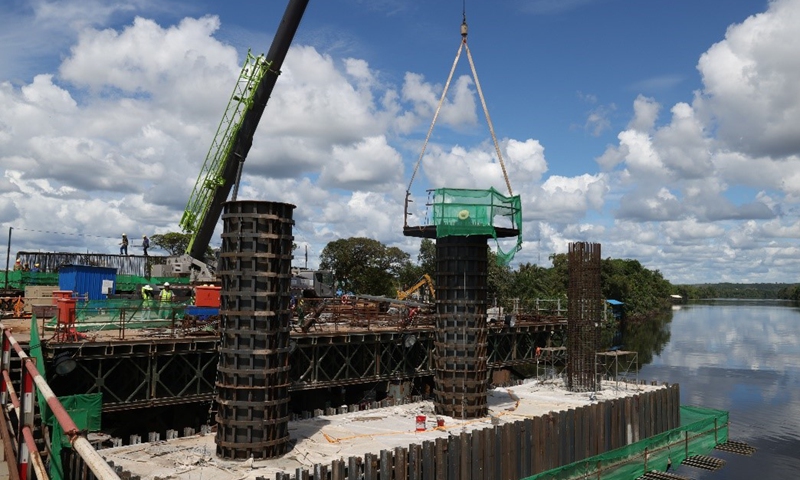
Meanwhile, the bridge's construction was far more than a simple "application" of Chinese technology. Confronted with challenges such as ultra-deep soft soil layers at the river mouth, a highly corrosive marine environment and a daily tidal range of up to three meters, the construction team innovatively adopted reverse circulation drilling technology to drive 120-meter ultra-long piles deep into the ground. Together with over 40,000 meters of pile foundations in total, these measures have provided a solid foundation for the project.
Chief engineer of the project Ning Guangwei noted that to tackle the problem of high fine particle content in local sand and the high cost of imported sand, the project team drew inspirations from "harnessing water to scour away sand" - a concept of Pan Jixun, an engineering expert of the Ming Dynasty - and developed a new process of "harnessing water to separate sand." This involved using drills to create high-speed water flows with sand to scour the adhesion between particles, followed by separation through impact with grid plates. This approach has resolved the sand supply problem, reduced costs and improved construction efficiency.
According to CRCC International, since the project began, it has created over 2,000 jobs for local people, with the employment of more than 20 local senior engineers and over 300 technicians. They also regularly held "open days," inviting Guyanese engineers, university students and schoolchildren to visit, cumulatively hosting over 2,000 visitors.
When viewing from the bridge, a long stretch of mangrove forests runs along the western bank of the Demerara River into the distance. Among the trees, egrets occasionally leap from the branches, skimming over the water. This mangrove forest serves as a protective barrier for the riverbank and is an important habitat for various aquatic plants and animals.
From the initial design stage, the project prioritized "green construction."
"We adopted a bridge-crossing scheme, bypassing the most densely populated mangrove areas to minimize ecological disruption," explained Francis, who is the project's Health, Safety, and Environment Officer. During construction, the project team consistently conducted water and soil testing, dust suppression treatments, collected 20 tons of waste oil and strictly prohibited open flames near the protected area.
"This is our responsibility towards the wetlands, the wildlife, and the future," Francis said.
"The fruits of our joint efforts under the Belt and Road Initiative (BRI) are being realized and implemented."
Traveling upstream along the Demerara River leads to Linden, a city thriving on mineral and timber resources. However, traffic between the two sides of the river has long relied on a nearly 50-year-old bridge with only single-lane passage, causing frequent vehicle delays and severely hampering the city's development.
Now, this situation is about to change. The Mackenzie-Wismar Bridge project, also undertaken by CRCC International, is under intense construction. Project Manager of the Mackenzie-Wismar Bridge An Pengfei stated that upon completion, the new bridge will replace the old one, reducing the average crossing time from 20 minutes to less than three minutes. The new bridge is designed with a navigational clearance height of 11.5 meters and a width of 32 meters, allowing large cargo ships to pass through. Once completed, it will effectively alleviate congestion from the old bridge and serve as a hub connecting Guyana's coastal and inland regions, promoting local economic and social development.
Currently, Guyana is planning the construction of a highway from Linden to Lethem on the southern border with Brazil. The Mackenzie-Wismar Bridge is a critical node in this important transportation corridor. The Guyana Chronicle, one of the most influential newspapers in Guyana, commented that this is a strategic move by Guyana to advance transportation modernization and enhance regional connectivity.
According to data from the Department of Public Information of Guyana, the country's construction sector grew by 20 percent year-on-year in 2024. This number is expected to continue rising with the completion of a series of national-level infrastructure projects. Chinese companies are playing a significant role in this process. Beyond the New Demerara River Bridge and the Mackenzie-Wismar Bridge, Chinese enterprises are also involved in airport expansions, hospital and school constructions and power transmission projects in Guyana, promoting the country's modernization transformation.
Chinese Ambassador to Guyana Yang Yang told reporters that Guyana is an important partner for China in the Caribbean region. Since establishing diplomatic relations 53 years ago, cooperation between the two countries has yielded fruitful results across various fields, setting an example of equal treatment, mutual support and win-win cooperation between countries of different sizes.
"The practical cooperation between China and Guyana is entering a fast lane of rapid development, and the fruits of our joint efforts under the BRI are being realized and implemented," Yang said.
"Promoting trade through connectivity, driving growth through cooperation and sharing," Paul Cheong, president of the Guyana-China Friendship Society, told reporters. He expressed that the bridges not only improve people's livelihoods but also represent the deepening mutual trust and cooperation between Guyana and China, demonstrating that the BRI provides broad development opportunities for Latin American countries.
"This is a bridge of friendship, a bridge of development, and a bridge to the future," Cheong added.
The New Demerara River Bridge Photo: Hu Zihan
"Today is a day written in the stars of our nation's history. This bridge we commission today is no ordinary structure; it is a monument of courage, wisdom, and progress," said President Irfaan Ali of Guyana at the opening ceremony.
"This bridge is our pride and it is changing our lives," said the president.
"During peak hours, it used to take an hour to cross the river. Now, with the new bridge, the crossing time has been significantly reduced," said taxi driver Harvey, whose gaze turned to the floating bridge nearby, which was built in 1978 with a design lifespan of only 10 years.
Before the new bridge opened to traffic, the floating bridge served as the critical lifeline for cross-river commuters. "The floating bridge had limited capacity. During peak hours every day, long queues of vehicles caused severe congestion. Additionally, the floating bridge had to open for one to two hours daily to allow ships to pass, further exacerbating traffic issues. With the construction of the new bridge, everything changes," Harvey said.
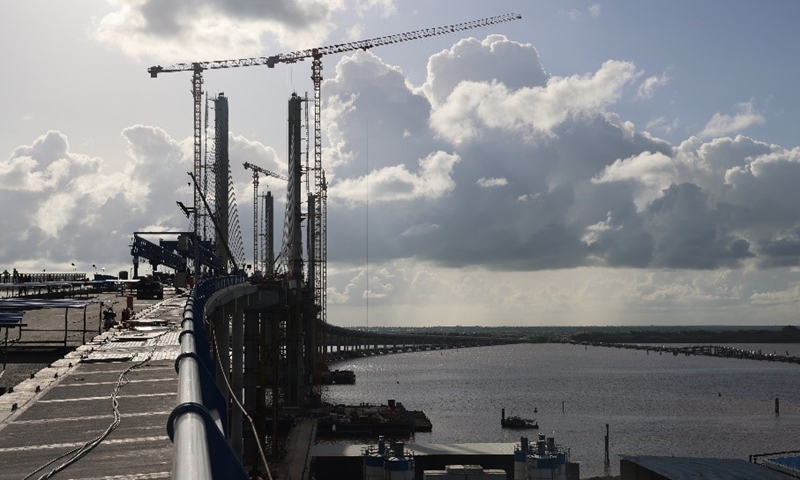
The New Demerara River Bridge is under construction, which is a sharp contrast to the old floating bridge (right). Photo: Shi Yuanhao
CRCC International signed a construction contract with Guyana's Ministry of Public Works in 2022, and construction began in January 2023 - one that embodies the high expectations of the Guyanese people.
Spanning 2,900 meters, the bridge features four lanes in both directions along with a non-motorized vehicle lane, with a designed speed of 80 km/h. The new bridge cuts the crossing time by three-quarters, and its main navigation channel can accommodate 50,000-ton vessels, said Project Manager Wang Zhiliang. This not only significantly improves traffic efficiency but also greatly enhances navigation conditions on the Demerara River.
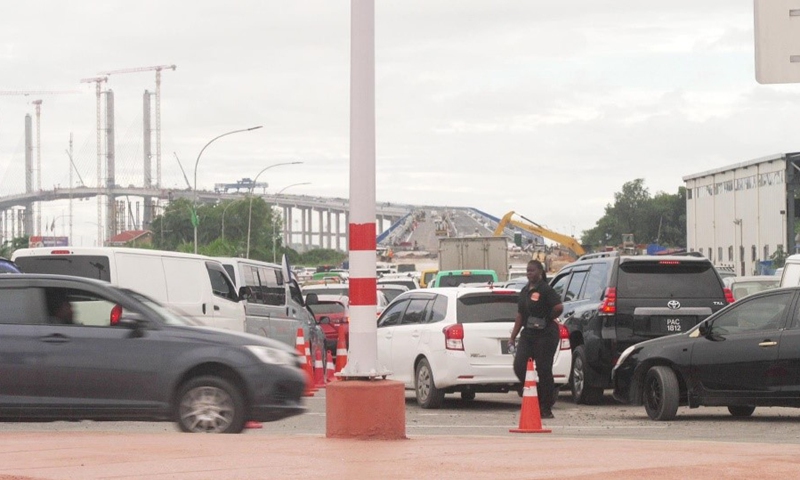
Prior to the opening of the New Demerara River Bridge, Georgetown grappled with serious traffic congestion. Photo: Luiz Branco
"With smoother traffic, doing business has become more convenient," a fruit vendor told the Global Times reporters. "This bridge is our pride and it is changing the way we live."
"The project transforms from an ambitious idea into one of the most transformative undertakings in Guyana's history," said Guyana's Minister of Public Works Juan Edghill at the opening ceremony.
The Department of Public Information of Guyana published an article stating, "The bridge is a landmark development in Guyana's ongoing journey toward modernization, providing safe, efficient, and sustainable connectivity for generations to come."
"Thank my Chinese colleagues for bringing advanced technology to Guyana," it said.
Behind the successful opening of the bridge lies over two years of round-the-clock dedication from Chinese and Guyanese builders. Looking back on the construction process, Ganesh, a Guyanese young engineer, still recalls numerous details.
Ganesh pursued his studies in Trinidad, and after graduation, he worked in the local construction sector. Upon learning that a bridge would be built in his hometown, he resolutely returned to Guyana and joined CRCC International. From driving the first pile to hoisting the first beam and installing the first stay cable, Ganesh witnessed and participated many "firsts" in his career during the bridge's construction.
"More importantly, I have learned valuable new technologies from my Chinese colleagues. For them, these bridge construction techniques are 'routine experiences,' but for me, they were entirely new knowledge," he said. "I sincerely thank my Chinese colleagues for bringing advanced technologies to Guyana and thank the Chinese company for bringing this first-class bridge to Guyana."
The New Demerara River Bridge is under construction. Photo: Shi Yuanhao
Meanwhile, the bridge's construction was far more than a simple "application" of Chinese technology. Confronted with challenges such as ultra-deep soft soil layers at the river mouth, a highly corrosive marine environment and a daily tidal range of up to three meters, the construction team innovatively adopted reverse circulation drilling technology to drive 120-meter ultra-long piles deep into the ground. Together with over 40,000 meters of pile foundations in total, these measures have provided a solid foundation for the project.
Chief engineer of the project Ning Guangwei noted that to tackle the problem of high fine particle content in local sand and the high cost of imported sand, the project team drew inspirations from "harnessing water to scour away sand" - a concept of Pan Jixun, an engineering expert of the Ming Dynasty - and developed a new process of "harnessing water to separate sand." This involved using drills to create high-speed water flows with sand to scour the adhesion between particles, followed by separation through impact with grid plates. This approach has resolved the sand supply problem, reduced costs and improved construction efficiency.
According to CRCC International, since the project began, it has created over 2,000 jobs for local people, with the employment of more than 20 local senior engineers and over 300 technicians. They also regularly held "open days," inviting Guyanese engineers, university students and schoolchildren to visit, cumulatively hosting over 2,000 visitors.
When viewing from the bridge, a long stretch of mangrove forests runs along the western bank of the Demerara River into the distance. Among the trees, egrets occasionally leap from the branches, skimming over the water. This mangrove forest serves as a protective barrier for the riverbank and is an important habitat for various aquatic plants and animals.
From the initial design stage, the project prioritized "green construction."
"We adopted a bridge-crossing scheme, bypassing the most densely populated mangrove areas to minimize ecological disruption," explained Francis, who is the project's Health, Safety, and Environment Officer. During construction, the project team consistently conducted water and soil testing, dust suppression treatments, collected 20 tons of waste oil and strictly prohibited open flames near the protected area.
"This is our responsibility towards the wetlands, the wildlife, and the future," Francis said.
"The fruits of our joint efforts under the Belt and Road Initiative (BRI) are being realized and implemented."
Traveling upstream along the Demerara River leads to Linden, a city thriving on mineral and timber resources. However, traffic between the two sides of the river has long relied on a nearly 50-year-old bridge with only single-lane passage, causing frequent vehicle delays and severely hampering the city's development.
Now, this situation is about to change. The Mackenzie-Wismar Bridge project, also undertaken by CRCC International, is under intense construction. Project Manager of the Mackenzie-Wismar Bridge An Pengfei stated that upon completion, the new bridge will replace the old one, reducing the average crossing time from 20 minutes to less than three minutes. The new bridge is designed with a navigational clearance height of 11.5 meters and a width of 32 meters, allowing large cargo ships to pass through. Once completed, it will effectively alleviate congestion from the old bridge and serve as a hub connecting Guyana's coastal and inland regions, promoting local economic and social development.
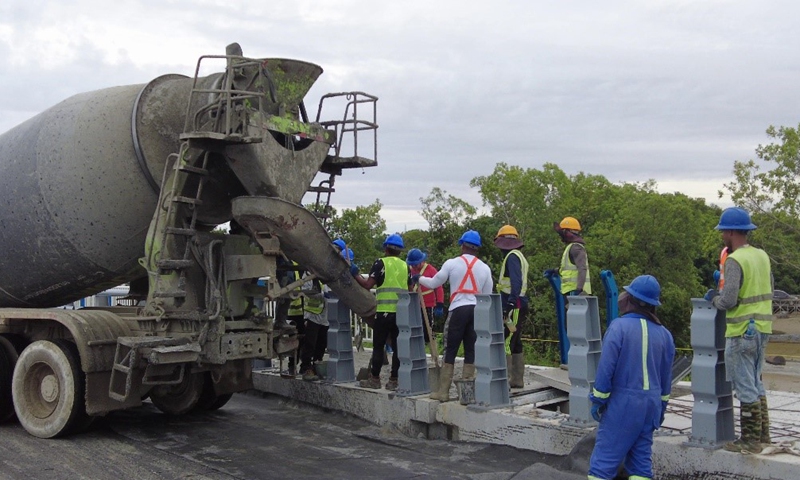
The Mackenzie–Wismar Bridge is under construction by Chinese and Guyanese workers. Photo: Shi Yuanhao
Currently, Guyana is planning the construction of a highway from Linden to Lethem on the southern border with Brazil. The Mackenzie-Wismar Bridge is a critical node in this important transportation corridor. The Guyana Chronicle, one of the most influential newspapers in Guyana, commented that this is a strategic move by Guyana to advance transportation modernization and enhance regional connectivity.
According to data from the Department of Public Information of Guyana, the country's construction sector grew by 20 percent year-on-year in 2024. This number is expected to continue rising with the completion of a series of national-level infrastructure projects. Chinese companies are playing a significant role in this process. Beyond the New Demerara River Bridge and the Mackenzie-Wismar Bridge, Chinese enterprises are also involved in airport expansions, hospital and school constructions and power transmission projects in Guyana, promoting the country's modernization transformation.
Chinese Ambassador to Guyana Yang Yang told reporters that Guyana is an important partner for China in the Caribbean region. Since establishing diplomatic relations 53 years ago, cooperation between the two countries has yielded fruitful results across various fields, setting an example of equal treatment, mutual support and win-win cooperation between countries of different sizes.
"The practical cooperation between China and Guyana is entering a fast lane of rapid development, and the fruits of our joint efforts under the BRI are being realized and implemented," Yang said.
"Promoting trade through connectivity, driving growth through cooperation and sharing," Paul Cheong, president of the Guyana-China Friendship Society, told reporters. He expressed that the bridges not only improve people's livelihoods but also represent the deepening mutual trust and cooperation between Guyana and China, demonstrating that the BRI provides broad development opportunities for Latin American countries.
"This is a bridge of friendship, a bridge of development, and a bridge to the future," Cheong added.
