ARTS / CULTURE & LEISURE
Mexican Tourism Fair staged in Beijing as first stop
Mexico eyes huge potential in China outbound market
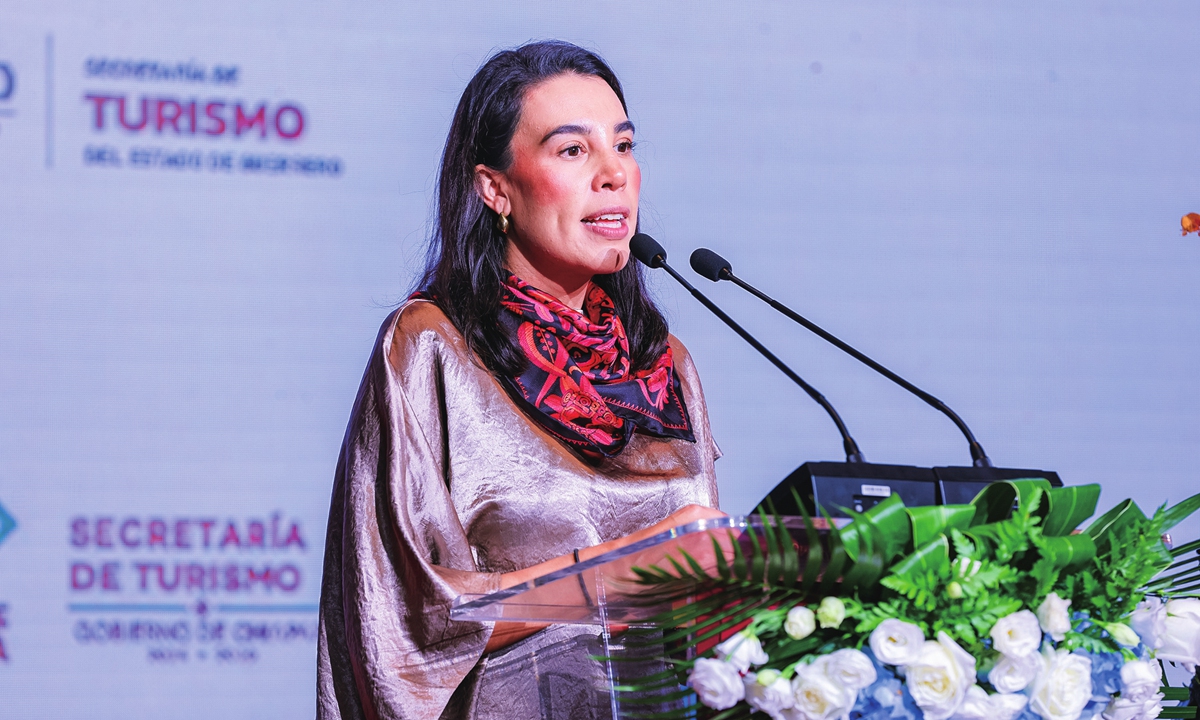
The Secretary of Tourism of Mexico, Josefina Rodríguez Zamora, gives a speech at the Mexico Tourism Fair in China 2025 in Beijing on September 25, 2025. Photos: Courtesy of the Embassy of the United Mexican States in China
In an exclusive interview, Josefina Rodríguez Zamora, the secretary of Tourism of Mexico, told the Global Times that the Mexico Tourism Fair in Beijing is a historic moment for the country's international strategy.In conjunction with the Mexican Ministry of Tourism and the Mexican Ministry of Foreign Affairs, the Embassy of the United Mexican States in China hosted the first Mexico Tourism Fair in China 2025 (Tianguis Turístico de México en China 2025) in Beijing on September 25-26.
"For the first time, we are bringing a complete Tourism Fair to China, demonstrating our commitment to this strategic market. It is an unprecedented event for Mexican states to showcase their tourism and cultural diversity, something never before achieved in China," Zamora told the Global Times.
In her keynote speech at the Mexico Tourism Fair in China 2025 in Beijing, Zamora shared that "we have an enormous potential for Chinese tourists to discover."
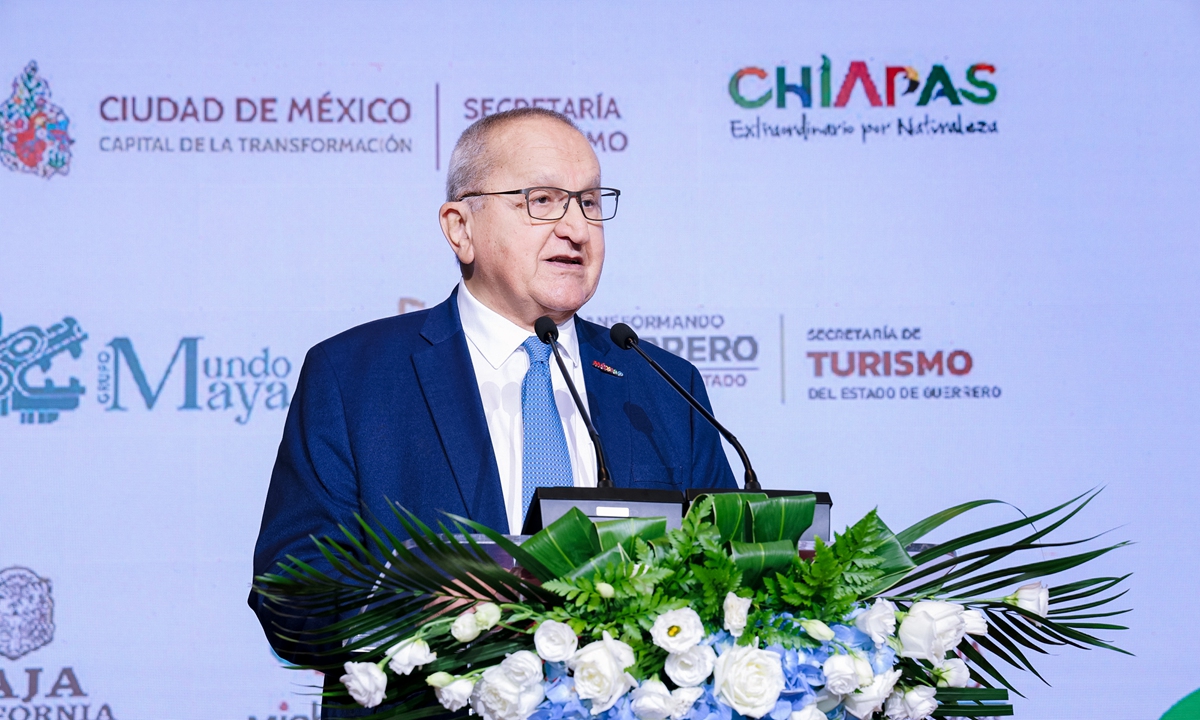
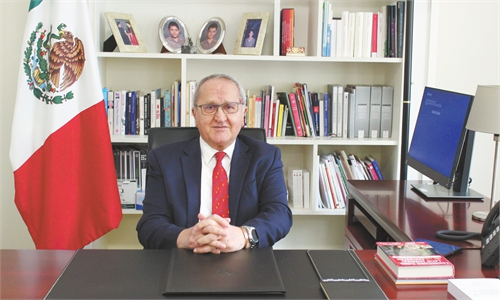
Mexican Ambassador to China, Jesús Seade, gives his welcome remarks at the Mexico Tourism Fair in China 2025 in Beijing, on September 25, 2025.
Mexican Ambassador to China Jesús Seade said in his welcome speech that "this Tourism Fair is the first to be held in China and the first to be held outside of Mexico. As you can see from the level of representation here, Mexico places great importance on further strengthening the bonds of friendship between Mexico and China through the noble activity of tourism.""This event not only allows us to raise Mexico's profile among travel agencies, tour operators, and specialized media, but also generates business opportunities, promotes the creation of tourism packages, and opened new air routes. All of this reinforces the confidence of the private sector and strengthens cultural and economic cooperation between Mexico and China," Zamora told the Global Times in the written interview.
"Tianguis" is a magical word from ancient Mexico that means "market" in our Nahuatl language, which was the lingua franca of Mesoamerica and remains a living language in Mexico, very much alive, spoken by millions, and even with constant new literary production. In their markets, ancient Mexicans exhibited and offered the best of their different regions, putting everything on display for potential customers who, coming from far away, acquired things they didn't know or couldn't easily find elsewhere. Beyond the exchange of products, this market, the Tianguis, would serve as a framework for the emergence of new interactions and connections between potential partners who, otherwise, would not have had mutual contact, Ambassador Seade elaborated in his remarks.
This is precisely what the Mexican government wants with China. "This Tianguis gives substance to the political commitment made between the governments of Mexico and China to increase people-to-people contacts and exchanges and develop the enormous potential we have to understand each other and become closer," the ambassador noted.
He continued to say that friendship must be cultivated, and to do so, it is essential to know each other more deeply in order to truly understand one another.
"President Claudia Sheinbaum is convinced that this is the way to deepen the lasting and historic friendship between our peoples." said Ambassador Seade.
"I have always maintained that knowing each other better generates mutual understanding, and mutual understanding generates trust; and trust generates friendship," he noted.
Zamora shared her observation to the potential of the bilateral cultural exchanges as more Chinese tourists are expected to visit Mexico in the upcoming months and years.
"The potential is enormous. In the first seven months of 2025 we recorded nearly 59,000 Chinese tourists, a 13 percent increase compared to the previous year. This shows that there is a great opportunity to attract more visitors and strengthen tourism cooperation between our countries," she said.
Meanwhile, for global tourism players, Chinese tourists could also mean demanding high standard service. To meet such demand, the Mexican Tourism Board has taken specific measures to make it Chinese-tourist-friendly in Mexico.
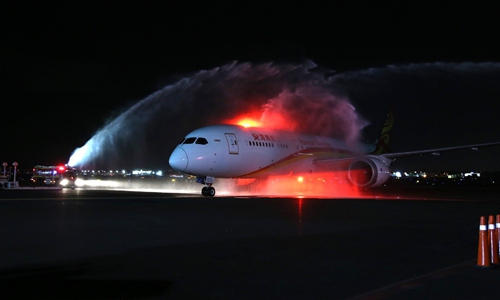
The air connectivity has been strengthened with the reactivation of strategic routes such as Mexico City-Tijuana-Shenzhen and Mexico City-Tijuana-Beijing, and "we continue to manage new frequencies. We have also implemented training programs for tourism services providers, hotels, restaurants, and guides to help them better understand the expectations of Chinese travelers regarding language, customs, cuisine, and payment methods," Zaroma said.
The development of airports, roads, and accessibility in tourist destinations are priority projects for President Claudia Sheinbaum Pardo's administration. "They not only aim to create well-being, but also include modernization plans so that tourists can enjoy a high-quality experience from arrival to departure. The idea is for every Chinese tourist to feel welcomed, cared for, and have access to authentic experiences that meet their quality expectations," she elaborated.
In the case of soccer, the 2026 World Cup represents a historic opportunity not only to promote Mexico as a tourist destination, but also to generate sports and cultural exchanges, especially among young people.
"We want to organize meetings and tournaments that will allow Chinese players and fans to experience this experience firsthand in our country. In this way, we see great potential for young people from China and Mexico to experience each other's culture and strengthen bonds of mutual understanding, exploring our traditions, cuisine, heritage, and artistic expressions," she said.
In addition to hosting the 2026 World Cup, Mexico will be a Guest Country at FITUR Feria Internacional de Turismo 2026 (or International Tourism Fair), providing global platforms to further strengthen Mexico's relationship with China.
RELATED ARTICLES