US’ proposed ban on China-operated flights over Russia groundless, detrimental to cooperation: expert
By Published: Oct 10, 2025 10:50 PM

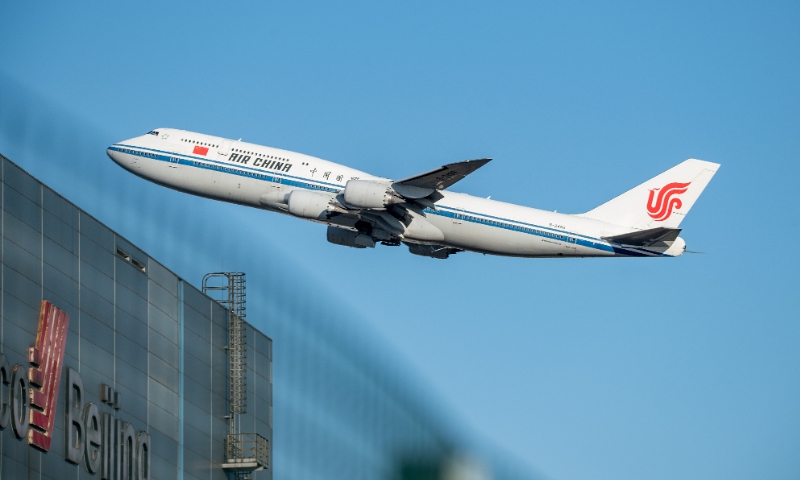
Air China flight CA985 takes off from Beijing Capital International Airport on November 11, 2023, heading to San Francisco International Airport in the US. Photo: VCG
Any US restrictions on Chinese airline operations would be detrimental to personnel exchanges between the two countries, a Chinese Foreign Ministry spokesperson said on Friday.
The comment came in response to a media inquiry over a reported proposal by the administration of President Donald Trump to ban Chinese airlines from operating China-US flights that go over Russian airspace and the claims that American carriers are put at a disadvantage.
The US should reflect on the impact of its own policies on US companies, rather than unreasonably suppressing other countries and leaving global consumers to foot the bill, FM spokesperson Guo Jiakun told a routine press conference on Friday.
"For the specifics, I would refer you to relevant Chinese authorities," Guo said.
The proposed ban is groundless and unjustified, and could seriously impact bilateral civil aviation cooperation and people-to-people exchanges if implemented, a Chinese expert told the Global Times on Friday.
The proposal was raised by the Trump administration on Thursday, Reuters reported on Friday.
The US Transportation Department claimed on Thursday in its proposed order that "this imbalance has become a significant competitive factor" and said it is giving Chinese carriers two days to respond and a final order could be in effect as soon as November.
Wang Ya'nan, chief editor of Beijing-based Aerospace Knowledge magazine, told the Global Times on Friday that the recent renewed demand by the US side to prohibit Chinese airlines from flying over Russian airspace on China-US routes, coupled with a two-day response deadline for Chinese carriers, is entirely illogical and groundless and it is utterly unjustified for the US to shift its conflict with Russia to China.
This demand stems from the US' own unilateral considerations, and its self-perceived notion of not being on reciprocal terms with China on China-US flights, Wang said, adding that it smells of power politics. China is not the root cause of the problem and this is a typical case of blaming another for one's own problems, Wang added.
In the proposal, the US Transportation Department claimed the aim of the move is to "level this competitive disparity amongst US and Chinese air carriers," and that the current situation was "unfair and has resulted in substantial adverse competitive effects on US air carriers."
Russia has barred US airlines and some other foreign carriers from flying over its airspace in retaliation for Washington banning Russian flights over the US in March 2022 after the Ukraine crisis began, according to Reuters.
"Should the US forcibly implement such a ban, it would constitute a unilateral and overbearing act," Wang said. "Such a move would undermine the long-established commercial aviation cooperation between the two nations, causing harm to both sides while also damaging global public interests."
The only way is for the two sides to negotiate, instead of taking unilateral moves, the expert noted.
Because of the nature of air travel, avoiding Russian airspace is costly for airlines in terms of flight time and fuel costs when they operate flights between China and the US or Europe.
Some US carriers have told the Trump administration that direct East Coast flights to China are not economically feasible because of the added expense from not flying over Russia, according to Reuters.
In some cases, carriers must leave some seats open and reduce cargo because of the increased flight length.
Last month, the US Transportation Department approved another six-month extension that allowed United Airlines, American Airlines and Delta Air Lines to fly just 48 total flights weekly to China out of 119 that are approved. Chinese carriers fly an equivalent number to the US, Reuters reported.
Civil aviation cooperation between China and the US has been subject to political interference from some in US political circles.
In September, John Moolenaar, chair of a US House of Representatives committee on China, called on the US administration to restrict or suspend Chinese airline landing rights in the US unless China restores full access to rare earths and magnets, Reuters reported.
RELATED ARTICLES