ARTS / CULTURE & LEISURE
9,000-year-old carbonized adzuki bean provides evidence that suggests the species originated from China
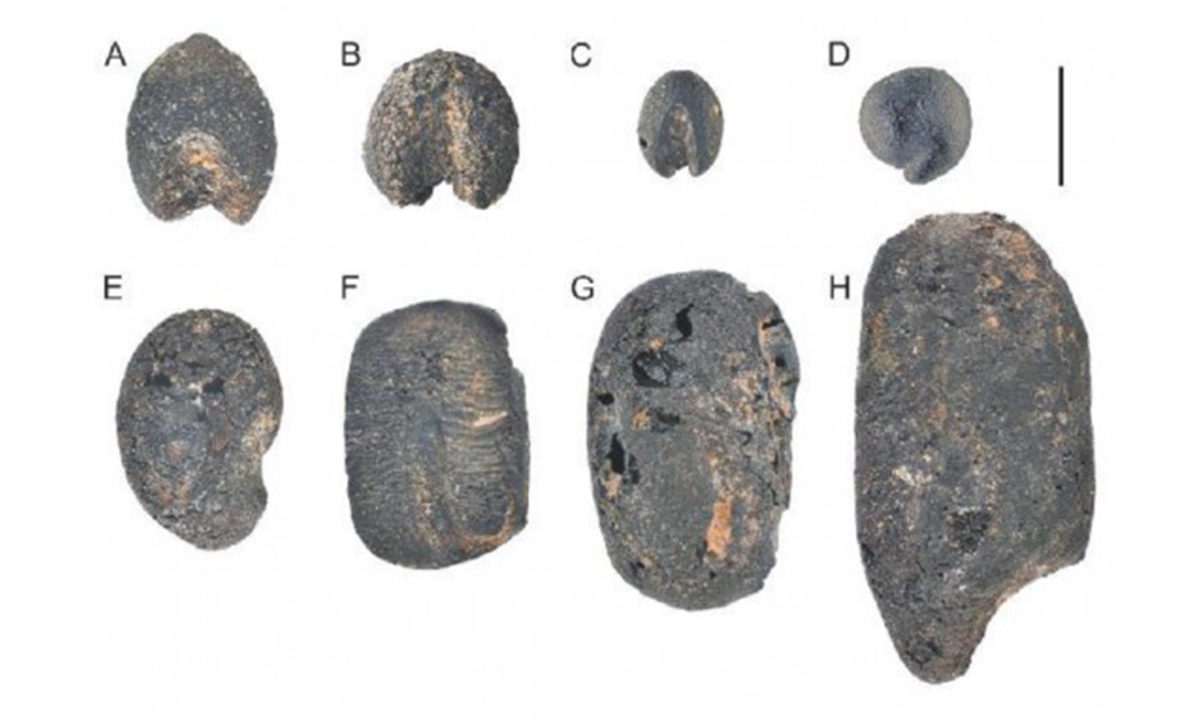
Carbonized plant seeds unearthed from the Xiaogao site in Zibo, Shandong Province Photos: sdu.edu.cn
The recent discovery of 9,000-year-old adzuki beans (Vigna angularis) in East China's Shandong Province provides new evidence that suggests the species originated from China, according to experts.An international team, led by Shandong University, that included the Shandong Provincial Institute of Cultural Relics and Archaeology, the Department of Anthropology, and the Washington University in St. Louis, USA, has discovered 9,000-year-old charred adzuki beans at the Xiaogao site in Zibo, Shandong Province. These discoveries are 4,000 years older than any previously discovered charred adzuki beans in China. The findings were published in the Proceedings of the National Academy of Sciences of the United States of America (PNAS).
In August, an article stated that adzuki beans were first domesticated in Japan 3,000 to 5,000 years ago, saying that red adzuki beans were first cultivated in Japan and later diversified in China, citing a DNA analysis.
However, the latest discovery pushes back the timeline of adzuki bean cultivation in the Yellow River considerably, informing complex domestication pathways of a crucial legume enhancing global food security. The discovery expands our knowledge of prehistoric farming systems in East Asia, enabling us to better understand the roles of dietary conditions in domestication and enriching its evidentiary basis, according to the research.
This discovery, with archaeological evidence, fully proves that China began to eat and even cultivate adzuki beans 9,000 years ago. This suggests that China may be one of the areas from which adzuki beans originated, said Zhao Zhijun, a professor at the Institute of Cultural Heritage, Shandong University, in an interview with Science and Technology Daily.
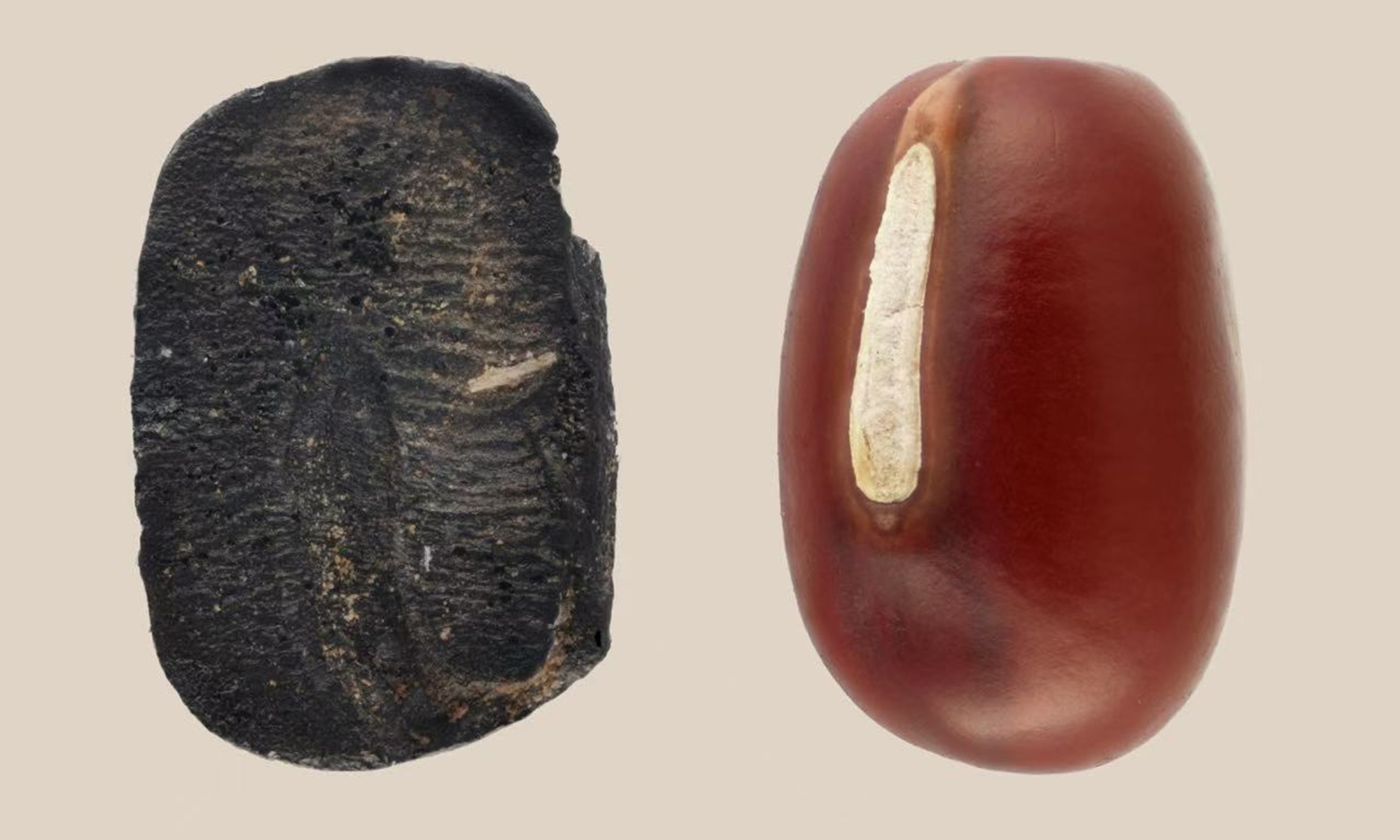
Carbonized adzuki bean unearthed by archaeologists at modern adzuki bean
Adzuki beans are an important legume crop, widely cultivated in East Asia and highly valued for their nutritional value and nitrogen-fixing properties.Citing the evidence, the research paper said it suggests that adzuki beans formed part of an Early Neolithic multicropping system alongside millet, rice, and soybean in a well-established agricultural tradition in the Lower Yellow River region.
How do archaeologists know the age of a charred seed? Using archaeobotanical research and carbon-14 dating, the research team dated the charred adzuki beans discovered to 9,000 years ago. These are the earliest known adzuki bean remains in the Yellow River Basin, extending the period of adzuki bean use in the region.
Morphometric analysis of adzuki beans from 41 archaeological sites across East Asia reveals a gradual increase in seed size over time when regional data are aggregated, yet highlights distinct regional trajectories. These patterns reflect complex, multiregional domestication processes shaped by both cultural practices and ecological conditions. Notably, the marked differences in bean sizes observed between the Neolithic Yellow River and Jomon-period Japan could be contingent on the distinctions in dietary regimes and associated selective pressures, the paper reads.
This discovery sheds light on how domestication unfolded as a diverse, regionally varied process rather than a single, linear story.
Differences in the size and usage of adzuki beans across regions highlight the ways culture and cuisine influenced domestication. In the Yellow River valley, beans followed one evolutionary path, while in Jomon-period Japan they followed another. The divergence reflects not only environmental pressures but also human choices - what people preferred to eat, how they prepared food, and what qualities they valued in their crops.
Meanwhile, the research highlights a new aspect of the shared heritage of East Asia. Long before national borders, people across the Yellow River basin, the Japanese archipelago, and the Korean peninsula were connected through parallel innovations in agriculture. The adzuki bean stands as a humble yet powerful symbol of this intertwined history, according to the research team.
Global Times
RELATED ARTICLES