China-ASEAN relationship becomes most successful, dynamic model of cooperation in Asia-Pacific: customs official
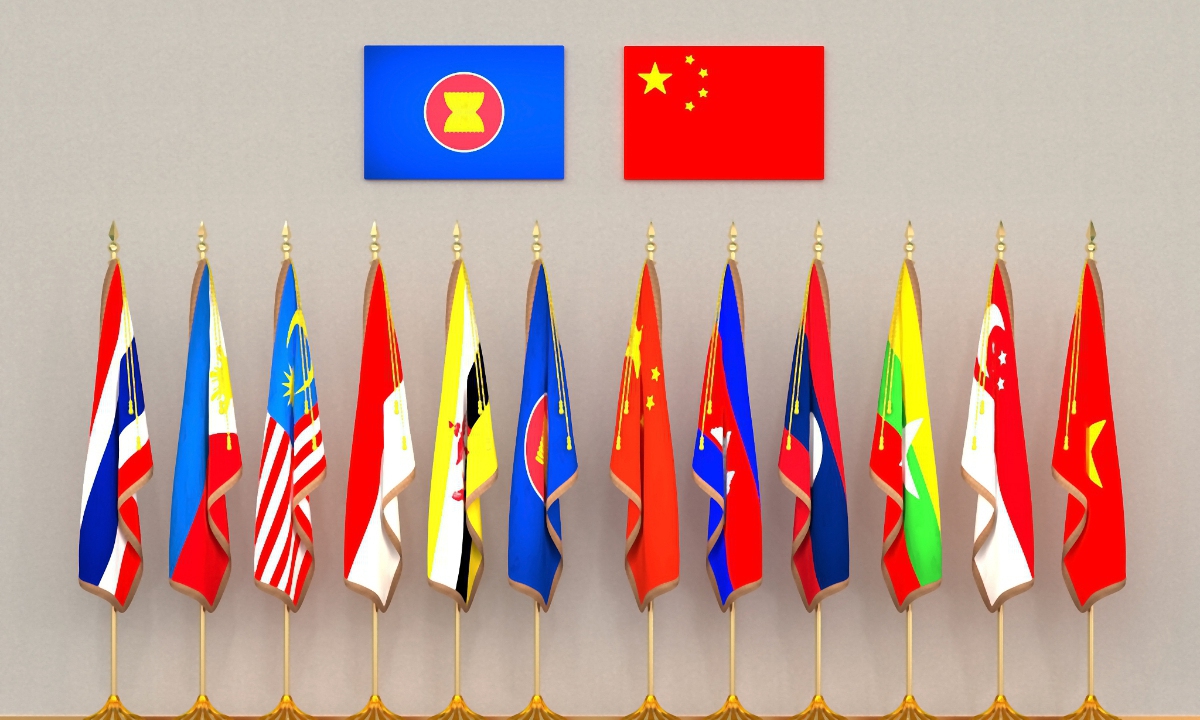
China ASEAN Photo:VCG
The China-ASEAN relationship has become the most successful and dynamic model of cooperation in the Asia-Pacific region, Lü Daliang, spokesperson of the General Administration of Customs (GAC), said on Monday during a press conference in Beijing.
According to the GAC, in the first three quarters of this year, China's total import and export with ASEAN countries reached 5.57 trillion yuan, marking a year-on-year increase of 9.6 percent, accounting for 16.6 percent of China’s total foreign trade, with ASEAN continuing to maintain its position as China’s largest trading partner.
Lü said that ASEAN has been China’s largest trading partner for agricultural products for eight consecutive years. In the first three quarters of this year, China’s agricultural products imports from ASEAN grew by 15.3 percent, accounting for 19.1 percent of the country’s total agricultural product imports, making ASEAN the second-largest source of China’s agricultural imports.
Notably, fruit imports through the “golden corridor” of the China-Laos Railway increased by 37.8 percent, allowing Chinese consumers to enjoy tropical flavors more quickly and freshly, according to Lü.
Meanwhile, ASEAN is also the largest market for China’s agricultural exports. In the first three quarters, the country’s exports of citrus, lettuce, and other products to ASEAN saw rapid growth, enabling ASEAN consumers to enjoy a wider variety of “Chinese flavors,” said Lü.
With the full implementation of multilateral and bilateral free trade agreements between China and ASEAN, as well as ASEAN members, the effects of tariff reductions and the benefits of trade facilitation policies continue to be unleashed, deepening the integration of regional industrial and supply chains, and continuously expanding the scope for industrial cooperation between China and ASEAN, the GAC spokesperson said.
In the first three quarters, China’s exports of textile machinery and textile raw materials to ASEAN grew by 28.2 percent and 13.4 percent, respectively, while imports of clothing rose by 9.3 percent. Imports of rubber from ASEAN surged by 40.7 percent, with exports of tires and other auto parts up 19.8 percent, according to Lü.
In addition, China and ASEAN are geographically connected, and the Belt and Road Initiative aligns closely with the ASEAN's Master Plan on Connectivity 2025. Landmark projects such as the China-Laos Railway have been completed, further improving the multidimensional connectivity network between the two sides, providing strong support for deepening economic and trade cooperation, Lü said.
In the first three quarters, China’s imports and exports to ASEAN via land transportation grew by 21 percent, with maritime shipping and air transport also experiencing rapid growth, the spokesperson noted.
Since the establishment of a comprehensive strategic partnership between China and ASEAN in 2021, bilateral economic and trade cooperation has become closer, with trade volume continuously surpassing the 5 trillion yuan and 6 trillion yuan marks, reaching 6.99 trillion yuan in 2024, Lü said.
The negotiations on the Version 3.0 China-ASEAN Free Trade Area CAFTA have been fully completed, which will inject new momentum into the development of bilateral economic and trade relations, providing greater certainty for regional and global trade. Chinese customs will continuously enhance regulatory efficiency and service levels to promote China-ASEAN economic and trade cooperation to new heights, the spokesperson noted.
Global Times
RELATED ARTICLES