ARTS / CULTURE & LEISURE
Vacherot's fairy-tale run in Shanghai, including final win against cousin, continues to inspire
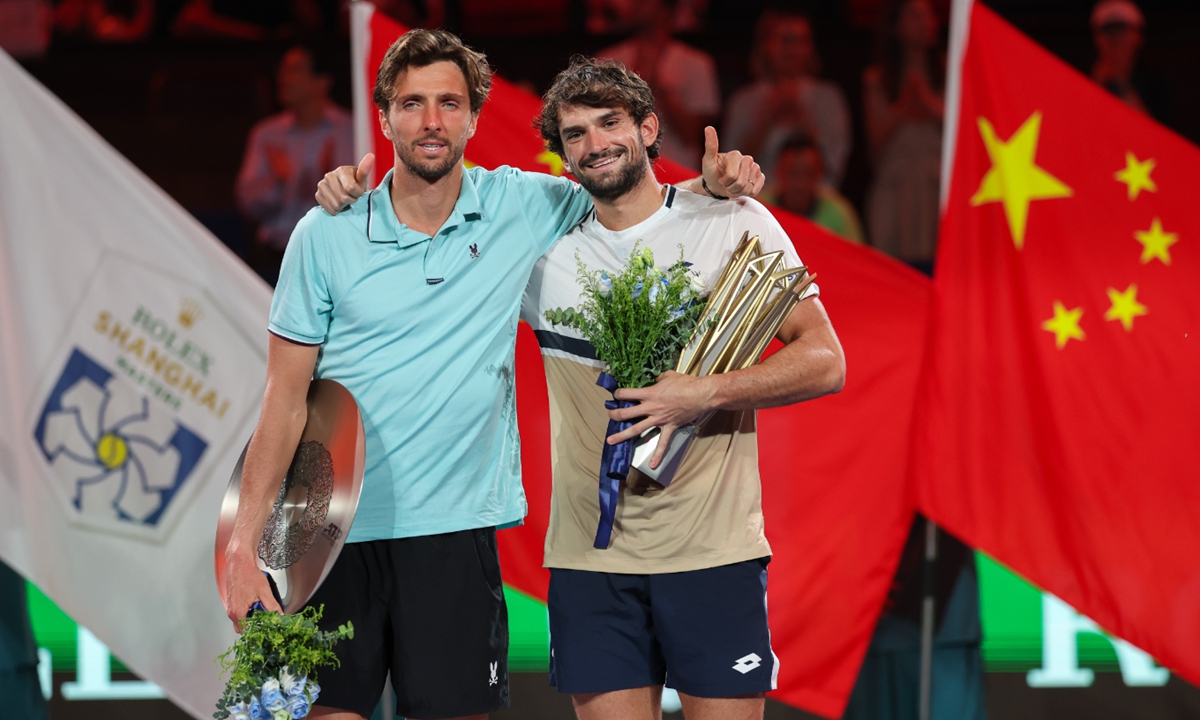
Champion Valentin Vacherot of Monaco and runner-up Arthur Rinderknech of France pose with their trophies during the awarding ceremony after the Men's Singles Final match on day 14 of the 2025 Shanghai Rolex Masters at Qi Zhong Tennis Center on October 12, 2025 in Shanghai, China. Photo: VCG
Amid Shanghai's unusually humid and scorching October heat, the Shanghai Masters ended more like a novel than a tennis tournament, as last-minute qualifier Valentin Vacherot of Monaco completed an improbable run to the title.
Vacherot, previously ranked 204th in the world, lifted the trophy after defeating his cousin, France's Arthur Rinderknech, in the final. His win has sent him up to 40th place in the ATP rankings.
Consider how unlikely Vacherot's run was. Less than 24 hours before qualifying began, he did not even know if he would compete. Yet through two weeks of searing heat, he won nine matches in a row, including impressive victories over top seeds and a stunning semifinal win over 24-time Grand Slam winner Novak Djokovic.
For Rinderknech, ranked outside the top 50 just weeks ago and once questioning his future in professional tennis, the run to the Shanghai finals also marks a turning point. His wins over Daniil Medvedev and Alexander Zverev confirmed a late-career surge that few predicted.
When Vacherot, in tears, wrote "Grandpa and Grandma, you'll be proud" on the court-side camera after his final win, it was not just a family tribute, but an inspiring story that has resonated in global tennis.
Vacherot's triumph read like fiction, yet every moment of it was real. To call the final any less than epic would be an understatement: two cousins who grew up playing together, now meeting on a stage in China, battling not only one another but their own histories and expectations.
Beyond the personal drama, Vacherot's breakthrough holds wider resonance, especially for a country like China, which is still shaping its tennis identity.
For years, China's tennis ambitions were symbolized by Li Na's Grand Slam titles before Zheng Qinwen won the Paris Olympics gold medal. The question now is whether the country can build a deeper competitive base and become a true part of the global circuit. Events like the Shanghai Masters help: They offer exposure to high-intensity tennis and show that upsets are possible anywhere, even in a field dominated by European and North American players.
In a broader sense, this is the kind of story China's tennis needs. It is not merely about hosting top names or scheduling marquee matchups, it is about giving space for the underdogs, for narratives that touch hearts, for moments that reverberate beyond the lines of the court. In recent years, Chinese tennis has invested heavily in youth development, facilities, and international exposure. But events risk being hollow without stories that capture public imagination.
What happened in Shanghai may also offer a practical lesson for Chinese athletes. Neither Vacherot nor Rinderknech were junior prodigies; both developed through college tennis in the US, taking longer routes to maturity. Their success suggests that alternative development pathways, combining sport with education, embracing delayed peaks rather than early stardom, can still lead to elite results. That's a message Chinese tennis could find useful as it expands its youth programs and seeks to keep players in the system through their early 20s.
The event did indeed capture the imagination, and in a way that went beyond marketing slogans. Over days of humid conditions above 30 C, attendance reached record highs, local volunteers kept matches running smoothly, and Chinese players such as Shang Juncheng and Bu Yunchaokete earned valuable experience despite early exits. The atmosphere proved that China's tennis audience is both knowledgeable and growing, able to appreciate not only star power but stories of perseverance like Vacherot's.
This year's Shanghai Masters didn't just deliver a new champion but also acted as a reminder of what sports can look like when persistence meets opportunity. The cousins' story may soon fade from the headlines, but its message that persistence can defy ranking and reputation will linger much longer.
The author is a reporter with the Global Times. life@globaltimes.com.cn
RELATED ARTICLES