China ensures ample grain supply during 14th Five-Year Plan; annual grain purchases reach 400 million tons: official
China ensures ample supply during 14th Five-Year Plan period
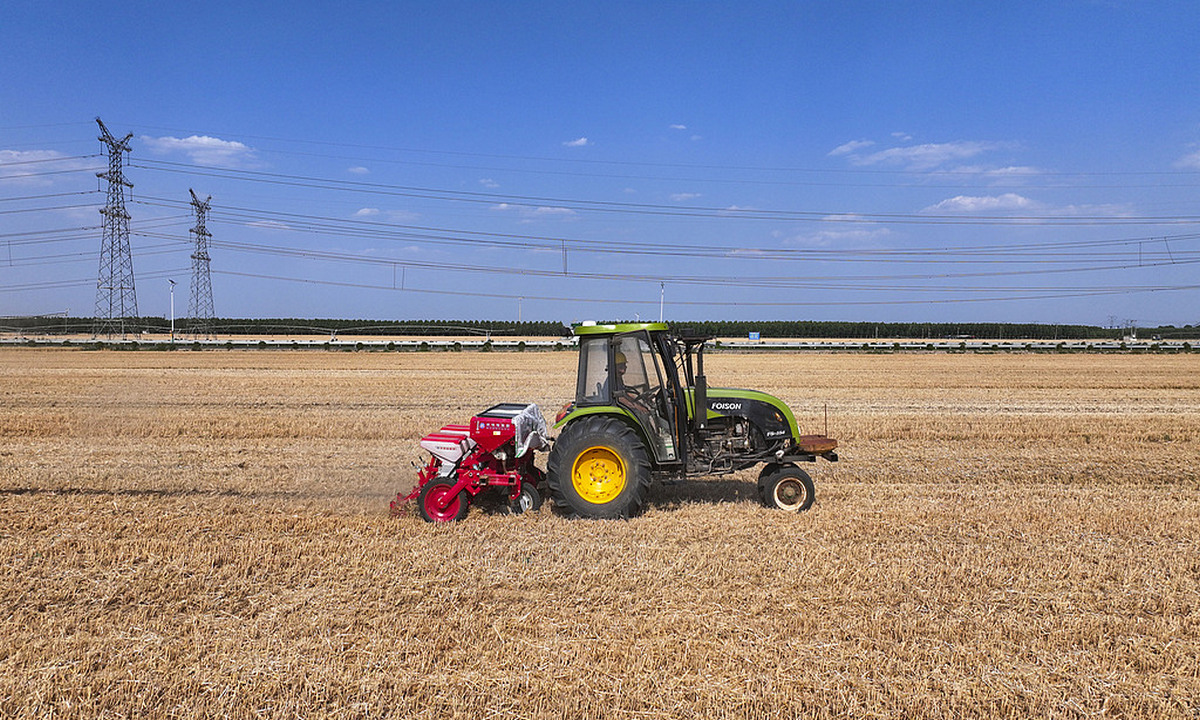
A machine harvests ripe wheat and plants summer corn in high-standard farmland in Guangrao county, East China's Shandong Province, on June 17, 2025. By 2030, China aims to have developed 1.35 billion mu (90 million hectares) of high-standard farmland, the Xinhua News Agency reported. Photo: VCG
During the 14th Five-Year Plan period (2021-25), China's grain supply has remained ample and the grain market has kept stable, with an average annual grain purchase exceeding 400 million tons, an official from the National Food and Strategic Reserves Administration (NFSRA) said on Tuesday.
Chinese analysts highlighted the role of coordinated efforts between the government and the market forces in ensuring sufficient food supply.
Over the past five years, China's annual grain output has stayed above 1.3 trillion jin (650 million tons), reaching a new milestone of 1.4 trillion jin (700 million tons) in 2024, Liu Huanxin, head of NFSRA, told a press conference in Beijing.
During the period, China's per capita grain availability increased by 25 kilograms from the 13th Five-Year Plan period (2015-20), reaching 500 kilograms, well above the internationally recognized food security threshold of 400 kilograms.
"We have ensured basic self-sufficiency in grain production and absolute security in staple food supply," Liu said.
Liu attributed the achievement to the government's strong efforts in improving grain sale channels for farmers, and optimizing services for grain enterprises. "With ample grain reserves and a stable market, the Chinese people's rice bowls are held more firmly and filled with better quality," he noted.
Government support helps drive the high-quality development of China's agriculture. As of the end of September, local governments had allocated 46.2 billion yuan ($6.4 billion) in fiscal funds, said NFSRA deputy head Qian Yi.
These funds were used to implement more than 8,400 projects and foster 897 premium corporate brands, which significantly enhances the overall development level of agriculture, Qian said.
China has also utilized ultra-long-term special treasury bonds to support the promotion of new technologies for production of grain and edible oil, as well as deep grain processing, Qian noted. "All projects under the 2025 funding plan have already entered the implementation phase."
Despite facing some challenges, including extreme weather, export restrictions taken by certain countries and sharp fluctuations in market prices, China has effectively ensured food security, demonstrating the country's growing supply resilience, said Li Guoxiang, a research fellow at the Rural Development Institute of the Chinese Academy of Social Sciences.
From the consumer perspective, although grain purchase prices have fluctuated in recent years, retail prices - which matter most to ordinary people -- have remained stable, Li told the Global Times on Tuesday.
In terms of grain reserves, Liu said that China's capacity to regulate and control grain supply at varied levels has become increasingly strong, due to the continued optimization of the central reserve structure and stronger local reserve capability.
Speaking of grain circulation and storage, Liu said that with the continued advancement of storage and logistics projects, the country's total warehouse capacity has exceeded 730 million tons, an increase of 58 million tons from five years earlier.
Anc, construction of major grain logistics hubs has accelerated, leading to greater circulation efficiency, Liu said. Events such as the China Grain Trading Conference (CGTC) and various regional grain trade fairs have helped streamline connections between production and sales.
The most influential national event in China's grain sector, the 7th CGTC, was held on July 12 in Shenyang, Northeast China's Liaoning Province, attracting more than 4,000 enterprises, according to a report by people.cn.
Officials pointed to the rapid advancement of technological innovation in the grain industry. "A growing number of specialized industrial clusters, renowned brands, and high-quality products are emerging, injecting new vitality into agriculture," Liu said.
"With just 9 percent of the world's arable land and 6 percent of freshwater resources, China feeds nearly one-fifth of the global population — itself a major contribution to global food security," Liu said.
Tuesday's briefing revealed that this year's autumn grain is now being harvested. Officials said market-based procurement has become the dominant channel, accounting for more than 90 percent of total purchases.
Official data showed that about 30 percent of China's autumn grain had been harvested nationwide as of October 5, the state broadcaster CCTV News reported.
China is accelerating its drive to build a strong grain industry, and many modern grain depots have adopted intelligent management systems and green, energy-saving technologies that will lay a solid foundation for high-quality development in the next five years, Liu said.
RELATED ARTICLES