BRASIL 247 / MORE
Founder of China's leading Think Tank proposes six steps to deepen Brazil-China cooperation
At the Brazil-China Business Council, Henry Huiyao Wang of the Center for China and Globalization urges stronger ties in infrastructure, green energy, technology, and finance
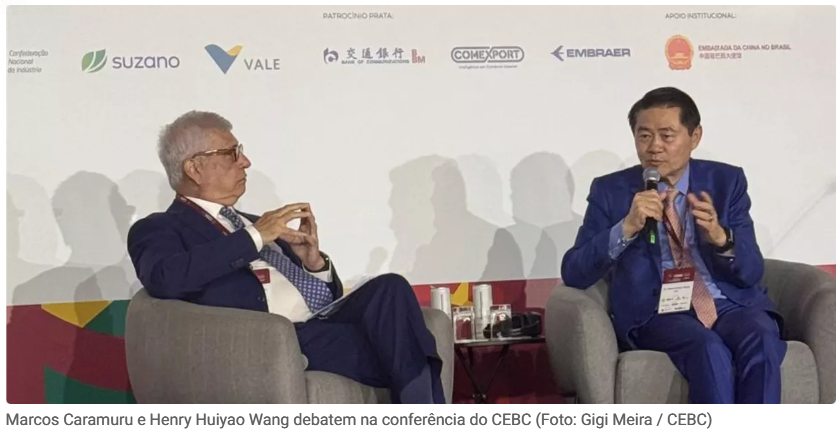
Photo: screengrab from the official website of Brasil 247
By Brasil 247 — Henry Huiyao Wang, founder and president of the Center for China and Globalization (CCG), called for six concrete measures to strengthen and modernize relations between Brazil and China during remarks at the Brazil-China Business Council (CEBC) in São Paulo on Monday, October 13.
"Brazil and China have walked side by side for fifty years, evolving from trade cooperation to collaboration in innovation, green growth, and global governance", Wang said. He described the partnership as "a model for emerging nations—one capable of promoting more inclusive and sustainable development."
Record Trade and Growing Investment
China has been Brazil's top trading partner for 15 consecutive years, with bilateral trade exceeding $180 billion in 2024, representing nearly one-third of Brazil's total foreign trade. Since 2007, Chinese investments in Brazil have totaled $79 billion, spanning energy, mobility, technology, and manufacturing.
Wang highlighted renewable energy and industrial projects such as State Power Investment Corporation's (SPIC) wind and solar parks in Bahia and Paraíba, and the transformation of Ford's former factory in Camaçari (Bahia) into an electric vehicle and battery complex by BYD. "It is a symbol of renewal, green innovation, and shared prosperity," he said.
Six Pathways for a New Phase of Partnership
Wang outlined six strategic avenues to guide what he called a "new phase of cooperation" between the two largest economies of the Global South:
● Integrated Infrastructure — Expand collaboration in energy, transport, and logistics, including a proposed high-speed rail link between São Paulo and Rio de Janeiro to reduce costs, emissions, and foster new industries.
● Financial Integration — Increase use of the real and yuan in bilateral trade. Since 2023, about 30% of transactions have been settled without US dollar intermediation, enhancing "stability and reducing exchange costs," Wang noted.
● Green Transition and Sustainable Reindustrialization — Foster joint ventures in clean energy, green hydrogen, and Industry 4.0, linking Brazilian industrial policies—such as the New Industry Brazil and the Growth Acceleration Program—with Chinese advances in renewables and digital technology.
● Digital Economy and Artificial Intelligence — Expand cooperation in 5G, cloud computing, and robotics through joint innovation projects between Chinese companies and Brazilian startups.
● Cultural and Educational Exchange — Simplify visa procedures, expand direct flights, and promote scholarship and exchange programs for students and researchers in both countries.
● Academic Dialogue and Think Tank Cooperation — Establish a Permanent Brazil-China Think Tank Forum, bringing together institutions such as CCG, CEBC, and CEBRI to debate global governance, sustainable finance, and industrial policy.
A Model for the Global South
Concluding his address, Wang described the Brazil-China relationship as "a success story of the Global South" and a model for developing nations seeking balanced growth. "It is time to build not only bridges of trade, but also green corridors of growth and digital innovation", he declared.
For the next fifty years, he said, the partnership should be guided by one principle: "shared development, shared responsibility, and shared prosperity."
(Reported by Brasil 247 on October 14, 2025)
