SPORT / MISCELLANY
Hong Kong to send its largest delegation to National Games
Young Chinese shooters take center stage at venues
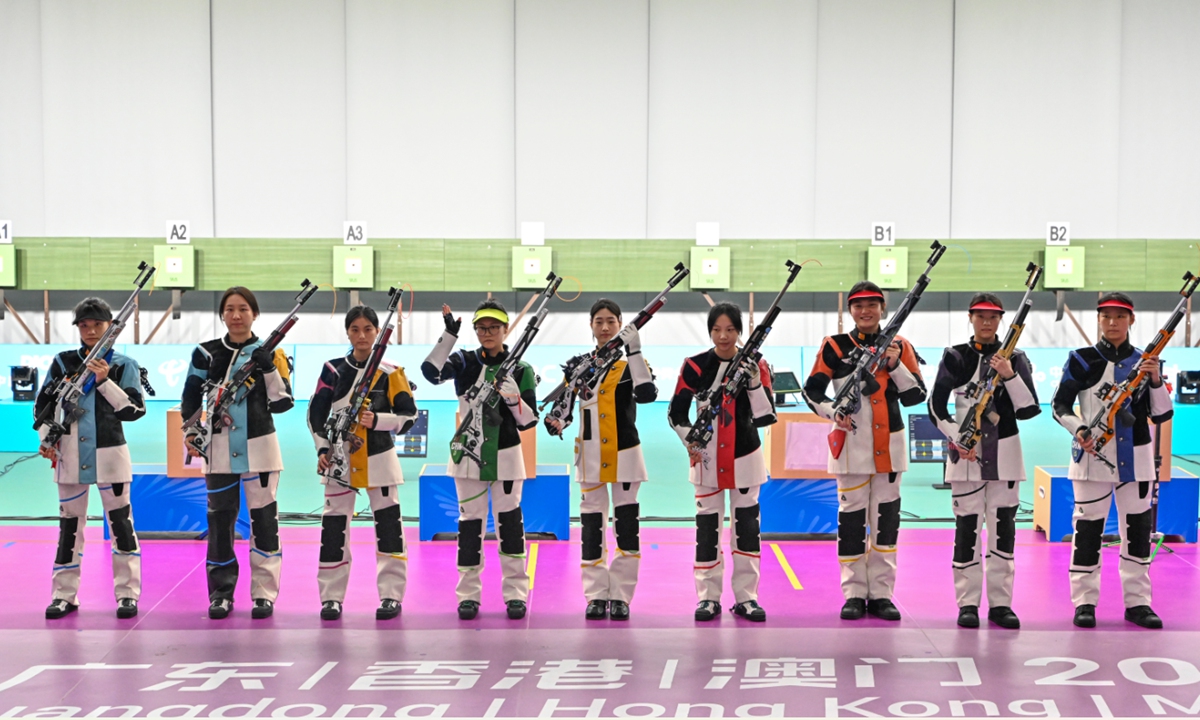
Photo: VCG
For the 15th National Games, China's Hong Kong will send over 600 athletes to compete in 28 events, marking the largest delegation in the Special Administrative Region's history, John Lee, chief executive of China's Hong Kong Special Administrative Region (HKSAR), told reporters on Tuesday.
"We have developed detailed plans and made full preparations for every aspect of the Games," he said.
"We expect more than 4,000 athletes, delegation members, event staff, and media personnel to participate, while onsite spectators from home and abroad are expected to exceed 100,000."
"We have assembled our largest volunteer team ever to support the Games. More than 16,000 volunteers from all walks of life, aged 15 to over 80, will serve in different positions throughout the event," Lee noted.
In addition to preparing personnel, Lee recently attended the flame collection ceremony and brought the flame back to Hong Kong. The "source fire" for this edition comes from combustible ice located at a depth of 1,522 meters in the northern South China Sea, marking the world's first deep-sea flame collection for sports games.
Lee added that torch relays for the 15th National Games will be held in early November in Hong Kong and Macao SARs, and the cities of Guangzhou and Shenzhen in Guangdong Province. "We are planning Hong Kong's relay route to highlight the city's cultural and sports characteristics," he said.
The collection of the "sports flame" from deep-sea combustible ice involved multiple independently developed deep-sea technologies. For example, remotely operated underwater vehicles collected methane from deep-sea cold seeps, synthesized strategic clean energy combustible ice in situ, and then used solar-powered equipment to ignite it, achieving "light from the sky, fire from the sea," according to the 15th National Games' official website.
The 15th National Games is not only pioneering when it comes to the "source fire" collection. In many other areas, it serves as a "super scenario" for technological innovation. For example, in the venues, security robots patrol intelligently, digital humans provide real-time explanations of events, athletes receive high-precision technical diagnostics, and a metaverse cloud-based National Games Village has been implemented.
"The 15th National Games, empowered by various innovative technologies, not only enhance the event experience but also provide a model for the integration of sports and technology," Hu Bin, a representative of the China Institute of Sport, told the Global Times on Tuesday.
At the venues, the first batch of events has already kicked off. In the men's 10-meter air rifle final on Tuesday, Chinese shooter Sheng Lihao scored a total of 254.6 points to win the gold medal, while Wang Yutong took silver.
Paris Olympic Games men's 25-meter rapid-fire pistol champion Li Yuehong and bronze medalist Wang Xinjie failed to advance to the finals in this event at the National Games on Monday. First-time participant Su Lianbofan led the qualification with 588 points. Among the six finalists, five are from the post-2000 generation.
In the women's 10-meter air rifle team final on Tuesday, the Zhejiang team, composed of World Championship gold medalist Han Jiayu, Paris Olympic Games women's 10-meter air rifle silver medalist Huang Yuting, and Wang Zifei, who claimed three World Cup wins from three in the 2025 season, captured the gold medal.
Looking back at Monday's qualification, the Zhejiang team scored a total of 1,903.6 points, setting a new national record and surpassing the 1,902.0-point team world record set by the Chinese team at this year's Asian Championship.
The cutoff for the women's 10-meter air rifle individual final reached 633.9 points, exceeding the qualification threshold of the four World Cup stages earlier this year. All eight finalists are from the post-2000 generation, with six born after 2005.
"Young athletes today are very fortunate; technology accelerates their development," noted Olympic champion and head coach of the Guangdong Shooting Team Yi Siling.
"Provincial teams now deeply integrate technology into training, especially with the widespread use of devices such as laser simulators, improving the youth development system," she said.
Yi recalled that when she visited the national team in 2022 for study and exchange, she had already noticed the growing "miniaturization" trend among shooting athletes. "At that time, 15-year-old Huang Yuting was already training with the national team, and two years later she became an Olympic champion. If they perform well, age is no longer a barrier."
RELATED ARTICLES